
Q: 2
George Armor, CFA, is a new stock analyst for Pedad Investments. One tool that Pedad uses to
compare stock valuations is the dividend discount model (DOM). In particular, the firm evaluates
stocks in terms of "justified" multiples of sales and book value. These multiples are based on
algebraic manipulation of the DDM. Over time, these multiples seem to provide a good check on the
market valuation of a stock relative to the company's fundamentals. Any stock which is currently
priced below its value based on a justified multiple of sales or book value is considered attractive for
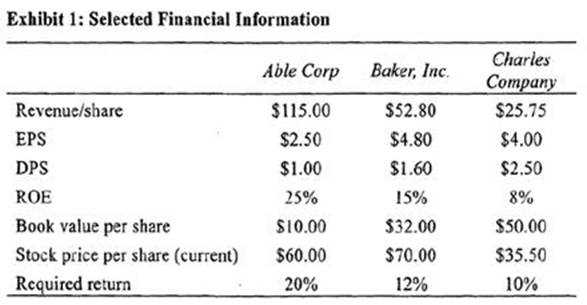
purchase by Pedad portfolio managers. Exhibit 1 contains financial information from the year just
ended for three stable companies in the meat-packing industry: Able Corp, Baker, Inc., and Charles
Company, from which Armor will derive his valuation estimates.
 One of Pedad's other equity analysts, Marie Swift, CFA, recently held a meeting with Armor to
discuss a relatively new model the firm is implementing to determine the P/E ratios of companies
that Pedad researches. Swift explains that the model utilizes a cross-sectional regression using the
previous year-end data of a group of comparable companies' P/E ratios against their dividend payout
ratios (r), sustainable growth rates (g), and returns on equity (ROE). The resulting regression equation
is used to determine a predicted P/E ratio for the subject company using the subject company's most
recent year-end data. Swift has developed the following model, which has an R-squared of 81%, for
the meat packing industry (16 companies):
Predicted P/E = 2.74 + 8.21(r) + 14.21(g) + 2.81(ROE)
(STD error) (2.11) (6.52) (9.24) (2.10)
After Swift presents the model to Armor, she points out that models of this nature are subject to
limitations. In particular, multicollinearity, which appears to be present in the meat packing industry
model, can create great difficulty in interpreting the effects of the individual coefficients of the
model. Swift continues by stating that in spite of this limitation, models of this nature generally have
known and significant predictive power across different time periods although not across different
stocks.
Based on Exhibit 1, the justified price-to-sales ratio of Baker, Inc. is closest to:
One of Pedad's other equity analysts, Marie Swift, CFA, recently held a meeting with Armor to
discuss a relatively new model the firm is implementing to determine the P/E ratios of companies
that Pedad researches. Swift explains that the model utilizes a cross-sectional regression using the
previous year-end data of a group of comparable companies' P/E ratios against their dividend payout
ratios (r), sustainable growth rates (g), and returns on equity (ROE). The resulting regression equation
is used to determine a predicted P/E ratio for the subject company using the subject company's most
recent year-end data. Swift has developed the following model, which has an R-squared of 81%, for
the meat packing industry (16 companies):
Predicted P/E = 2.74 + 8.21(r) + 14.21(g) + 2.81(ROE)
(STD error) (2.11) (6.52) (9.24) (2.10)
After Swift presents the model to Armor, she points out that models of this nature are subject to
limitations. In particular, multicollinearity, which appears to be present in the meat packing industry
model, can create great difficulty in interpreting the effects of the individual coefficients of the
model. Swift continues by stating that in spite of this limitation, models of this nature generally have
known and significant predictive power across different time periods although not across different
stocks.
Based on Exhibit 1, the justified price-to-sales ratio of Baker, Inc. is closest to:
 One of Pedad's other equity analysts, Marie Swift, CFA, recently held a meeting with Armor to
discuss a relatively new model the firm is implementing to determine the P/E ratios of companies
that Pedad researches. Swift explains that the model utilizes a cross-sectional regression using the
previous year-end data of a group of comparable companies' P/E ratios against their dividend payout
ratios (r), sustainable growth rates (g), and returns on equity (ROE). The resulting regression equation
is used to determine a predicted P/E ratio for the subject company using the subject company's most
recent year-end data. Swift has developed the following model, which has an R-squared of 81%, for
the meat packing industry (16 companies):
Predicted P/E = 2.74 + 8.21(r) + 14.21(g) + 2.81(ROE)
(STD error) (2.11) (6.52) (9.24) (2.10)
After Swift presents the model to Armor, she points out that models of this nature are subject to
limitations. In particular, multicollinearity, which appears to be present in the meat packing industry
model, can create great difficulty in interpreting the effects of the individual coefficients of the
model. Swift continues by stating that in spite of this limitation, models of this nature generally have
known and significant predictive power across different time periods although not across different
stocks.
Based on Exhibit 1, the justified price-to-sales ratio of Baker, Inc. is closest to:
One of Pedad's other equity analysts, Marie Swift, CFA, recently held a meeting with Armor to
discuss a relatively new model the firm is implementing to determine the P/E ratios of companies
that Pedad researches. Swift explains that the model utilizes a cross-sectional regression using the
previous year-end data of a group of comparable companies' P/E ratios against their dividend payout
ratios (r), sustainable growth rates (g), and returns on equity (ROE). The resulting regression equation
is used to determine a predicted P/E ratio for the subject company using the subject company's most
recent year-end data. Swift has developed the following model, which has an R-squared of 81%, for
the meat packing industry (16 companies):
Predicted P/E = 2.74 + 8.21(r) + 14.21(g) + 2.81(ROE)
(STD error) (2.11) (6.52) (9.24) (2.10)
After Swift presents the model to Armor, she points out that models of this nature are subject to
limitations. In particular, multicollinearity, which appears to be present in the meat packing industry
model, can create great difficulty in interpreting the effects of the individual coefficients of the
model. Swift continues by stating that in spite of this limitation, models of this nature generally have
known and significant predictive power across different time periods although not across different
stocks.
Based on Exhibit 1, the justified price-to-sales ratio of Baker, Inc. is closest to:Options
Discussion
No comments yet. Be the first to comment.
Be respectful. No spam.
