
Q: 15
Mark Taber, CFA, is the Chief Investment Officer of the Taber Emerging Markets Fund, (TEMF). Taber
uses a top-down approach to investing in countries. By interviewing government officials and the
managements of foreign companies, Taber often gains economic and investment insights not yet
fully understood by the foreign market. Taber is currently researching a potential investment in the
emerging market country of Alphia. Taber travels to Ullom, the capital of Alphia, to discuss past,
present, and future economic growth theory development with Dr. Raman Satish, managing director
of the Alphia Economic Development Agency (AEDA).
Dr. Satish starts the conversation with Taber by discussing the three great growth cycles that the
Alphian economy has experienced over the past 120 years: (1) the classical growth era, (2) the
neoclassical growth era, and (3) the new growth era. Taber takes down the following statements
from the meeting with Dr. Satish's meeting.
1. The Classical Growth Era of Alphia (1850-1950)
This hundred-year era was noted for periodic high levels of population growth and the sporadic
introductions of technology. The average Alphianian's income was very modest and the standard of
living remained almost the same over the 100-ycar period, except when new technology was
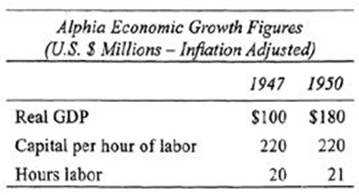
introduced. Dr. Satish cites the example of the one-time introduction of electricity to the Alphian
economy from 1947 to 1950. E
 2. The Neoclassical Growth Era o/Alphia (1951-1990)
During the neoclassical growth period, Alphia experienced a period of great economic growth. For
example, from 1986 to 1990, Alphia's capital per hour of labor grew at a 9% annual rate, while real
GDP grew at 7% per annum.
Also, Alphia was able to achieve economic growth rates and income levels comparable with many of
its neighboring countries during the neoclassical growth period. Alphian scientists, together with the
engineering department of the University of Ullom, provided access to the finest technology in the
world. In addition, Alphia opened up its equity markets to outside investors and allowed its currency
to float. Dr. Satish believes that, given time, these capital market improvements should allow the
Alphian economy to achieve an economic growth rate and per capita income level comparable to any
country in the world.
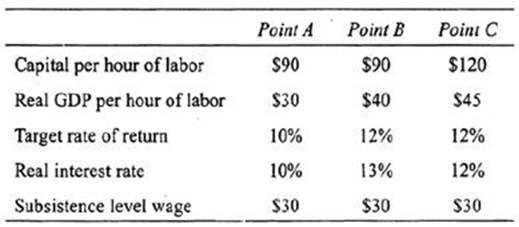
To understand the role of technology in the growth of the Alphian economy (using neoclassical
growth theory assumptions), the following table was developed to show the increased productivity
of Alphian farmers using disease resistant grains. Assume new disease resistant grain technology was
introduced into the Alphian farm economy at Point A.
3. The New Growth Era (1991-Today)
Since the Alphian energy crises of the late 1980s, the economy has been in transition. The AEDA goal
is to have more than 50% of Alphian GDP coming from what we now call knowledge capital based
industries by the year 2020. Given the large and growing population and their constant need for
health care, the pharmaceutical industry was Alphia's first knowledge capital based industry. Dr.
Satish believes that a focus on knowledge capital will enhance the long term growth prospects of
Alphia's economy.
According to the classical growth theory, Alphia would:
2. The Neoclassical Growth Era o/Alphia (1951-1990)
During the neoclassical growth period, Alphia experienced a period of great economic growth. For
example, from 1986 to 1990, Alphia's capital per hour of labor grew at a 9% annual rate, while real
GDP grew at 7% per annum.
Also, Alphia was able to achieve economic growth rates and income levels comparable with many of
its neighboring countries during the neoclassical growth period. Alphian scientists, together with the
engineering department of the University of Ullom, provided access to the finest technology in the
world. In addition, Alphia opened up its equity markets to outside investors and allowed its currency
to float. Dr. Satish believes that, given time, these capital market improvements should allow the
Alphian economy to achieve an economic growth rate and per capita income level comparable to any
country in the world.
To understand the role of technology in the growth of the Alphian economy (using neoclassical
growth theory assumptions), the following table was developed to show the increased productivity
of Alphian farmers using disease resistant grains. Assume new disease resistant grain technology was
introduced into the Alphian farm economy at Point A.
3. The New Growth Era (1991-Today)
Since the Alphian energy crises of the late 1980s, the economy has been in transition. The AEDA goal
is to have more than 50% of Alphian GDP coming from what we now call knowledge capital based
industries by the year 2020. Given the large and growing population and their constant need for
health care, the pharmaceutical industry was Alphia's first knowledge capital based industry. Dr.
Satish believes that a focus on knowledge capital will enhance the long term growth prospects of
Alphia's economy.
According to the classical growth theory, Alphia would:
 2. The Neoclassical Growth Era o/Alphia (1951-1990)
During the neoclassical growth period, Alphia experienced a period of great economic growth. For
example, from 1986 to 1990, Alphia's capital per hour of labor grew at a 9% annual rate, while real
GDP grew at 7% per annum.
Also, Alphia was able to achieve economic growth rates and income levels comparable with many of
its neighboring countries during the neoclassical growth period. Alphian scientists, together with the
engineering department of the University of Ullom, provided access to the finest technology in the
world. In addition, Alphia opened up its equity markets to outside investors and allowed its currency
to float. Dr. Satish believes that, given time, these capital market improvements should allow the
Alphian economy to achieve an economic growth rate and per capita income level comparable to any
country in the world.
To understand the role of technology in the growth of the Alphian economy (using neoclassical
growth theory assumptions), the following table was developed to show the increased productivity
of Alphian farmers using disease resistant grains. Assume new disease resistant grain technology was
introduced into the Alphian farm economy at Point A.
2. The Neoclassical Growth Era o/Alphia (1951-1990)
During the neoclassical growth period, Alphia experienced a period of great economic growth. For
example, from 1986 to 1990, Alphia's capital per hour of labor grew at a 9% annual rate, while real
GDP grew at 7% per annum.
Also, Alphia was able to achieve economic growth rates and income levels comparable with many of
its neighboring countries during the neoclassical growth period. Alphian scientists, together with the
engineering department of the University of Ullom, provided access to the finest technology in the
world. In addition, Alphia opened up its equity markets to outside investors and allowed its currency
to float. Dr. Satish believes that, given time, these capital market improvements should allow the
Alphian economy to achieve an economic growth rate and per capita income level comparable to any
country in the world.
To understand the role of technology in the growth of the Alphian economy (using neoclassical
growth theory assumptions), the following table was developed to show the increased productivity
of Alphian farmers using disease resistant grains. Assume new disease resistant grain technology was
introduced into the Alphian farm economy at Point A.
 3. The New Growth Era (1991-Today)
Since the Alphian energy crises of the late 1980s, the economy has been in transition. The AEDA goal
is to have more than 50% of Alphian GDP coming from what we now call knowledge capital based
industries by the year 2020. Given the large and growing population and their constant need for
health care, the pharmaceutical industry was Alphia's first knowledge capital based industry. Dr.
Satish believes that a focus on knowledge capital will enhance the long term growth prospects of
Alphia's economy.
According to the classical growth theory, Alphia would:
3. The New Growth Era (1991-Today)
Since the Alphian energy crises of the late 1980s, the economy has been in transition. The AEDA goal
is to have more than 50% of Alphian GDP coming from what we now call knowledge capital based
industries by the year 2020. Given the large and growing population and their constant need for
health care, the pharmaceutical industry was Alphia's first knowledge capital based industry. Dr.
Satish believes that a focus on knowledge capital will enhance the long term growth prospects of
Alphia's economy.
According to the classical growth theory, Alphia would:Options
Discussion
No comments yet. Be the first to comment.
Be respectful. No spam.
