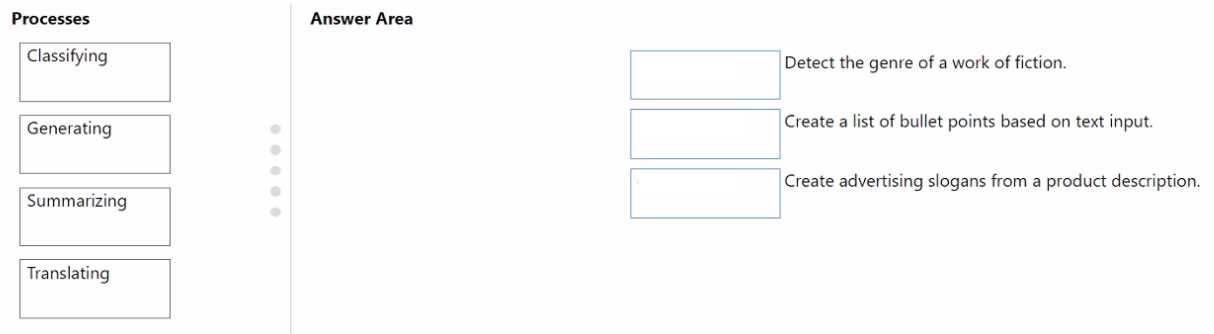
Reference for Classifying:
Source: Speech and Language Processing (3rd ed. draft), Jurafsky, D., & Martin, J. H. (2023). Section: Chapter 5: Text Classification and Sequence Labeling.
Details: This chapter covers the application of models (including LLMs) to text classification tasks, where the model determines the category (like genre) of the input text.
Reference for Summarizing:
Source: OpenAI Documentation: Azure OpenAI Service (Microsoft Official Documentation). Section: Core Concepts: Summarization.
Details: Official vendor documentation often categorizes generating concise bullet points from a long text as a form of extractive or abstractive summarization task.
Reference for Generating:
Source: Attention Is All You Need, Vaswani, A., et al. (2017). arXiv:1706.03762. DOI: https://doi.org/10.48550/arXiv.1706.03762.
Details: This foundational paper on the Transformer architecture (the basis for LLMs) describes the model's ability to produce new sequences (text generation), which encompasses creative tasks like slogan creation.
Reference for Classifying, Generating, and Summarizing as LLM tasks:
Source: Stanford CS224N: Natural Language Processing with Deep Learning (Stanford University Courseware). Topic: Large Language Models and their applications.
Details: University course materials routinely delineate these three operations—Classification (e.g., sentiment, topic), Summarization (e.g., abstractive, extractive), and Generation (e.g., creative writing, dialogue)—as fundamental applications of modern LLMs.