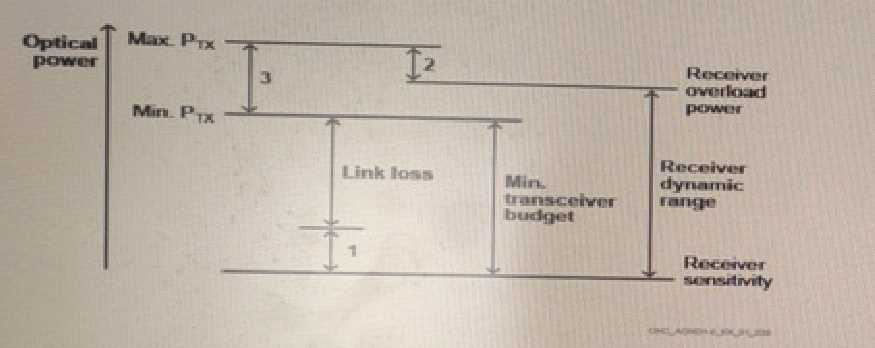
1. Nokia Optical Networking Fundamentals, Student Guide (Course Number: TTP32001V3.0), Module 3: Link Engineering. This guide explains that the receiver dynamic range is the difference in power (dB) between the receiver overload level and the receiver sensitivity. The diagram in the question is a standard representation used in this context, where the bracketed area '2' denotes this power range.
2. Gerd Keiser, "Optical Fiber Communications," 5th Edition, McGraw-Hill, 2015. Chapter 6, Section 6.8.2, "Receiver Dynamic Range," states: "The dynamic range of an optical receiver is the range of received optical power levels over which the receiver can operate and produce a specified BER. The upper limit is set by the receiver saturation or overload level... The lower limit is determined by the receiver sensitivity." (p. 329). This directly corresponds to the region marked '2'.
3. Rajiv Ramaswami, Kumar N. Sivarajan, Galen H. Sasaki, "Optical Networks: A Practical Perspective," 3rd Edition, Morgan Kaufmann, 2010. Chapter 5, Section 5.2, "Power Budget," describes the key parameters in a link power budget. It defines the receiver's dynamic range as the difference between the maximum and minimum receivable power levels, which is precisely what is depicted at location 2 in the exhibit.