
Refer to the exhibit. 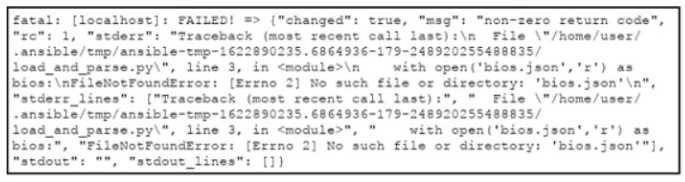 An engineer creates an application that leverages the Ansible framework to provision CPE endpoints that have configuration changes. The application contains an Ansible playbook named provision_cpes.yml that uses the ansible.builtin.script Ansible module to execute these two Python scripts: • gather and_create.py. which creates a JSON file named bios.json that contains the CPE models and their respective IOS file information • load and parse.py. which loads the file data and parses it for later consumption After several successful runs, the application fails. During a review of the Ansible execution logs, the engineer discovers an error output that indicates that one of the stages failed. What is the cause of this issue?
DRAG DROP Drag and drop the code from the bottom onto the box where the code is missing to construct a contact tracking application that dynamically returns all the Bluetooth clients on a given Meraki network. Not all options are used. 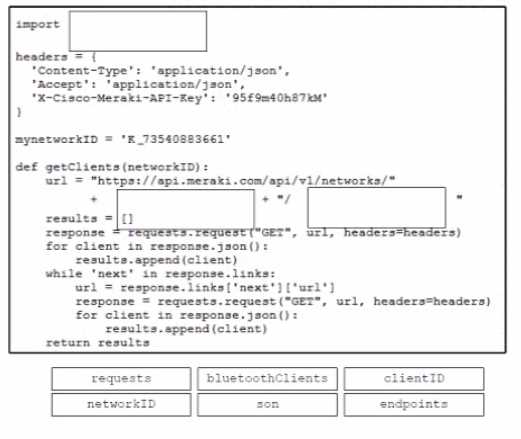
DRAG DROP Drag and drop the code from the bottom onto the box where the code is missing to retrieve and display wireless network hearth information. The wireless network devices are being managed by Cisco DNA Center and are compatible with REST API Not all options are used. 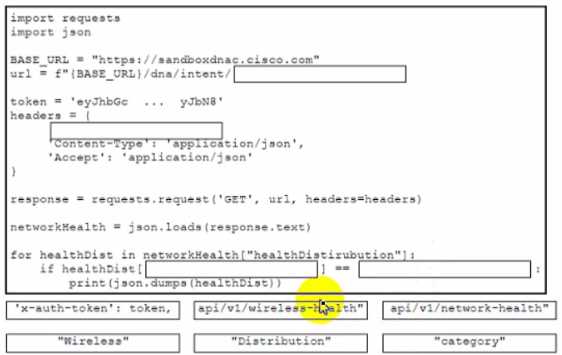
Looks right to me, Bucket 1 is api/v1/wireless-health since that's the correct endpoint, then token header, then checking 'category' for "Wireless" in the loop. Pretty sure that's how Cisco DNA Center REST calls work. Agree?
DRAG DROP Drag and drop the code from the bottom onto the box where the code is missing to configure a router that runs Cisco IOS XE by using RESTCONF. The API call is made to the management URL of the IOS XE device and on a registered port number. Errors that are caught during HTTP operation are registered. Not all options are used. 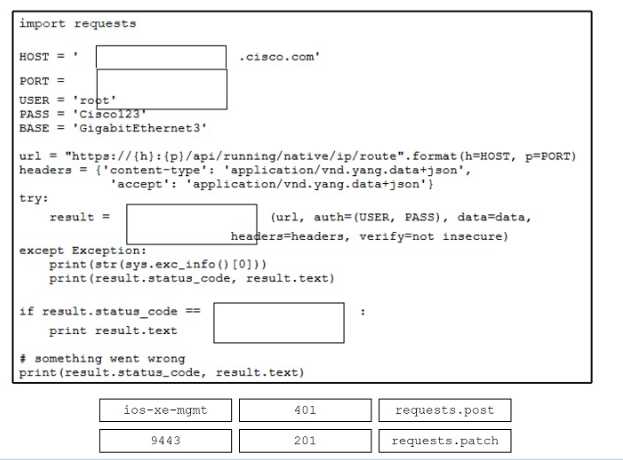
That's the order I remember from a similar question on a practice set. The patch method lines up with making config changes via RESTCONF and port 9443 is standard for IOS XE mgmt. Pretty sure this matches what Cisco expects.
Hmm, respectfully disagree with some of the earlier posts. It should be ios-xe-mgmt, 9443, requests.patch, 201. Port 9443 is typical for RESTCONF on IOS XE and PATCH matches partial config updates. Some might pick requests.post here but that would be for new resources, not updates. Correct me if I'm off but this is what I've seen in exam reports.
FILL BLANK Fill in the blanks to complete the Python script to enable the SSID with a name of “371767916” in the network resource “11111111” using the Meraki Dashboard API. 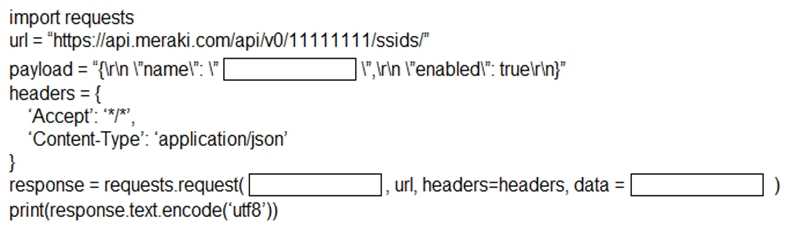
Wait, does the script already import requests and set the API key in headers? If not, that might change which variables are required or how payload is used. Just trying to clarify if the question assumes prior setup or if blanks need to cover more.
Option C but is the question asking for the immediate next protocol step after form presentation, or after the user actually submits consent? That would flip it between D and C I think.
Honestly, if the question is strictly after the form is presented but before it's submitted, I'd pick D instead of C. In OAuth2, the user submits consent and only then does the redirect happen. But since the wording seems to mean after granting access (form submitted), C fits. Small detail but I think it matters here. Anyone disagree?
Is the focus on efficiently handling all these varied data types together, or is there a requirement for strict schema enforcement? That could flip between C and A depending on the need for flexibility vs rigid structure.
