Our ENCOR 350-401 Exam Questions feature the latest, real exam questions for the Cisco Enterprise Network Core Technologies certification, all verified by Cisco experts. You’ll get accurate answers with in-depth explanations, clarifications on incorrect choices, and references for better understanding. With free demo questions and our online exam simulator, Cert Empire helps you prepare thoroughly and pass your ENCOR 350-401 exam on the first try.
All the questions are reviewed by Aidan Cortes who is a ENCOR 350-401 certified professional working with Cert Empire.
Exam Questions
📖 About this Domain
The Architecture domain covers foundational enterprise network design principles, including multi-tier and fabric architectures. It contrasts on-premises infrastructure with cloud deployments and introduces key Cisco solutions like SD-WAN and SD-Access. This domain also explores Quality of Service (QoS) mechanisms and fundamental switching concepts.
🎓 What You Will Learn
You will learn to differentiate enterprise network designs like Tier 2, Tier 3, and spine-leaf fabric architectures.
You will learn the operational principles of Cisco SD-WAN, including the roles of vManage, vSmart, vBond, and vEdge routers.
You will learn the components of the Cisco SD-Access solution, such as the control plane using LISP and the data plane using VXLAN.
You will learn to distinguish between hardware-based switching using CEF, TCAM, and FIB, and software-based process switching.
🛠️ Skills You Will Build
You will build the skill to analyze and compare traditional WAN architectures against modern SD-WAN overlay fabrics.
You will build the skill to evaluate high availability designs using techniques like SSO, NSF, and First Hop Redundancy Protocols (FHRP).
You will build the skill to map QoS components like classification, marking, queuing, and policing to enterprise network policies.
You will build the skill to describe the data forwarding process in a Cisco SD-Access fabric, including endpoint-to-fabric node communication.
💡 Top Tips to Prepare
Focus on understanding the control plane and data plane separation in both SD-WAN and SD-Access architectures.
Memorize the functions of key hardware components like TCAM, FIB, and the adjacency table for CEF-based forwarding.
Practice differentiating QoS models, including IntServ and DiffServ, and their respective marking mechanisms like DSCP and CoS.
Create comparison tables for on-premises vs. cloud deployments, and traditional campus vs. SD-Access designs.
CISCO ENCOR 350-401 Exam Questions
View Mode
Q: 1
With IGMPv2, which multicast group address does the IGMP querier use to send query messages to
all hosts on the LAN?
Options
Correct Answer:
B
Explanation
In the Internet Group Management Protocol version 2 (IGMPv2), a multicast router acting as the querier periodically sends a General Query message to discover which multicast groups have active members on a directly attached network. To ensure this query reaches every multicast-capable host on the local segment, it is sent to the destination IP address 224.0.0.1. This is the IANA-reserved "All Hosts" multicast address. All hosts that support IP multicasting are required to join this group on all their multicast-capable interfaces. This mechanism allows the querier to efficiently solicit Membership Report messages from any host interested in any multicast group.
Why Incorrect
A. 239.0.0.2: This address is in the administratively scoped multicast range ("limited scope") and is not used for fundamental network control protocols like IGMP.
C. 239.0.0.1: Similar to 239.0.0.2, this is an administratively scoped address intended for private multicast applications, not for IGMP control plane messages.
D. 224.0.0.2: This is the "All Routers" multicast address, used for communication between multicast routers (e.g., PIM, OSPF), not for querying hosts.
References
1. Internet Engineering Task Force (IETF) RFC 2236: Internet Group Management Protocol
Version 2.
Section 2
"Protocol Description
" Paragraph 2: "Queries are sent with a destination IP address of 224.0.0.1 (the all-hosts group)."
" Subsection: "Query-Response Process": "The querier periodically sends a general IGMP query to the all-hosts multicast group address 224.0.0.1."
3. Kurose
J. F.
& Ross
K. W. (2017). Computer Networking: A Top-Down Approach (7th ed.). Pearson.
Chapter 4
Section 4.4.2
"IP Multicasting: The Internet Group Management Protocol (IGMP)": This standard university textbook explains that IGMP query messages are sent to the all-systems multicast address 224.0.0.1.
Q: 2
What is one main REST security design principle?
Options
Correct Answer:
A
Explanation
The principle of separation of privilege, also known as the principle of least privilege, is a fundamental security design concept for any system, including REST APIs. It dictates that a client (user, service, or application) should only be granted the minimum set of permissions required to perform its specific, authorized tasks. In the context of a REST API, this means carefully designing roles and access controls so that a consumer can only access the specific endpoints and perform the specific actions (e.g., GET, POST, DELETE) necessary for its function, thereby minimizing the potential attack surface and the impact of a compromised key or token.
Why Incorrect
B. password hashing: This is a specific cryptographic technique used to securely store credentials. It is an implementation detail, not a high-level architectural design principle for an API.
C. confidential algorithms: This concept, known as "security through obscurity," is an anti-pattern in security design. Robust security relies on public, well-vetted algorithms combined with private, well-managed keys.
D. OAuth: This is a specific authorization framework or protocol. While it is commonly used to secure REST APIs, it is a mechanism to implement security principles like separation of privilege, not the principle itself.
References
1. National Institute of Standards and Technology (NIST)
Special Publication 800-204A
Building Secure Microservices-based Applications Using Service-Mesh Architecture
December 2019.
Reference: Section 3.1
"Security Principles
" explicitly lists "Least Privilege" as a core principle. It states
"The principle of least privilege requires that a user
process
or component should be given only the minimum privileges essential to perform its intended function." This is directly applicable to API security design.
" and "API5:2023 - Broken Function Level Authorization" are all fundamentally about failures to correctly implement the principle of least privilege/separation of privilege at different layers of the API.
3. Cisco
Cisco ENCOR 350-401 Official Cert Guide
Volume 2
1st Edition.
Reference: Chapter 23
"Network Security and Monitoring
" discusses access control principles. While not specific to REST
it covers the foundational concept of authorization
which is the mechanism for enforcing separation of privilege. The design of authorization policies for a REST API is directly guided by this principle.
Q: 3
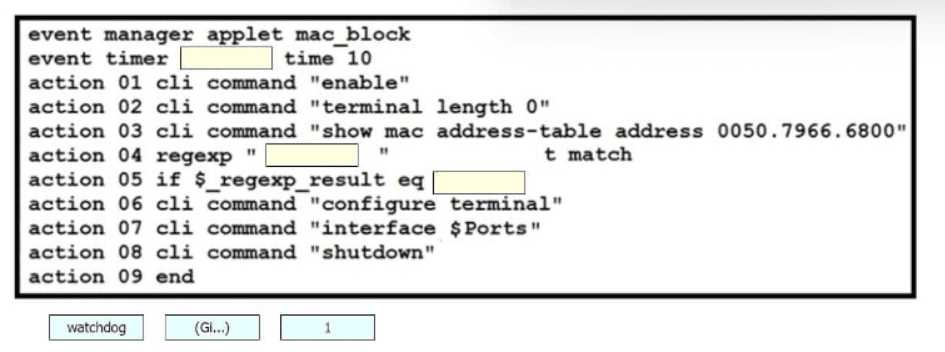
DRAG DROP Drag and drop the snippets onto the blanks within the code to construct a script that blocks a MAC address.
Drag & Drop
Correct Answer:
Explanation
This Cisco Embedded Event Manager (EEM) applet is designed to periodically check for a specific MAC address and shut down the interface where it is found. The script components work together to automate this security action. event timer watchdog time 10: This command configures the trigger for the applet. The watchdog keyword specifies a recurring timer that will execute the applet's actions every 10 seconds. This is the correct timer type for periodic, repeated checks. 2. action 04 regexp "(Gi...)" ...: This action processes the output from the show mac address-table command. The goal is to find the port associated with the MAC address. A regular expression (regexp) is used to match and capture the interface name. The pattern (Gi...) will match any string starting with "Gi" (e.g., GigabitEthernet0/1), and the parentheses () capture this matched string for later use (in action 07). 3. action 05 if $_regexp_result eq 1: This action creates a conditional block. After the regexp action runs, the special EEM variable $_regexp_result is automatically set. It is set to 1 if the regular expression found a match and '0' otherwise. Therefore, if $_regexp_result eq 1 is the correct syntax to execute the subsequent shutdown commands only if the MAC address was found in the table.
Policies," Section: "Configuring an EEM Policy Action").
Q: 4
Which tag defines the properties to be applied to each specific WLAN?
Options
Correct Answer:
B
Explanation
In the Cisco Catalyst 9800 Wireless Controller's New Configuration Model, the policy tag is the component that links a specific WLAN Profile to a Policy Profile. The WLAN Profile defines the SSID, while the Policy Profile defines the properties applied to that WLAN, such as VLAN assignment, Quality of Service (QoS) policies, session timeouts, and Access Control Lists (ACLs). By associating a WLAN with a policy profile, the policy tag effectively defines the complete set of properties for that specific WLAN, which is then applied to Access Points (APs) that are assigned that tag.
Why Incorrect
A. RF tag: This tag assigns radio-frequency (RF) profiles to APs, controlling parameters like data rates, power levels, and channel assignments, not WLAN-specific network policies.
C. AP tag: This is not a specific tag type within the Cisco 9800 configuration model. The model uses Policy, Site, and RF tags, which are assigned to APs.
D. site tag: This tag links APs to site-specific settings, such as an AP Join Profile (e.g., CAPWAP timers) or a FlexConnect Profile, which are not WLAN-specific properties.
References
1. Cisco Systems
Inc. (2023). Cisco Catalyst 9800 Series Wireless Controller Software Configuration Guide
Cisco IOS XE Cupertino 17.9.x. Chapter: "Configuring Tags and Profiles"
Section: "Information About Tags".
This document states
"Policy Tag: The policy tag is the link between a WLAN profile and a policy profile. The policy tag determines which WLANs are broadcasted on an AP
and what policies are applied for a specific WLAN."
2. Cisco Systems
Inc. (2023). Catalyst 9800-L Wireless Controller Data Sheet. Section: "Cisco Catalyst 9800 Series Wireless Controllers".
The data sheet describes the tag-based configuration: "The new configuration model... allows for a logical grouping of APs based on tags. Tags can be defined based on physical location
geography
or AP function. This allows for a much more simplified and intuitive configuration experience... The tags that can be defined are the policy tag
site tag
and RF tag." This confirms the three valid tag types and their purpose in grouping and applying policies.
Q: 5
SIMULATION
Correct Answer:
SEE THE EXPLANATION BELOW
Explanation
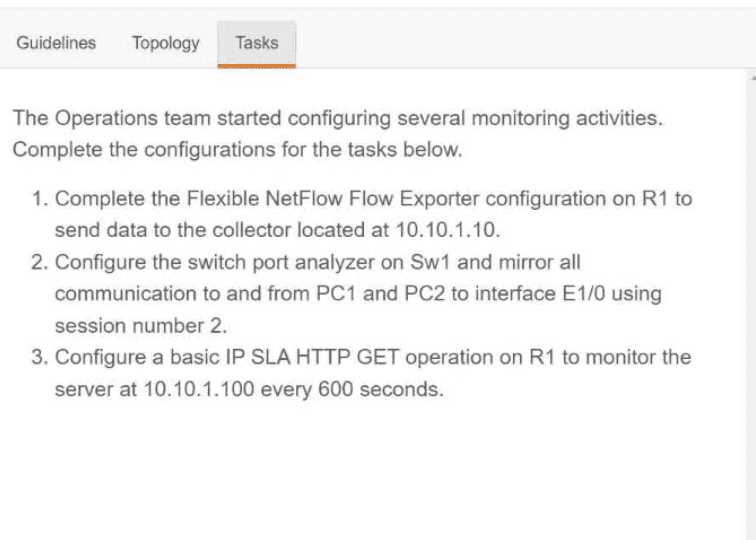
below Explanation: Task 1: Flexible NetFlow Exporter Configuration This configuration creates a NetFlow exporter on router R1 to send traffic flow data to a collector at 10.10.1.10. Cisco CLI R1(config)# flow exporter NETFLOW_EXPORT R1(config-flow-exporter)# destination 10.10.1.10 R1(config-flow-exporter)# source Loopback0 R1(config-flow-exporter)# transport udp 2055 ! R1(config)# flow monitor NETFLOW_MONITOR R1(config-flow-monitor)# record netflow-original R1(config-flow-monitor)# exporter NETFLOW_EXPORT R1(config-flow-monitor)# cache timeout active 60 ! R1(config)# interface [interface_name] R1(config-if)# ip flow monitor NETFLOW_MONITOR input Explanation: First, a flow exporter is defined, specifying the collector's IP address (destination 10.10.1.10). A source interface (e.g., Loopback0) is best practice for stability. Next, a flow monitor is created to link a flow record template (here, the predefined netflow-original) with the exporter. Finally, the flow monitor is applied to an interface in the desired direction (e.g., input) to begin monitoring traffic. Task 2: Switch Port Analyzer (SPAN) Configuration This configuration sets up a SPAN session on switch Sw1 to mirror all traffic from PC1 and PC2 to interface E1/0. (Note: The specific source interfaces for PC1 and PC2, e.g., E0/1 and E0/2, are assumed as they are not provided in the text). Cisco CLI Sw1(config)# monitor session 2 source interface [PC1_interface] , [PC2_interface] both Sw1(config)# monitor session 2 destination interface E1/0 Explanation: A SPAN session, also known as port mirroring, copies traffic from source ports to a destination port. The command monitor session 2 creates the specified session. The source interface command defines the ports to be monitored; the keyword both ensures traffic is captured in both ingress and egress directions. The destination interface command specifies where the mirrored traffic will be sent. Task 3: IP SLA HTTP GET Configuration This configuration creates an IP Service Level Agreement (SLA) operation on router R1 to send an HTTP GET request to the server at 10.10.1.100 every 600 seconds. Cisco CLI R1(config)# ip sla 1 R1(config-ip-sla)# http-get http://10.10.1.100/ R1(config-ip-sla-http)# exit ! R1(config)# ip sla schedule 1 life forever start-time now frequency 600 Explanation: First, an ip sla operation is created with entry number 1. The operation type is defined as http-get, targeting the specified server URL. Then, the ip sla schedule command activates the operation. It is scheduled to run indefinitely (life forever), begin immediately (start-time now), and repeat every 600 seconds (frequency 600), as required by the task.
References
Flexible NetFlow:
o Cisco, "Flexible NetFlow Configuration Guide," IOS XE Amsterdam
17.3.x. Sections: "Configuring Flexible NetFlow" and "Components
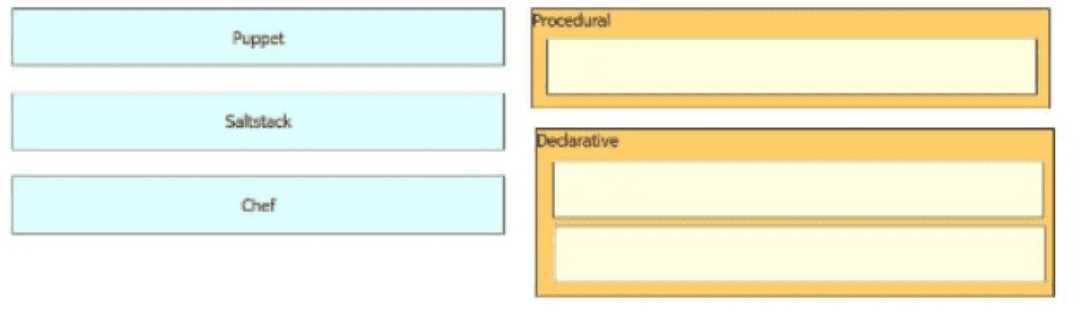
DRAG DROP Drag and drop the configuration management tools from the left onto the configuration styles they use on the right
Drag & Drop
Correct Answer:
Explanation
Configuration management tools are distinguished by their approach to defining a system's configuration.
Declarative tools, such as Puppet and Saltstack (using Salt States), focus on the desired end state. You define what the system should look like (e.g., "package 'nginx' must be installed"), and the tool's agent is responsible for figuring out how to achieve that state.
Procedural tools, such as Chef, focus on the process. You define the specific steps and the order in which they must be executed to reach the desired state. Chef uses "recipes" written in Ruby to script this sequence of actions.
References
Puppet (Official Documentation):
Source: Puppet, Inc. "Puppet's Declarative Language." Puppet Enterprise 2023.4 Documentation.
Reference: In the section "How Puppet's declarative language works," the documentation states: "Puppet is a declarative, model-based configuration management solution. This means that you define the desired state of the systems in your infrastructure, and Puppet... automatically enforces that state."
Chef (Official Documentation):
Source: Progress Chef. "What is Chef Infra?" Chef Infra Documentation.
Reference: The documentation explains: "Chef Infra uses reusable definitions called 'recipes' to describe the state of your infrastructure. These recipes are written in procedural Ruby code... This procedural approach allows for great flexibility in defining configurations." While individual resources within a recipe are declarative, the recipe itself is a procedural script that is executed in order.
Saltstack (Official Documentation):
Source: Salt Project. "Understanding Salt States." Salt Project 3006.0 Documentation.
Reference: In the section "Declarative vs. Imperative," the documentation states: "Salt States are declarative. This means that a state file declares what the state of a system should be, not how to get it there... Salt determines the 'how' by using the state modules."
Q: 7
SIMULATION
Correct Answer:
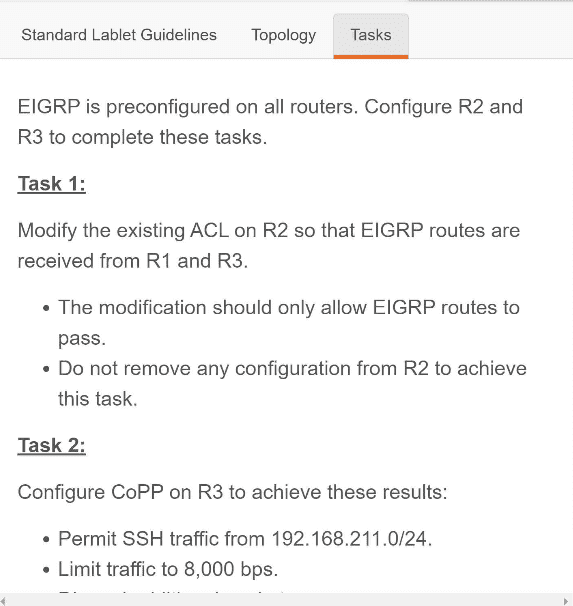
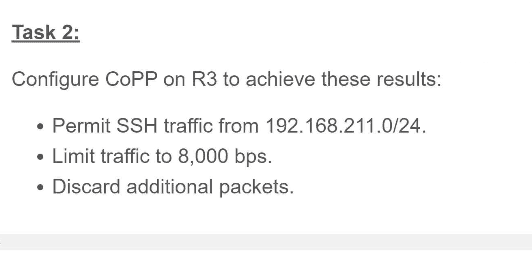
THE SOLUTION REQUIRES TWO SEPARATE CONFIGURATIONS ON R2 AND R3.
TASK 1: CONFIGURATION ON R2 (NOTE: THIS ASSUMES THE EXISTING, BLOCKING ACL ON R2 IS AN EXTENDED ACL NAMED R2_FILTER. IN A LIVE SIMULATION, YOU WOULD FIRST USE SHOW RUNNING-CONFIG | INCLUDE ACCESS-GROUP TO IDENTIFY THE ACL NAME APPLIED TO INTERFACES E0/0 AND E0/1.)
CISCO CLI
R2# CONFIGURE TERMINAL
R2(CONFIG)# IP ACCESS-LIST EXTENDED R2_FILTER
R2(CONFIG-EXT-NACL)# PERMIT EIGRP HOST 192.168.213.1 ANY
R2(CONFIG-EXT-NACL)# PERMIT EIGRP HOST 192.168.213.3 ANY
R2(CONFIG-EXT-NACL)# END
TASK 2: CONFIGURATION ON R3
CISCO CLI
R3# CONFIGURE TERMINAL
R3(CONFIG)# IP ACCESS-LIST EXTENDED COPP_SSH_ACL
R3(CONFIG-EXT-NACL)# PERMIT TCP 192.168.211.0 0.0.0.255 ANY EQ 22
R3(CONFIG-EXT-NACL)# EXIT
R3(CONFIG)# CLASS-MAP MATCH-ALL COPP_SSH_CLASS
R3(CONFIG-CM)# MATCH ACCESS-GROUP NAME COPP_SSH_ACL
R3(CONFIG-CM)# EXIT
R3(CONFIG)# POLICY-MAP COPP_POLICY
R3(CONFIG-PM)# CLASS COPP_SSH_CLASS
R3(CONFIG-PM-C)# POLICE 8000
R3(CONFIG-PM-C)# EXIT
R3(CONFIG-PM)# EXIT
R3(CONFIG)# CONTROL-PLANE
R3(CONFIG-CP)# SERVICE-POLICY INPUT COPP_POLICY
R3(CONFIG-CP)# END
Explanation
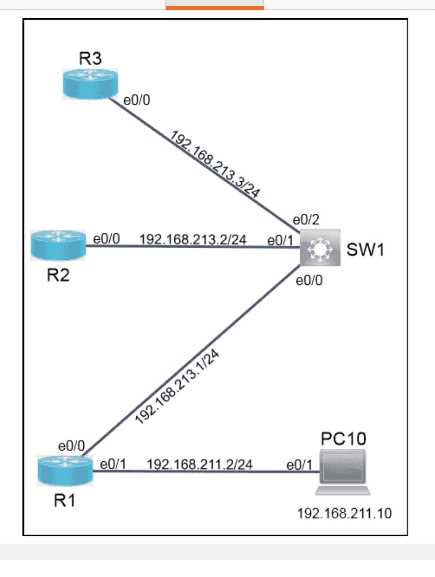
Task 1: This configuration modifies the existing access list on R2. The permit eigrp commands explicitly allow EIGRP (IP protocol 88) packets. The host 192.168.213.1 and host 192.168.213.3 stipulations specifically permit traffic from R1 and R3, respectively, which are R2's EIGRP neighbors according to the topology. The any destination wildcard is sufficient as the ACL is applied inbound to R2.
Task 2: This configuration implements Control Plane Policing (CoPP).
An ACL (COPP_SSH_ACL) is created to identify SSH (TCP port 22) traffic from the 192.168.211.0/24 source network.
A class-map (COPP_SSH_CLASS) matches traffic defined by that ACL.
A policy-map (COPP_POLICY) defines the action for that class. The police 8000 command rate-limits the matching SSH traffic to 8,000 bps. Packets exceeding this rate are discarded by default.
Finally, the service-policy input COPP_POLICY command applies this policy to the router's control plane.
References
Cisco Systems. (2020). IP Routing: EIGRP Configuration Guide, Cisco IOS XE Release 17.x. "Information About Filtering EIGRP" section. (Documents the use of permit eigrp within access lists to control routing updates).
Cisco Systems. (2021). Control Plane Policing Configuration Guide, Cisco IOS XE. "How to Configure Control Plane Policing" section. (Details the required steps of creating an ACL, class-map, policy-map with the police command, and applying it via the control-plane configuration mode).
Cisco Systems. (2019). Cisco IOS Security Configuration Guide: Security for Management Plane. "Configuring Control Plane Policing" section. (Provides examples and rationale for rate-limiting protocols like SSH to protect the CPU).
Doyle, J. & DeHaven, S. (2006). Routing TCP/IP, Volume 1 (2nd Edition). Cisco Press. Chapter 8: "EIGRP," sub-section "Route Filtering." (Explains mechanisms for filtering EIGRP, including access-lists).
Massachusetts Institute of Technology (MIT) OpenCourseWare. (2014). 6.829 Computer Networks, Lecture 15: Router Design. (Discusses the architecture of routers, including the distinction between the data plane and the control plane, which is the target of CoPP configuration).
Q: 8
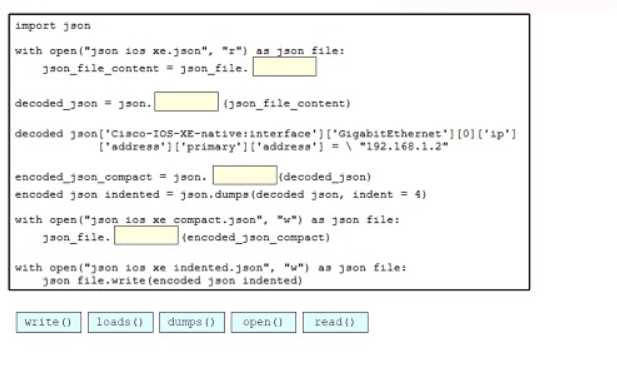
DRAG DROP Drag and drop the code snippets from the bottom onto blanks m the Python script so that the program changes the IP address and saves It as a new JSON Me on the disk Not all options are used
Drag & Drop
Correct Answer:
Explanation
This Python script manipulates JSON data. 1. read(): The script first opens a file and needs to read its contents into a string variable. The file object's read() method accomplishes this by reading the entire file content. 2. loads(): The json.loads() method (short for "load string") is used to parse a JSON formatted string and convert it into a Python dictionary. This allows the script to manipulate the data using Python's dictionary syntax. 3. dumps(): After modifying the IP address in the Python dictionary, the json.dumps() method (short for "dump string") serializes the Python object back into a JSON formatted string. 4. write(): Finally, the script opens a new file in write mode ("w") and uses the file object's write() method to save the newly created JSON string to the disk.
References
Python json module documentation: The official Python documentation
details the functions for encoding and decoding JSON. It specifies that
json.loads() is used to deserialize from a string and json.dumps() is used
to serialize to a string.
o Source: Python Standard Library, json — JSON encoder and
Which two functions is an edge node responsible for? (Choose two.)
Options
Correct Answer:
A, E
Explanation
In a Cisco Software-Defined Access (SD-Access) fabric, an edge node functions as the access layer switch, connecting endpoints like PCs, IP phones, and IoT devices to the fabric. Its primary responsibilities include acting as the ingress and egress point for traffic originating from or destined to these connected endpoints (A). Additionally, the edge node is responsible for the onboarding process of these endpoints, which involves performing authentication and authorization, typically using 802.1X in conjunction with Cisco ISE, to verify the endpoint's identity and assign appropriate network policies (E).
Why Incorrect
B. provides the default exit point for fabric traffic: This role is performed by a border node, which connects the SD-Access fabric to external networks (e.g., WAN, internet).
C. provides the default entry point for fabric traffic: This is also a function of a border node, handling traffic entering the fabric from an external network.
D. provides a host database that maps endpoint IDs to a current location: This is the primary function of the control plane node, which runs the LISP Map-Server and maintains the authoritative endpoint-to-locator (EID-to-RLOC) database.
References
1. Cisco SD-Access Solution Design Guide (CVD) - Cisco DNA Center 2.3.3
"SD-Access Fabric Roles
" Section: "Fabric Edge Nodes." This document states
"The fabric edge nodes are responsible for connecting and authenticating wired endpoints
registering the endpoint identity and location with the control plane
and applying policies to traffic to and from the endpoints." This directly supports that edge nodes authenticate endpoints (E) and
by connecting them
serve as their entry/exit points (A).
2. Cisco ENCOR 350-401 Official Cert Guide
Volume 1
1st Edition
Chapter 25
"Understanding Cisco SD-Access Architecture." The section "SD-Access Fabric Control Plane" (p. 728) explicitly states: "The control plane node... has a host tracking database (HTDB) that stores all the EID-to-RLOC mappings." This confirms that option D is a function of the control plane node
not the edge node.
3. Cisco ENCOR 350-401 Official Cert Guide
Volume 1
1st Edition
Chapter 25
"Understanding Cisco SD-Access Architecture." The section "Endpoint Onboarding" (p. 734) details the authentication process: "The endpoint connects to a port on an edge switch... The edge switch uses MAB or 802.1X to authenticate the endpoint with ISE." This confirms the edge node's role in authentication (E).
Q: 10
DRAG DROP Drag and drop the snippets onto the blanks within the code to construct a script that brings up the failover Ethernet port if the primary port goes down and also shuts down the failover port when the primary returns to service. Not all options are used.
Drag & Drop
Correct Answer:
Explanation
The script automates interface failover using two EEM applets:
Applet SRV-1-Up: Designed to activate the backup link. It monitors the primary interface (GigabitEthernet4/0/9). When the primary interface changes state to Down, the script triggers no shutdown on the backup interface (GigabitEthernet3/0/10) to bring it online.
Applet SRV-1-Down: Designed to deactivate the backup link when the primary recovers. It monitors the primary interface (GigabitEthernet4/0/9) changing state to up. When this occurs, the script issues the shutdown command on the backup interface to revert traffic to the primary path.
What is the Cisco 350-401 ENCOR Exam, and what will you learn from it?
The Cisco 350-401 ENCOR (Implementing Cisco Enterprise Network Core Technologies) exam is a crucial step toward earning the Cisco Certified Network Professional (CCNP) Enterprise certification. It also serves as the core exam for the Cisco Certified Internetwork Expert (CCIE) Enterprise Infrastructure and CCIE Enterprise Wireless tracks.
This exam is offered by Cisco, and it validates your ability to implement core enterprise network technologies, including dual-stack (IPv4 and IPv6) architecture, virtualization, infrastructure, network assurance, security, and automation.
By passing ENCOR 350-401, you will learn how to:
Configure, manage, and troubleshoot enterprise-level networks.
Implement virtualization and programmability within networks.
Secure and automate large-scale networks for better efficiency and reliability.
Prepare yourself for advanced Cisco specializations and higher-level roles in networking.
Not officially published. (Based on job market, CCNP / Enterprise Network Engineer roles often command salaries in the range of USD 90,000–130,000+ depending on location, experience, role)
Select your preferred language (English or Japanese).
Schedule the exam online or at a testing center.
You’ll receive your exam results immediately after completion.
Cisco 350-401 Exam Cost and Available Discounts
Exam Fee: USD $400 (price may vary by region).
Discount Options:
Cisco sometimes offers discount vouchers through training partners.
Students and military personnel may qualify for special pricing.
Group training packages via Cisco Learning Partners often include exam discounts.
Exam Policies You Should Know Before Taking Cisco 350-401
You must bring valid government-issued photo ID.
No personal items (phones, watches, notes) are allowed.
You can retake the exam after 5 calendar days if you fail.
Certification is valid for 3 years; recertification requires either retaking the exam or earning Continuing Education (CE) credits.
What Can You Expect on Your Cisco 350-401 Exam Day?
Expect a proctored environment either at a Pearson VUE center or online. You’ll encounter:
Scenario-based questions simulating real network issues.
A blend of theory and hands-on configuration tasks.
Tight time management requirements, so practice pacing yourself.
Take a few deep breaths before you start; it’s a comprehensive but achievable exam if you’re well-prepared.
Plan Your 350-401 Study Schedule Effectively with 5 Study Tips
Tip 1: Create a 12-week plan, dedicating at least 2–3 hours daily to one domain at a time. Tip 2: Use Cisco’s official study materials (Cisco Press, ENCOR Official Cert Guide). Tip 3: Join online forums or Discord groups where candidates share exam experiences. Tip 4: Practice real exam scenarios through labs (Cisco Packet Tracer, GNS3, or EVE-NG). Tip 5: Take mock exams and practice tests to measure your readiness.
Cisco Learning Network: Access free videos, practice labs, and community discussions.
CertEmpire Practice Exam: Reliable, updated question banks for real-world practice.
Boson ExSim or CBT Nuggets: Great for simulated practice exams and video lessons.
Hands-on Labs: Use EVE-NG, GNS3, or Packet Tracer for real practice.
Career Opportunities You Can Explore After Earning Cisco 350-401
Passing the Cisco 350-401 exam opens doors to various high-demand roles, such as:
Network Engineer
Enterprise Infrastructure Specialist
Network Security Engineer
Wireless Network Engineer
Network Consultant or Architect
These roles often come with salaries ranging from $90,000 to over $ 130,000 annually, depending on experience and region.
Certifications to Go for After Completing Cisco 350-401
Once you’ve cleared 350-401, consider pursuing:
CCNP Enterprise (specialization exam required)
CCIE Enterprise Infrastructure or Wireless
Cisco DevNet Professional for automation-focused careers
Cisco Security Core (SCOR 350-701) for network security specialization
How Does Cisco 350-401 Compare to Other Beginner-Level Cloud Certifications?
Certification
Focus Area
Difficulty Level
Career Path
Cisco 350-401 (ENCOR)
Enterprise networking, automation, security
Intermediate
Network & Infrastructure Engineering
Microsoft AZ-900
Cloud fundamentals
Beginner
Cloud computing, Azure basics
AWS Cloud Practitioner
Cloud services overview
Beginner
Cloud solutions, DevOps
CompTIA Network+
Networking fundamentals
Beginner
IT and Network Support
Ready to pass your Cisco 350-401 ENCOR exam?
Practice smarter with real, updated questions and verified answers.
Visit Cert Empire for the best Cisco 350-401 exam question files and boost your preparation today!
About 350-401 Exam Questions
Why Practice Exam Questions Are Essential for Passing Cisco 350-401 ENCOR in 2025
Passing the Cisco 350-401 ENCOR certification isn’t about memorization; it’s about deep understanding and consistent problem-solving. Cert Empire’s Cisco 350-401 Exam Questions replicate the official Cisco exam environment, helping you approach complex questions confidently and master each domain with precision.
Prepare Smarter with Exam Familiar Quiz
The ENCOR exam challenges both theory and practical reasoning. Regular practice with realistic question sets strengthens your timing, reduces exam anxiety, and improves focus. Over time, you’ll recognize patterns and frameworks that Cisco frequently tests, giving you a natural advantage.
Master Every Domain with Real Exam Logic
Cert Empire’s Cisco 350-401 question bank covers all the official exam domains, from infrastructure and virtualization to network security and automation. Each question mirrors Cisco’s technical depth, helping you build practical understanding instead of surface-level recall.
What’s Included in Our Cisco 350-401 ENCOR Exam Prep Material
At Cert Empire, we go beyond simple questions, we provide a structured learning experience designed to help you pass efficiently and confidently. Here’s what comes with your purchase:
PDF Exam Questions
Instant Access: Download your material immediately after purchase and start preparing right away.
Study Anywhere: Access your file from desktop, laptop, tablet, or mobile.
Printable Format: Perfect for offline study and note-taking during focused revision sessions.
Interactive Practice Simulator
Real Exam Mode: Practice under simulated test conditions with options to hide answers or review after completion.
Flashcard Practice: Save challenging questions for repetition and focused improvement.
Progress Tracking: Resume from where you left off with a full history of your practice sessions.
3 Months of Unlimited Access
Your purchase includes unlimited access to both PDF and simulator for three months. This gives you flexibility to revise each domain multiple times and retake practice sessions until you’re fully ready for the real Cisco exam.
Regular Updates
Cert Empire’s Cisco experts continuously monitor Cisco’s certification blueprints and update the question sets accordingly. Every file reflects the latest ENCOR syllabus, including any revisions in automation, security, and network assurance topics.
Free Practice Tests
You can try a free version of the Cisco 350-401 ENCOR practice test directly from the sidebar. It’s a limited sample of actual questions to give you a realistic preview before purchasing the complete package.
Free Exam Guides
The Cert Empire blog includes free guides for the Cisco 350-401 ENCOR exam, from topic breakdowns and study schedules to exam-day preparation strategies. Anyone can access these resources, even without purchasing the product, to plan smarter and study more effectively.
Important Note
Cert Empire’s Cisco 350-401 ENCOR Exam Questions are constantly updated to reflect Cisco’s latest official version.
✔ Each question includes detailed explanations for both correct and incorrect answers. ✔ References link to official Cisco documentation for further learning. ✔ Fully mobile-compatible PDFs and simulators make studying flexible across all devices.
The Cisco 350-401 ENCOR remains one of the most crucial and respected certifications for networking professionals, serving as the gateway to advanced Cisco credentials and better career opportunities.
Is This Exam Dump for Cisco 350-401 ENCOR?
No. Cert Empire does not provide or promote Cisco exam dumps. Our Cisco 350-401 ENCOR Exam Questions are ethically created practice materials designed to help you prepare effectively. Each question is verified and structured to mirror Cisco’s testing logic, ensuring you gain genuine understanding rather than rely on shortcuts.
FAQS
Frequently Asked Questions (FAQs)
Q1. What is the Cisco 350-401 ENCOR exam?
The Cisco 350-401 ENCOR is the core exam for Cisco’s CCNP Enterprise certification path. It evaluates your ability to implement and troubleshoot advanced enterprise networking solutions, including automation, security, and dual-stack technologies.
Q2. Who should take the Cisco 350-401 exam?
Network professionals, system engineers, and administrators who want to advance toward Cisco’s professional or expert-level certifications should take this exam. It’s ideal for anyone managing or designing enterprise-level networks.
Q3. How difficult is the Cisco 350-401 ENCOR exam?
The ENCOR exam is moderately difficult and technical. It requires a strong understanding of routing, switching, wireless, and automation. Regular practice with simulated questions helps reduce difficulty and builds confidence.
Q4. What topics are covered in the 350-401 ENCOR exam?
The exam includes architecture, virtualization, infrastructure, network assurance, security, and automation. Each domain carries a different weight, making it essential to prepare comprehensively across all topics.
Q5. How do Cert Empire’s Cisco 350-401 questions help in preparation?
Ourpractice questions bank reflect Cisco’s real exam style, including scenario-based and logic-driven items. Each question has explanations and references that reinforce understanding and strengthen exam-level reasoning.
Q6. Are these 350-401 questions real Cisco dumps?
No. Cert Empire provides legal and verified practice content. Our files are created by Cisco-certified experts to simulate real-exam logic and structure without violating Cisco’s exam policies.
Q7. How often is the Cisco 350-401 material updated?
We review and update every ENCOR file frequently to align with the latest Cisco blueprint and technical changes. You’ll always have access to the most accurate and up-to-date question set available.
Q8. Can I study the 350-401 PDF on my phone?
Yes. Cert Empire’s PDF and simulator are optimized for mobile and tablet use. You can study anywhere, whether you’re traveling or reviewing short sessions on your lunch break.
Q9. How long will I have access to the material?
You get unlimited access to your simulator and files for three months. This allows you to study at your own pace, revisit difficult areas, and build the consistency needed to pass.
Q10. Does Cert Empire offer a free Cisco 350-401 practice test?
Yes. We provide a free Cisco 350-401 sample test on the right sidebar. It includes a few representative questions so you can experience our quality and interface before purchasing the full version.
6 reviews for CISCO ENCOR 350-401 Exam Questions 2025
Rated 5 out of 5
Ethan Good (verified owner)–
I’ll always be thankful for this resource. It played a crucial role in my exam success and helped me achieve my goals. 100% Recommended Resource.
Rated 5 out of 5
Parker (verified owner)–
Cert Empire provided me with support on how to prepare for my exam. It gave me a roadmap for preparation, and using Cert Empire dumps helped me pass my exam.
Rated 5 out of 5
1905.mohammed.ahmed (verified owner)–
The study material is excellent, and I’m really impressed with the customer support. They’re very responsive and always ready to assist with any questions or concerns. It’s great to know that I can rely on such strong support throughout my preparation!
Rated 5 out of 5
Aadi (verified owner)–
This was my first time using dumps, and I’m glad I went with Cert Empire. The material was highly useful and made my exam preparation much smoother. I also appreciate their support team for always being available whenever I needed assistance with the dumps.
Rated 5 out of 5
Olivia (verified owner)–
If someone asks me to describe Cert Empire’s dumps in one word, I would simply say “fantastic”.
Rated 5 out of 5
Olivia (verified owner)–
The study material from Cert Empire was really helpful. It covered all the key topics and made me feel more confident before the exam.
Connor: Quick question, everyone, In a Cisco SDN setup, which protocol is mainly used for communication between the controller and switches?
a) OSPF
b) BGP
c) OpenFlow
d) NETCONF
It’s definitely c) OpenFlow. That’s the protocol that allows the controller to directly modify flow tables on switches. I remember Cisco stressing that in their official docs.
Good question, Owen. NETCONF is mostly for configuration management, pushing configuration changes and gathering device info via XML. OpenFlow, on the other hand, is specifically for controlling packet forwarding in SDN environments.
Adding to Nina, OpenFlow works at the data plane level, letting the controller instruct devices how to handle traffic. NETCONF is more management plane-focused.
Cisco supports multiple protocols. While OpenFlow is the standard southbound protocol in many SDN implementations, Cisco also leverages NETCONF, RESTCONF, and proprietary APIs depending on the platform and use case.
I remember being tripped up because BGP is such a popular routing protocol. But BGP doesn’t really have anything to do with controller-device communication in SDN, right?
OpenFlow’s ability to dynamically update flow tables means the controller can reroute traffic instantly without waiting for traditional routing protocol convergence.
Yes, some say OpenFlow adds overhead and complexity, and not all devices support it fully. So in production, Cisco sometimes uses hybrid approaches combining OpenFlow with traditional routing and management protocols.




 Mikel Aguirre
  tony
tony  1905.mohammed.ahmed
  Connor
  Jasmine
  Owen
Owen  Nina
Nina  Leo
Leo  Bella
Bella  Ethan
Ethan  Maria
Maria  Zane
Zane  Ruby
Ruby  Finn
Finn  Tara
Tara  Derek
Derek  Sofia
Sofia  Marcus
  Ivy
Ivy  Lucas
Lucas  Maya
Maya  Henry
Henry  Aria
Aria  Jonah
Jonah  Grace
Grace  Caleb
Caleb  Lena
Lena  Connor
  Jasmine
  Owen
Owen  Nina
Nina  Leo
Leo 


Ethan Good (verified owner) –
I’ll always be thankful for this resource. It played a crucial role in my exam success and helped me achieve my goals. 100% Recommended Resource.
Parker (verified owner) –
Cert Empire provided me with support on how to prepare for my exam. It gave me a roadmap for preparation, and using Cert Empire dumps helped me pass my exam.
1905.mohammed.ahmed (verified owner) –
The study material is excellent, and I’m really impressed with the customer support. They’re very responsive and always ready to assist with any questions or concerns. It’s great to know that I can rely on such strong support throughout my preparation!
Aadi (verified owner) –
This was my first time using dumps, and I’m glad I went with Cert Empire. The material was highly useful and made my exam preparation much smoother. I also appreciate their support team for always being available whenever I needed assistance with the dumps.
Olivia (verified owner) –
If someone asks me to describe Cert Empire’s dumps in one word, I would simply say “fantastic”.
Olivia (verified owner) –
The study material from Cert Empire was really helpful. It covered all the key topics and made me feel more confident before the exam.