1. Azure Network Security Groups Documentation: "You can associate a network security group to, or disassociate a network security group from a network interface or a subnet." This confirms that NSGs are applied at the NIC and subnet level, not centrally at the VNet level, and also shows that option B is imprecise.
Source: Microsoft Azure Documentation, "Network security groups".
(https://docs.microsoft.com/en-us/azure/virtual-network/network-security-groups-overview)
2. Azure Firewall vs. Network Security Groups Comparison: "Azure Firewall complements network security group functionality. Together, they provide better 'defense-in-depth' network security... A network security group (NSG) is used to filter network traffic to and from Azure resources in an Azure virtual network." This documentation implicitly defines the NSG's role as resource-level filtering, contrasting with the Firewall's role as a centralized VNet service.
Source: Microsoft Azure Documentation, "What is Azure Firewall?". (https://docs.microsoft.com/e
n-us/azure/firewall/overview#azure-firewall-vs-network-security-group)
3. NSG Rule Processing: "For inbound traffic, Azure processes the rules in an NSG associated with a subnet first, if there is one, and then the rules in an NSG associated with the network interface." This detail from the official documentation confirms that the ultimate enforcement point involves the network interface, which lends some credence to the flawed premise of option B.
Source: Microsoft Azure Documentation, "How network security groups filter network traffic".
(https://docs.microsoft.com/en-us/azure/virtual-network/network-security-group-how-it-works)

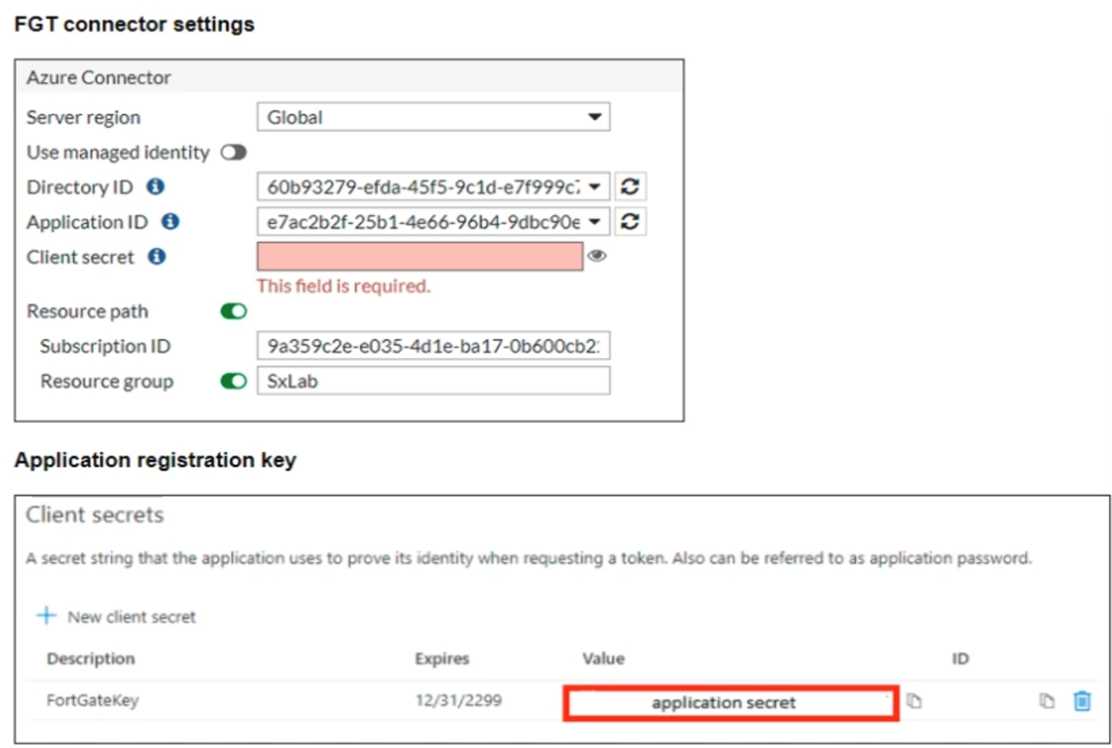 You are configuring an SDN connector for Azure on a FortiGate device You completed all the required steps on the Azure side. While configuring the FortiGate side, you notice that you did not save the client secret used in the Azure App Registration. What is the quickest way to obtain the value of the client secret?
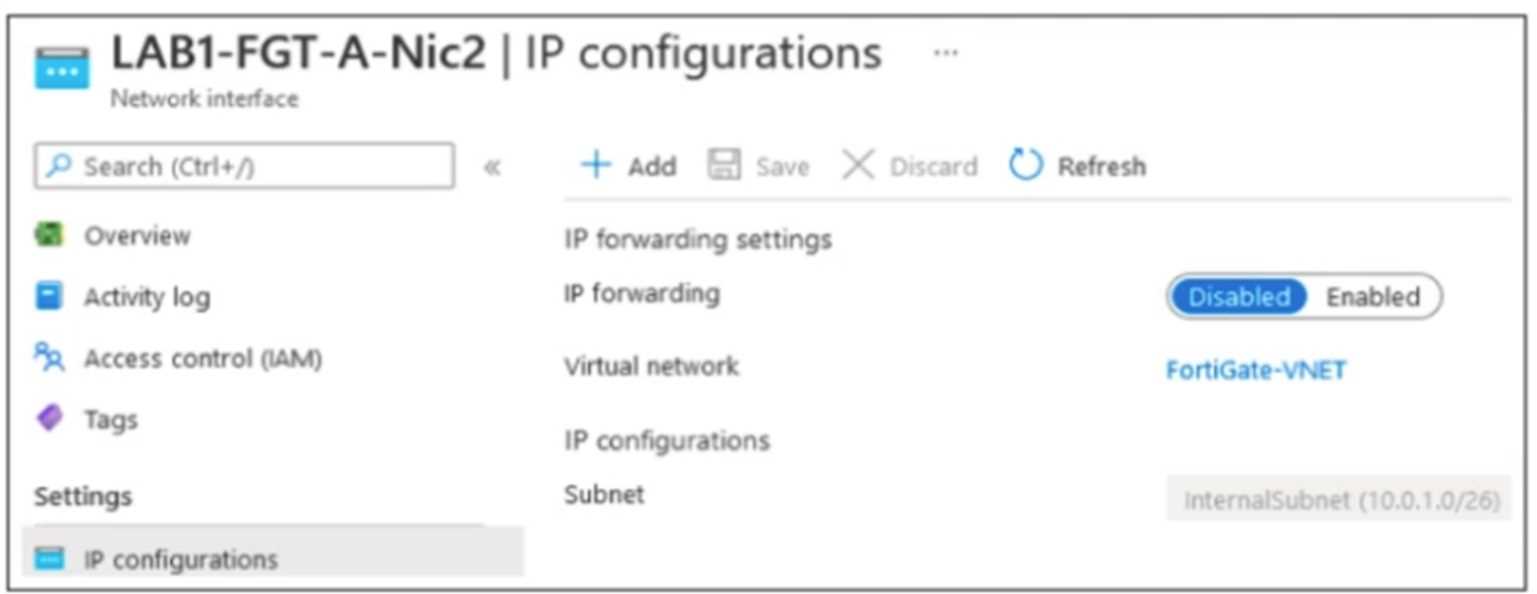 The exhibit shows some of the properties of a virtual NIC that is used by a FortiGate VM deployed in Azure. The virtual NIC shown is connected to a subnet (10.0.1.0/26) with several VMs that will be accessing the internet through the FortiGate VM. Which statement is true for this scenario?
 A high availability, active-active FortiGate with Elastic Load Balancing (ELB) and Internal Load Balancing (ILB) was deployed in your Azure environment. Which tools can you use to configure synchronization? (Choose two.)
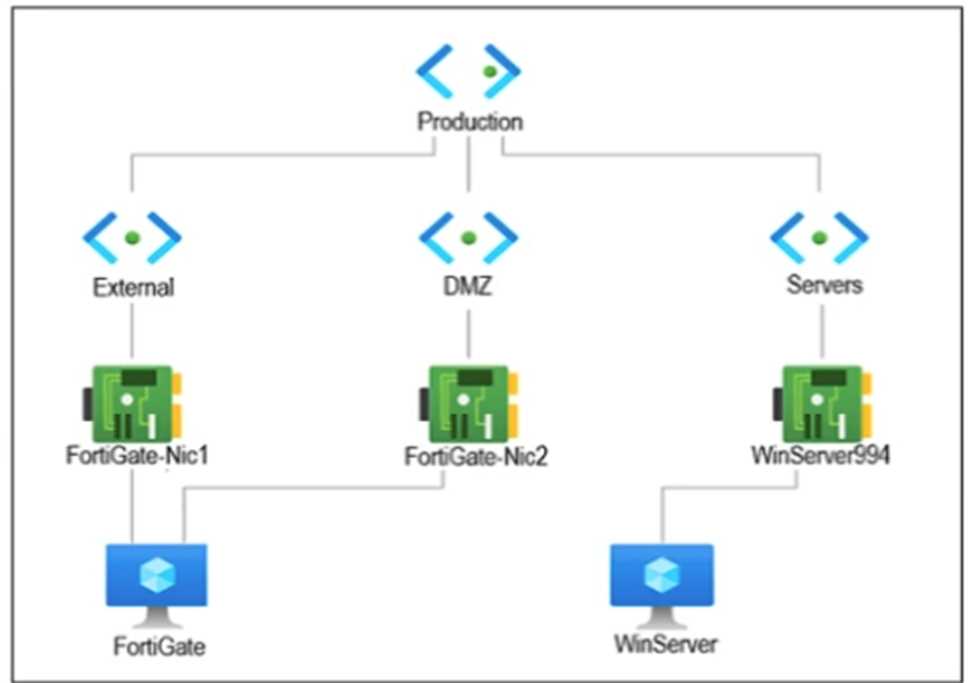 You are troubleshooting a network connectivity issue between two VMs that are deployed in Azure. One VM is a FortiGate that has one interface in the DMZ subnet, which is in the Production VNet. The other VM is a Windows Server in the Servers subnet, which is also in the Production VNet. You cannot ping the Windows Server from the FortiGate VM. What is the reason for this?