Free HPE7-A01 Practice Test Questions and Answers (2026) | Cert Empire Practice Questions
Free preview: 20 questions.
HP HPE7 A01
B)
C)
D)
E)

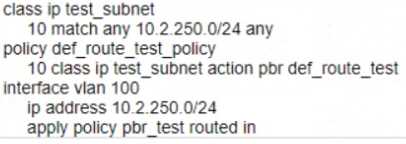
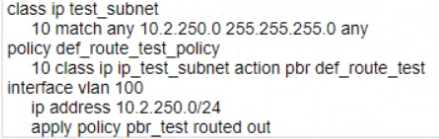
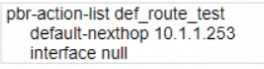
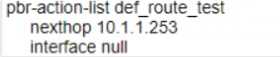
Had something like this in a mock. Pretty sure it's B and D, since B is the ACL/class matching both the source subnet and default route, and D applies the policy to set the next-hop. C would match too much traffic. Agree?
PBR config always trips me up a bit. I picked C and E since I thought E looked like the policy and C seemed to match traffic from 10.2.250.0/24, but now I'm wondering if option B is actually the correct ACL for matching default-route traffic from that subnet. Not fully sure, but that's my reasoning here. Agree?
B)
C)
D)

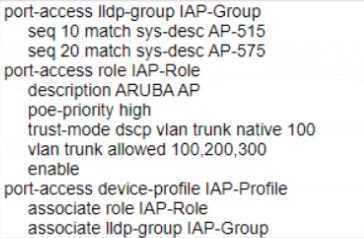
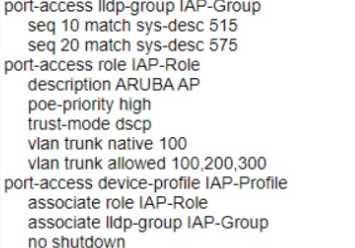
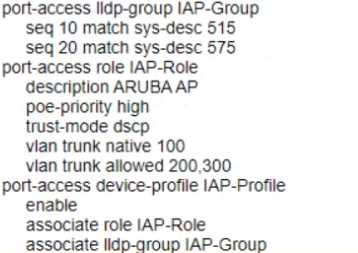
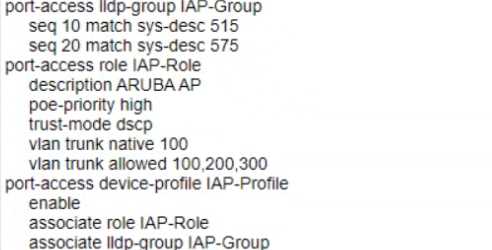
Option C is the right config for this scenario. Trunk mode lets the APs handle tagged client and guest VLANs as well as untagged management, which is what Aruba expects. D looks tempting but that one’s access mode so it’d break multi-VLAN support. Pretty sure C is the only one that works here, unless I’m missing something obvious. Agree?
Honestly, I thought D could work because it looks like an access port setup, which is usually simpler for field installs. But the APs need to support multiple VLANs for client and guest traffic, so just using access mode might not be enough here. Pretty sure that's the trap in D. Anyone else see it differently?
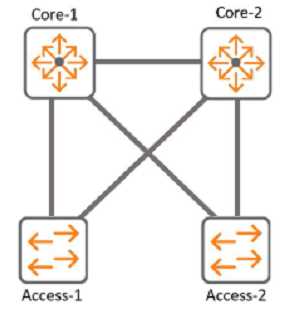
With Access-1, What needs to be identically configured With MSTP to load-balance VLANS?DRAG DROP List the WPA 4-Way Handshake functions in the correct order. 
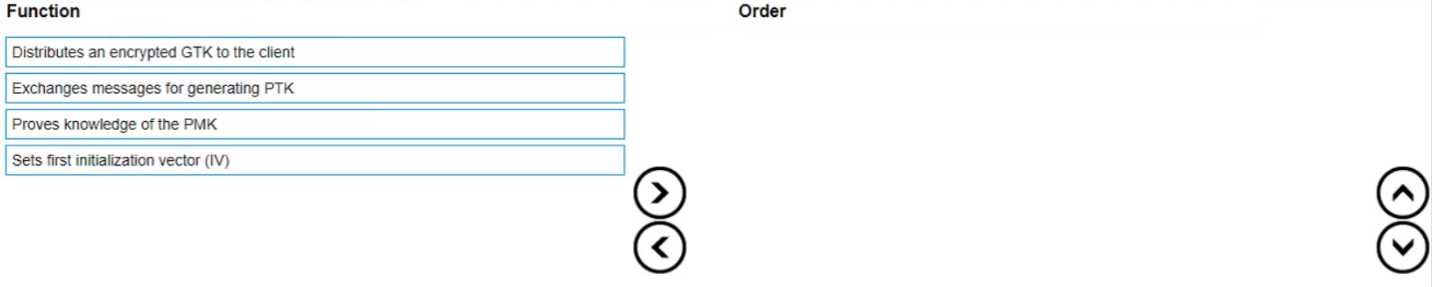
Honestly I think distributing the GTK happens right after PTK is generated, but I might be mixing up 3 and 2. Anyone else see it this way in their studies?
DRAG DROP Match the appropriate QoS concept with its definition. (Options may be used more than once or not at all.) 
I see people mix up CoS and DiffServ a lot-easy trap since both deal with prioritizing packets, just at different layers. Pretty sure this is right from what I've seen in similar questions, but let me know if you caught something else.
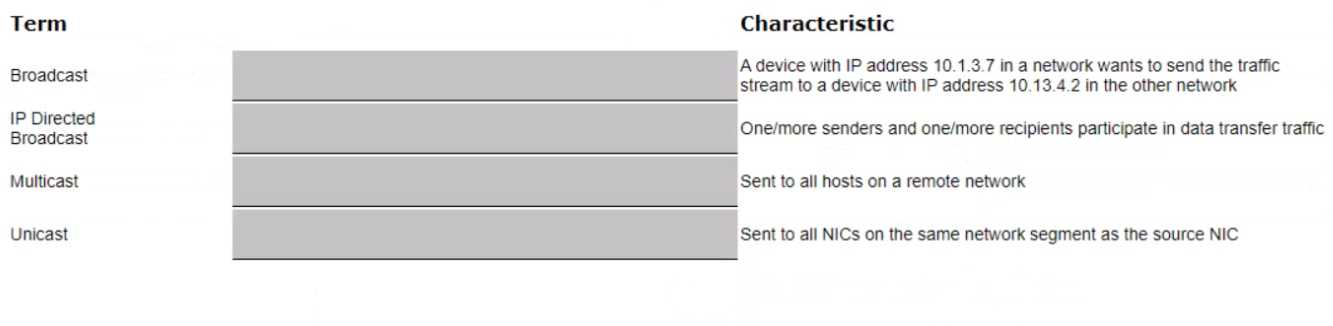
DRAG DROP Match the terms below to their characteristics (Options may be used more than once or not at all.) 
A device with IP 10.1.3.7 sending to 10.13.4.2 → Broadcast; One or more senders and recipients → Unicast; Sent to all hosts on remote network → Multicast; Sent to all NICs same segment → IP Directed Broadcast.
But is it looking for the best fit or could partial overlaps be correct too?
I actually thought it was like: 10.1.3.7 to 10.13.4.2 as Multicast, since there's more than one recipient possible, but maybe I'm mixing up group vs point-to-point traffic. Sent to all on remote sounded like Broadcast, and NICs on same segment I picked IP Directed Broadcast for, assuming local broadcast wouldn't leave the subnet. Not 100% on this, let me know if you see it differently.
DRAG DROP Match each PoE power class to Its corresponding 802.3 standard. (Options may he used more than once or not at all) 
DRAG DROP Match the topics with the underlying technologies (Options may be used more than once or not at all.) 
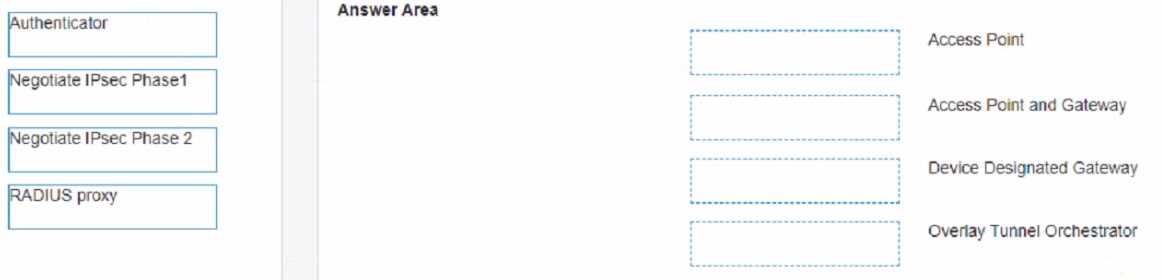
DRAG DROP Match the topics of an AOS10 Tunneled mode setup between an AP and a Gateway. (Options may be used more than once or not at all.) 
This lines up as Authenticator to Access Point, Phase 1 to Overlay Tunnel Orchestrator, Phase 2 to Access Point and Gateway, RADIUS proxy to Device Designated Gateway. I think that fits Aruba AOS10 tunneling flow, but correct me if I'm off.
Think Negotiate IPsec Phase1 belongs with Device Designated Gateway, and RADIUS proxy fits with Overlay Tunnel Orchestrator. That’s how I see the roles broken down for AOS10 tunnels. Not totally sure though, correct if you think I mixed it up!
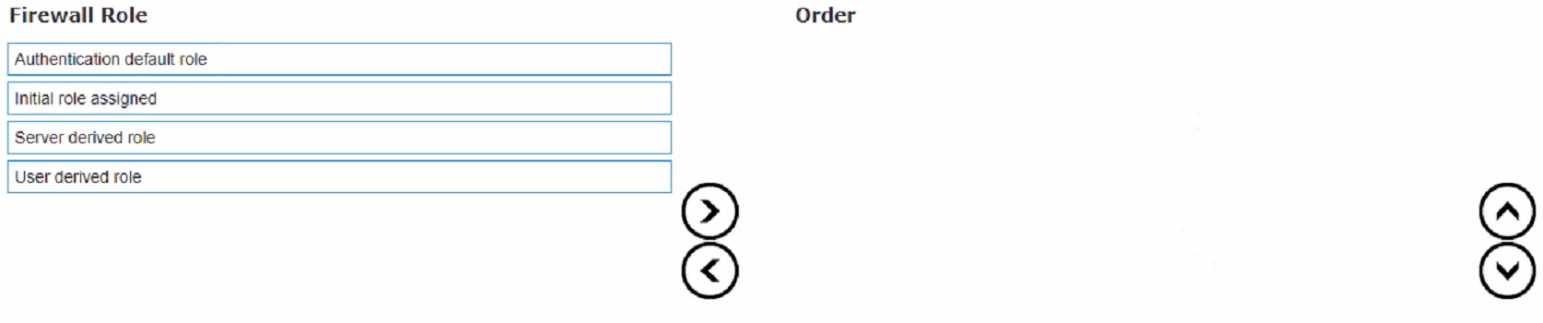
DRAG DROP List the firewall role derivation flow in the correct order 
Yeah, the flow should be: Initial role assigned, then Authentication default role, next User derived role, and finally Server derived role. Server VSA always trumps everything else from what I've seen. Pretty sure this matches Aruba docs.
DRAG DROP Select the Aruba stacking technology matching each option (Options may be used more than once or not at all.) 
Not seeing any mistakes in that mapping. Easy to mix up VSF/VSX on bandwidth but this matches Aruba docs.
VSF → Supports up to 10 devices, Individual ISL links up to 50G, A maximum aggregate ISL bandwidth of 200G
VSX → Supports two devices per stack, Individual ISL links up to 400G.
Did I mess any of those up?
Probably A, but does the question specify if there’s a deny-all fallback configured on the switch? If so, that might change it to C. The keyword here is what the default behavior is without a custom role set.