Free Practice Test

Free ATM Practice Test Questions and Answers (2026) | Cert Empire

ISTQB ATM

View Mode
Q: 1
Assume you are managing the system testing phase of a project. The system test execution period is scheduled to twenty weeks. All tests are manual tests. You are following a risk-driven test approach. During the last staff meeting the project manager tells you new deadlines that will not allow completion of all the system tests. Which of the following would you expect to be the best way to respond to this situation? K2 1 credit
Options
Q: 2

Consider the following statements describing the importance of improving the test process: I. Test process improvement is important because being focused only on the test process it can provide recommendations to improve the test process itself, but it can’t indicate or suggest improvement to areas of the development process II. Test process improvement is important because it is much more effective than software process improvement to improve the quality of a software system III. Test process improvement is important because several process improvement models (STEP, TPI Next, TMMi) have been developed over the years IV. Test process improvement is important because every organization, regardless of the context, should always achieve the maximum level of maturity of testing described in the test improvement models such as TMMi Which of the following answers is correct? K2 1 credit

Options
Q: 3
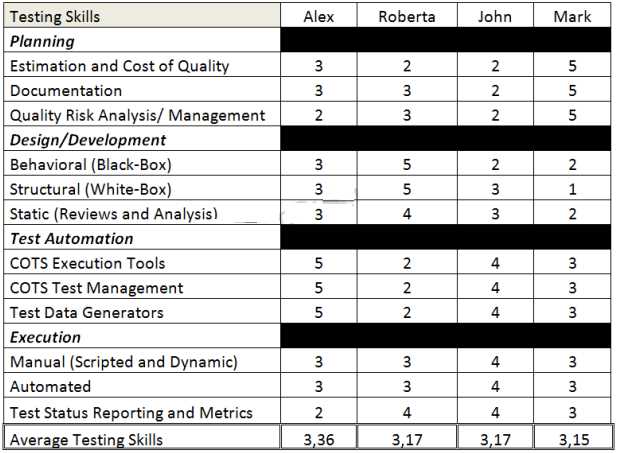
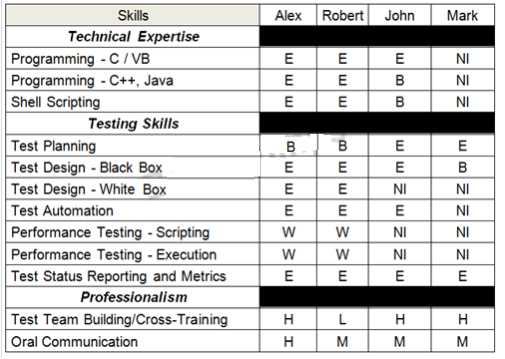
Consider the following skills assessment spreadsheet for your test team (consisting of four team members): This spreadsheet has three sections: technical expertise, testing skills and professionalism. The skill levels for each skill area for both the “technical expertise” and “testing skills” sections have been rated on a four-point scale: - E (Expert): indicates that a person has expert knowledge and experience in the skill area - B (Beginner): indicates that a person has some knowledge and experience in the skill area but he/she is not autonomous - W (Wants to learn): indicates that a person has no knowledge or experience in the skill area but he/she wants to learn that skill - NI (Not Interested): indicates that a person has no knowledge or experience in the skill area and he/she is not interested to learn that skill The skill levels for each skill area of the “professionalism” section have been rated on a three point scale (H=High, M=Medium, L=Low). Consider the following analysis of testing skills performed on four people. Alex, Robert, John and Mark (all the skills have been rated on an ascending scale. The higher the score, the better the skill): ISTQB ATM question Which of these people, based on this analysis, would you expect to be most suitable to work specifically as test designer? K4 3 credits
Options
Q: 4
Consider a defect report and assume that a part of its lifecycle includes the following states: New: Is the initial state Working. Means that the developers are addressing the defect in order to produce a fix for the defect Clarification: Means that the developers need more information from the tester to address the defect and produce a fix for the defect and the tester is working to provide this information to the developers Verification: Means that a fix for the defect has been produced and the tester is running the adequate tests to verify whether the fix solves the defect Closed. is the final state Which of the following answers represents an invalid sequence of states that can’t lead the bug report to the “Closed” state? K2 1 credit
Options
Q: 5
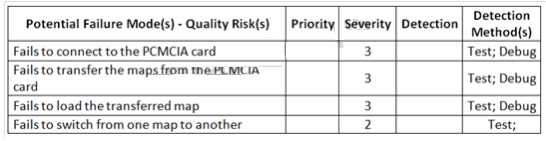
Assume you are working on a CAS (Conditional Access System) for Pay-TV that allows the access, selection and transfer of services and media to authorized users. Authorized users can choose their services through different channels: Web Customer Portal, IVR (Interactive Voice Response), Call Centre and SMS. The system uses a Smart Card to receive and decrypt the broadcasted encrypted control words which allow decrypting pay-per-view TV. Every authorized user must have a Smart Card and a Set-Top Box to view the contents. The following is an excerpt from the product risk analysis document: Both likelihood and impact have been rated on the following scale: (1 – Very low, 2 – Low, 3 – Medium, 4 – High, 5 – Very High). The required test environment and code have been delivered. All test cases for each identified product risk item have been written and are ready to be executed. The Database used to contain the Smart Cards is empty and so only new Smart Cards can be used during test execution. A Smart Card can only be activated if it has been previously pre-activated. This means the postconditions for the execution of the test cases to test the pre-activation of the Smart Card are the pre-conditions for activation of the Smart Card. Which of the following statements represents the most effective contribution of the stakeholders to the completion of the failure mode analysis table? K4 3 credits ISTQB ATM question
Options
Q: 6
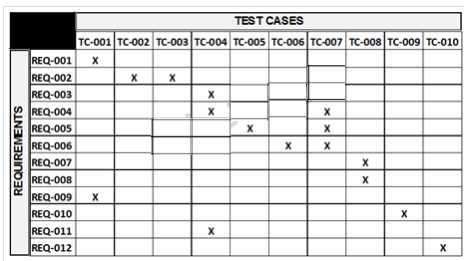
Assume that the following test cases have been executed at the end of the first week of test execution: TC-001, TC-002 and TC-007. All these tests are ‘passes’. ISTQB ATM question What is the MINIMUM number of the remaining test cases that must be successfully executed to fulfill the EX1 exit criteria? K3 2 credits
Options
Q: 7
The main objectives the senior management team wants to achieve are: - to reduce the costs associated with dynamic testing - to use reviews to ensure that the project is on course for success and following the plan - to use reviews as a well-documented and effective bug-removal activity following a formal process with well-defined roles - to determine the effectiveness of reviews in terms of phase containment - to improve phase containment effectiveness Which of the following answers would you expect to describe the best way to achieve these objectives? K4 3 credits
Options
Q: 8
You are the Test Manager for a project to develop a client-server application that allows wine vendors to order custom-assorted packages of wines of several winemakers to sell special packages in their wine shops. You decide to apply a blended risk-based and reactive testing strategy. Below the exit criteria for the system testing. EXCR1- Each “critical” quality risk item must be covered by at least one test condition EXCR2- Each “critical” requirement must be covered by at least one test condition The following are the “critical” requirements of the application: REQ-SEL-1. The application shall allow the user to order only one package at a time REQ-SEL-2. The application shall allow the user to select between four different packages (2-bottles, 6-bottles, 12-bottles, 15-bottles) REQ-SEL-3. The application shall allow the user to order a package containing at least 1 bottle and no more bottles than the package size. No error messages shall be displayed if the user selects a valid number of bottles (at least 1 bottle and no more than the package size) REQ-SEL-4. The application shall display an error message “Invalid number of bottles” if an invalid number of bottles is selected by the user (zero bottles or a number higher than the package size) REQ-PAY-1. The application shall allow the user to pay with the three accepted credit cards (Visa, MasterCard, American Express) REQ-PAY-2. The application shall display an error message “Invalid credit card” if invalid credit card data are given by the user The following is the unique “critical” quality risk item that has been identified: CR-RSK-1. The GUI of the application might accept non-integer values for the input field designed to get the number of bottles from the user Test analysis for system testing has just begun and the following test conditions have been identified. TC-SEL-2. Test the selection of the package sizes TC-SEL-4. Test wrong numbers of bottles for an order TC-CR-RSK-1. Test the accepted values from the input field designed to get the number of bottles from the user Assume that you have used traceability to determine the logical test cases that cover all the requirements and the single risk item identified in that scenario. Which of the following is a positive logical test that is complete and correct, and covers the REQSEL-4 requirement? K3 2 credits
Options
Q: 9
Which of the following statements best describes an appropriate approach for managing exploratory testing? Number of correct responses: 1 K2 1 credit
Options
Q: 10
Consider the following skills assessment spreadsheet for your test team (consisting of four team members): This spreadsheet has three sections: technical expertise, testing skills and professionalism. The skill levels for each skill area for both the “technical expertise” and “testing skills” sections have been rated on a four-point scale: - E (Expert): indicates that a person has expert knowledge and experience in the skill area - B (Beginner): indicates that a person has some knowledge and experience in the skill area but he/she is not autonomous - W (Wants to learn): indicates that a person has no knowledge or experience in the skill area but he/she wants to learn that skill - NI (Not Interested): indicates that a person has no knowledge or experience in the skill area and he/she is not interested to learn that skill The skill levels for each skill area of the “professionalism” section have been rated on a three point scale (H=High, M=Medium, L=Low). You are using this skills assessment spreadsheet in order to define a training development plan for your test team. Your objective is to fill the skill gaps by having at least a team member rated as an expert for each skill identified for the “technical expertise” and “testing skills” sections, and with the ability to train the other team members. Considering the budget constraints you can send only one person to a training course. ISTQB ATM question Based only on the given information, which of the following answers would you expect to be the best option to achieve your objective? K4 3 credits
Options
Question 1 of 10

Scroll to Top

FLASH OFFER

Days
Hours
Minutes
Seconds

avail 10% DISCOUNT on YOUR PURCHASE