1. HashiCorp Vault Documentation, "Auth Methods": "Auth methods are the components in Vault that perform authentication and are responsible for assigning identity and a set of policies to a user... Upon successful authentication, Vault returns a client token. This token has policies attached to it which control what the client is allowed to do in Vault."
Source: HashiCorp, Vault Documentation, "Auth Methods", Introduction section.
2. HashiCorp Vault Documentation, "Tokens": "A client's identity is tied to the policies that are assigned to the token. These policies dictate what the client can and cannot do within Vault... The primary way to get a token is to authenticate with an auth method."
Source: HashiCorp, Vault Documentation, "Tokens", Introduction section.
3. HashiCorp Vault Documentation, "Secrets Engines": "Secrets engines are components which store, generate, or encrypt data. Some secrets engines like the KV secrets engine simply store and read raw data. Other secrets engines connect to other services and generate dynamic credentials on-demand."
Source: HashiCorp, Vault Documentation, "Secrets Engines", Introduction section.
4. HashiCorp Vault Documentation, "Storage Backends": "Each Vault server must have a storage backend, which is a location for the durable storage of Vault's information (its configuration, policies, secrets, authentication data, etc)."
Source: HashiCorp, Vault Documentation, "Storage Backends", Introduction section.

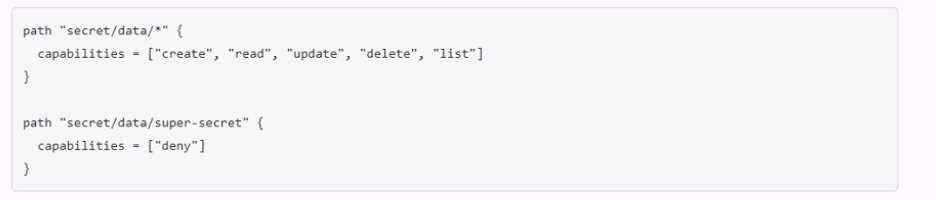 Which of the following operations are permitted by this policy? Choose two correct answers.
 Where on this page would you click to view a secret located at secret/my-secret?
 Which statement describes the fix for this issue?