
Arcitura S90.09
Q: 1
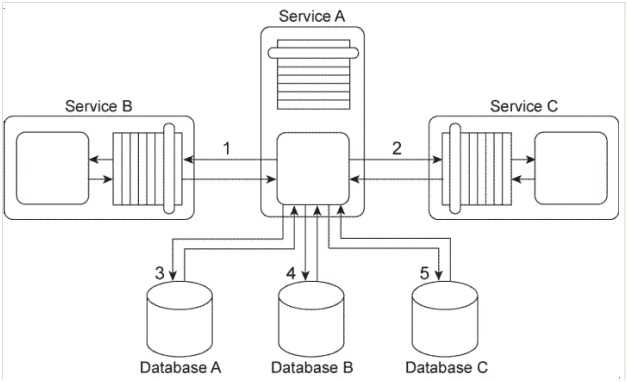
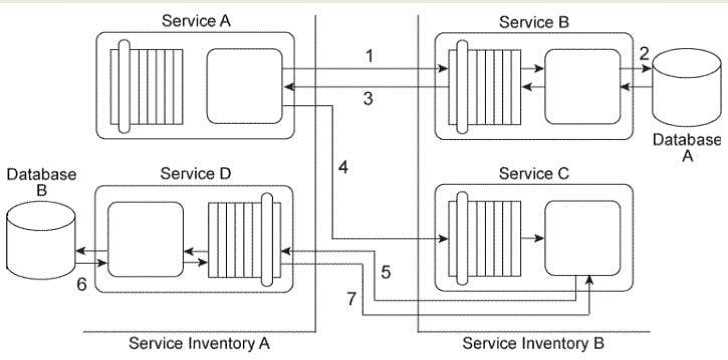
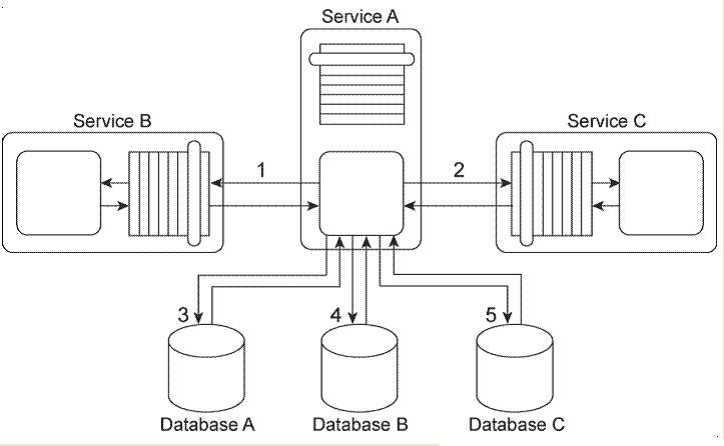
Service A sends a message to Service B (1). After Service B writes the message contents to Database
A (2) it issues a response message back to Service A (3). Service A then sends a message to Service C
(4). Upon receiving this message, Service C sends a message to Service D (5), which then writes the
message contents to Database B (6) and issues a response message back to Service C (7). Service A
and Service D are in Service Inventory A . Service B and Service C are in Service Inventory B .
 You are told that in this service composition architecture, all four services are exchanging invoice
related data in an XML format. However, the services in Service Inventory A are standardized to use a
different XML schema for invoice data than the services in Service Inventory B . Also, Database A can
only accept data in the Comma Separated Value (CSV) format and therefore cannot accept XML
formatted data. Database B only accepts XML formatted data. However, it is a legacy database that
uses a proprietary XML schema to represent invoice data that is different from the XML schema used
by services in Service Inventory A or Service Inventory B . What steps can be taken to enable the
planned data exchange between these four services?
You are told that in this service composition architecture, all four services are exchanging invoice
related data in an XML format. However, the services in Service Inventory A are standardized to use a
different XML schema for invoice data than the services in Service Inventory B . Also, Database A can
only accept data in the Comma Separated Value (CSV) format and therefore cannot accept XML
formatted data. Database B only accepts XML formatted data. However, it is a legacy database that
uses a proprietary XML schema to represent invoice data that is different from the XML schema used
by services in Service Inventory A or Service Inventory B . What steps can be taken to enable the
planned data exchange between these four services?
You are told that in this service composition architecture, all four services are exchanging invoice
related data in an XML format. However, the services in Service Inventory A are standardized to use a
different XML schema for invoice data than the services in Service Inventory B . Also, Database A can
only accept data in the Comma Separated Value (CSV) format and therefore cannot accept XML
formatted data. Database B only accepts XML formatted data. However, it is a legacy database that
uses a proprietary XML schema to represent invoice data that is different from the XML schema used
by services in Service Inventory A or Service Inventory B . What steps can be taken to enable the
planned data exchange between these four services?Options
Q: 2
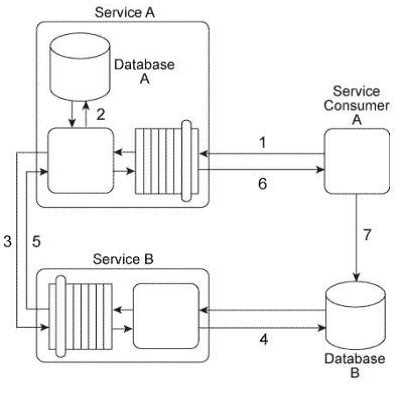
Service Consumer A sends a message with a business document to Service A (1), which writes the
business document to Database A (2). Service A then forwards the business document to Service B
(3), which writes the business document to Database B (4). Service B then responds to Service A with
a message containing a failure or success code (5) after which Service A responds to Service
Consumer A with a message containing a failure or success code (6). Upon receiving the message,
Service Consumer A updates a log table in Database B (7). The log entry is comprised of the entire
business document. Database A is dedicated to the Service A service architecture and Database B is a
shared database.
 You are told that the database updates performed by Service A and Service B must be either both
successful or they cannot happen at all. The database update performed by Service Consumer A
must happen after it is given the outcome of the database updates performed by Service A and
Service B . Given that Service Consumer A must also update Database B as part of this service
composition architecture, how is it possible to fulfill these requirements?
You are told that the database updates performed by Service A and Service B must be either both
successful or they cannot happen at all. The database update performed by Service Consumer A
must happen after it is given the outcome of the database updates performed by Service A and
Service B . Given that Service Consumer A must also update Database B as part of this service
composition architecture, how is it possible to fulfill these requirements?
You are told that the database updates performed by Service A and Service B must be either both
successful or they cannot happen at all. The database update performed by Service Consumer A
must happen after it is given the outcome of the database updates performed by Service A and
Service B . Given that Service Consumer A must also update Database B as part of this service
composition architecture, how is it possible to fulfill these requirements?Options
Q: 3
Currently, due to the increasing amount of concurrent access by service consumers, the runtime
performance of both the Client and Vendor services has worsened and has therefore reduced their
effectiveness as service composition members. Additionally, a review of the logic of both services
has revealed that some of the business rules used by the Client and Vendor services are actually the
same. What steps can be taken to improve performance and reduce redundant business rule logic?
Options
Q: 4
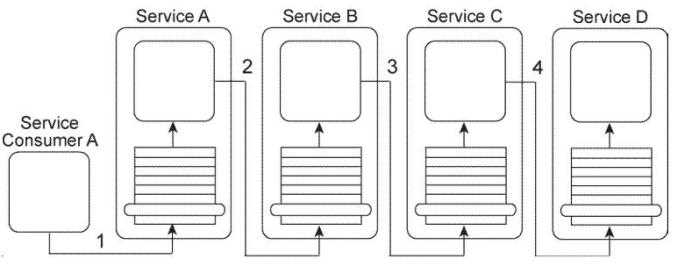
Service Consumer A sends a message to Service A (1), which then forwards the message to Service B
(2). Service B forwards the message to Service C (3), which finally forwards the message to Service D
(4). Services A, B, and C each contain logic that reads the content of the message and, based on this
content, determines which service to forward the message to. As a result, what is shown in the
Figure is one of several possible runtime scenarios.
 You are told that the current service composition architecture is having performance problems
because of two specific reasons. First, too many services need to be explicitly invoked in order for the
message to arrive at its destination. Secondly, because each of the intermediary services is required
to read the entire message contents in order to determine where to forward the message to, it is
taking too long for the overall task to complete. What steps can be taken to solve these problems
without sacrificing any of the functionality that currently exists?
You are told that the current service composition architecture is having performance problems
because of two specific reasons. First, too many services need to be explicitly invoked in order for the
message to arrive at its destination. Secondly, because each of the intermediary services is required
to read the entire message contents in order to determine where to forward the message to, it is
taking too long for the overall task to complete. What steps can be taken to solve these problems
without sacrificing any of the functionality that currently exists?
You are told that the current service composition architecture is having performance problems
because of two specific reasons. First, too many services need to be explicitly invoked in order for the
message to arrive at its destination. Secondly, because each of the intermediary services is required
to read the entire message contents in order to determine where to forward the message to, it is
taking too long for the overall task to complete. What steps can be taken to solve these problems
without sacrificing any of the functionality that currently exists?Options
Q: 5
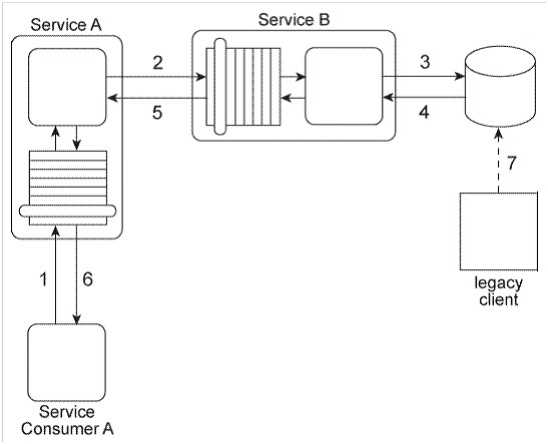
Service A has become increasingly difficult to maintain. Its core service logic has become bloated and
convoluted because it has been updated numerous times during which additional functionality was
added to interact with the database and the legacy system and to support interaction with Service
Consumers A and B (via the two service contracts) as well as interaction directly with Service
Consumer C .
 What steps can be taken to solve these problems and to prevent them from happening again in the
future?
What steps can be taken to solve these problems and to prevent them from happening again in the
future?
What steps can be taken to solve these problems and to prevent them from happening again in the
future?Options
Q: 6
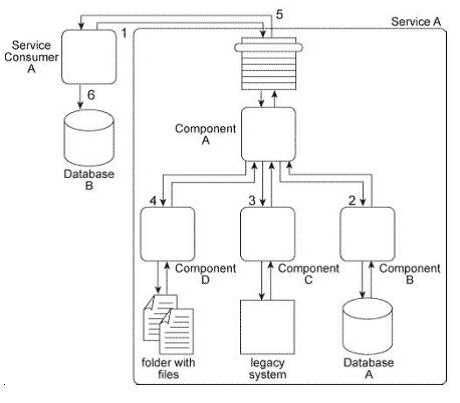
When Service A receives a message from Service Consumer A(1),the message is processed by
Component A . This component first invokes Component B (2), which uses values from the message
to query Database A in order to retrieve additional data. Component B then returns the additional
data to Component A . Component A then invokes Component C (3), which interacts with the API of
a legacy system to retrieve a new data value. Component C then returns the data value back to
Component A . Next, Component A sends some of the data it has accumulated to Component D (4),
which writes the data to a te>X file that is placed in a specific folder. Component D then waits until
this file is imported into a different system via a regularly scheduled batch import. Upon completion
of the import, Component D returns a success or failure code back to Component A . Component A
finally sends a response to Service Consumer A (5) containing all of the data collected so far and
Service Consumer A writes all of the data to Database B (6). Components A, B, C . and D belong to
the Service A service architecture. Database A, the legacy system, and the file folders are shared
resources within the IT enterprise.
 Service A is an entity service with a service architecture that has grown over the past few years. As a
result of a service inventory-wide redesign project, you are asked to revisit the Service A service
architecture in order to separate the logic provided by Components B, C, and D into three different
utility services without disrupting the behavior of Service A as it relates to Service Consumer A .
What steps can be taken to fulfill these requirements?
Service A is an entity service with a service architecture that has grown over the past few years. As a
result of a service inventory-wide redesign project, you are asked to revisit the Service A service
architecture in order to separate the logic provided by Components B, C, and D into three different
utility services without disrupting the behavior of Service A as it relates to Service Consumer A .
What steps can be taken to fulfill these requirements?
Service A is an entity service with a service architecture that has grown over the past few years. As a
result of a service inventory-wide redesign project, you are asked to revisit the Service A service
architecture in order to separate the logic provided by Components B, C, and D into three different
utility services without disrupting the behavior of Service A as it relates to Service Consumer A .
What steps can be taken to fulfill these requirements?Options
Q: 7
Service Consumer A invokes Service A (1). The logic within Service A is required to retrieve three
independent data values from Services B, C, and D and to then return these data values back to
Service Consumer A . To accomplish this, Service A begins by sending a request message to Service B
(2). After receiving a response message with the first data value from Service B, Service A sends a
request message to Service C (3). After it receives a response message with the second data value
from Service C, Service A then sends a request message to Service D (4). Upon receiving a response
message with the third data value from Service D . Service A finally sends its own response message
(containing all three collected data values) back to Service Consumer A . Service Consumer A and
Service A reside in Service Inventory A . Service B and Service C reside in Service Inventory B . Service
D is a public service that can be openly accessed via the World Wide Web. The service is also
available for purchase so that it can be deployed independently within IT enterprises. Due to the
rigorous application of the Service Abstraction principle within Service Inventory B, the only
information that is made available about Service B and Service C are the published service contracts.
For Service D, the service contract plus a Service Level Agreement (SLA) are made available. The SLA
indicates that Service D has a planned outage every night from 11 PM to midnight.
 You are an architect with a project team building services for Service Inventory A . You are told that
the owners of Service Inventory A and Service Inventory B are not generally cooperative or
communicative. Cross-inventory service composition is tolerated, but not directly supported. As a
result, no SLAs for Service B and Service C are available and you have no knowledge about how
available these services are. Based on the service contracts you can determine that the services in
Service Inventory B use different data models and a different transport protocol than the services in
Service Inventory A . Furthermore, recent testing results have shown that the performance of Service
D is highly unpredictable due to the heavy amount of concurrent access it receives from service
consumers from other organizations. You are also told that there is a concern about how long Service
Consumer A will need to remain stateful while waiting for a response from Service A . What steps can
be taken to solve these problems?
You are an architect with a project team building services for Service Inventory A . You are told that
the owners of Service Inventory A and Service Inventory B are not generally cooperative or
communicative. Cross-inventory service composition is tolerated, but not directly supported. As a
result, no SLAs for Service B and Service C are available and you have no knowledge about how
available these services are. Based on the service contracts you can determine that the services in
Service Inventory B use different data models and a different transport protocol than the services in
Service Inventory A . Furthermore, recent testing results have shown that the performance of Service
D is highly unpredictable due to the heavy amount of concurrent access it receives from service
consumers from other organizations. You are also told that there is a concern about how long Service
Consumer A will need to remain stateful while waiting for a response from Service A . What steps can
be taken to solve these problems?
You are an architect with a project team building services for Service Inventory A . You are told that
the owners of Service Inventory A and Service Inventory B are not generally cooperative or
communicative. Cross-inventory service composition is tolerated, but not directly supported. As a
result, no SLAs for Service B and Service C are available and you have no knowledge about how
available these services are. Based on the service contracts you can determine that the services in
Service Inventory B use different data models and a different transport protocol than the services in
Service Inventory A . Furthermore, recent testing results have shown that the performance of Service
D is highly unpredictable due to the heavy amount of concurrent access it receives from service
consumers from other organizations. You are also told that there is a concern about how long Service
Consumer A will need to remain stateful while waiting for a response from Service A . What steps can
be taken to solve these problems?Options
Q: 8
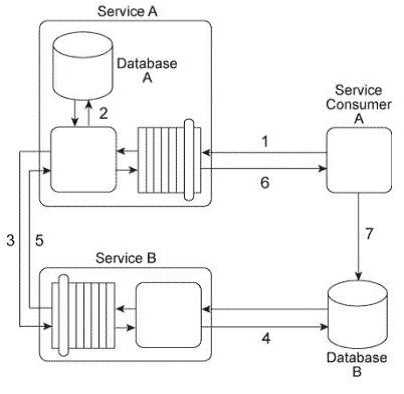
Service Consumer A sends a message with a business document to Service A (1), which writes the
business document to Database A (2). Service A then forwards the business document to Service B
(3), which writes the business document to Database B (4). Service B then responds to Service A with
a message containing a failure or success code (5) after which Service A responds to Service
Consumer A with a message containing a failure or success code (6). Upon receiving the message,
Service Consumer A updates a log table in Database B (7). The log entry is comprised of the entire
business document. Database A is dedicated to the Service A service architecture and Database B is a
shared database.
 There are two problems with this service composition architecture that you are asked to address:
First, both Service Consumer A and Service B need to transform the business document data from an
XML format to a proprietary Comma Separated Value (CSV) in order to write the data to Database B .
This has led to redundant data format transformation logic that has been difficult to keep in synch
when Database B changes. Secondly, Service A is an entity service that is being reused by several
other service compositions. It has lately developed reliability problems that have caused the service
to become unavailable for extended periods. What steps can be taken to solve these problems?
There are two problems with this service composition architecture that you are asked to address:
First, both Service Consumer A and Service B need to transform the business document data from an
XML format to a proprietary Comma Separated Value (CSV) in order to write the data to Database B .
This has led to redundant data format transformation logic that has been difficult to keep in synch
when Database B changes. Secondly, Service A is an entity service that is being reused by several
other service compositions. It has lately developed reliability problems that have caused the service
to become unavailable for extended periods. What steps can be taken to solve these problems?
There are two problems with this service composition architecture that you are asked to address:
First, both Service Consumer A and Service B need to transform the business document data from an
XML format to a proprietary Comma Separated Value (CSV) in order to write the data to Database B .
This has led to redundant data format transformation logic that has been difficult to keep in synch
when Database B changes. Secondly, Service A is an entity service that is being reused by several
other service compositions. It has lately developed reliability problems that have caused the service
to become unavailable for extended periods. What steps can be taken to solve these problems?Options
Q: 9
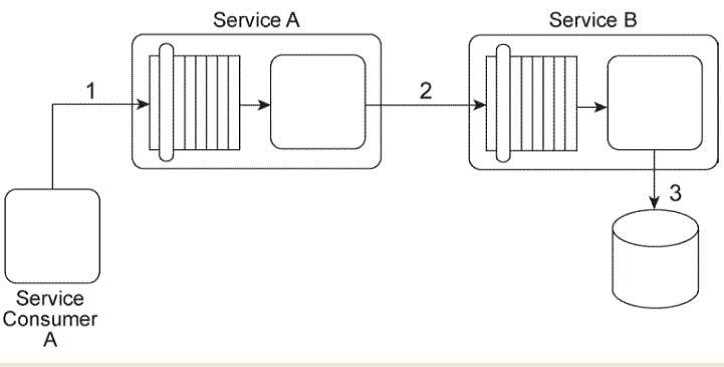
Service A is an entity service with a functional context dedicated to invoice-related processing.
Service B is a utility service that provides generic data access to a database. In this service
composition architecture, Service Consumer A sends a SOAP message containing an invoice XML
document to Service A(1). Service A then sends the invoice XML document to Service B (2), which
then writes the invoice document to a database. The data model used by Service Consumer A to
represent the invoice document is based on XML Schema A . The service contract of Service A is
designed to accept invoice documents based on XML Schema B . The service contract for Service B is
designed to accept invoice documents based on XML Schema A . The database to which Service B
needs to write the invoice record only accepts entire business documents in Comma Separated Value
(CSV) format.
 Due to the incompatibility of the XML schemas used by the services, the sending of the invoice
document from Service Consumer A through to Service B cannot be accomplished using the services
as they currently exist. Assuming that the Contract Centralization pattern is being applied and that
the Logic Centralization is not being applied, what steps can be taken to enable the sending of the
invoice document from Service Consumer A to the database without adding logic that will increase
the runtime performance requirements of the service composition?
Due to the incompatibility of the XML schemas used by the services, the sending of the invoice
document from Service Consumer A through to Service B cannot be accomplished using the services
as they currently exist. Assuming that the Contract Centralization pattern is being applied and that
the Logic Centralization is not being applied, what steps can be taken to enable the sending of the
invoice document from Service Consumer A to the database without adding logic that will increase
the runtime performance requirements of the service composition?
Due to the incompatibility of the XML schemas used by the services, the sending of the invoice
document from Service Consumer A through to Service B cannot be accomplished using the services
as they currently exist. Assuming that the Contract Centralization pattern is being applied and that
the Logic Centralization is not being applied, what steps can be taken to enable the sending of the
invoice document from Service Consumer A to the database without adding logic that will increase
the runtime performance requirements of the service composition?Options
Q: 10
You are told that in this service composition architecture, all four services are exchanging invoice
related data in an XML format. The services in Service Inventory A are standardized to use a specific
XML schema for invoice data. Design standards were not applied to the service contracts used in
Service Inventory B, which means that each service uses a different XML schema for the same kind of
data. Database A and Database B can only accept data in the Comma Separated Value (CSV) format
and therefore cannot accept XML formatted data. What steps can be taken to enable the planned
data exchange between these four services?
Options
Question 1 of 10
