Free PL-600 Practice Test Questions and Answers (2026)

View Mode
Q: 1

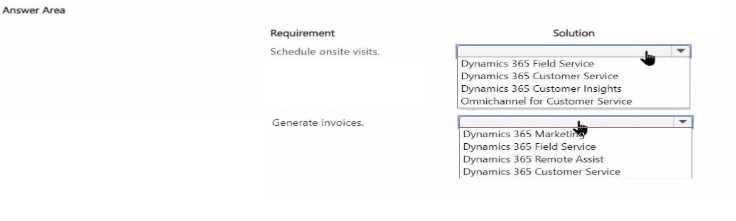
HOTSPOT A company plans to use Microsoft Dynamics 36S and Microsoft Power Platform. The company has the following requirements: • Schedule onsite visits for customers per availability. • Generate invoices based on services delivered to customers. You need to recommend a solution to meet the requirements. Which solutions should you recommend? To answer, select the appropriate options in the answer area. PL-600 question

Your Answer
19 comments in the community discussion
8
Not totally sure here, but for scheduling onsite visits I'd pick Dynamics 365 Field Service. For invoices, just Service. Can someone confirm if that's right?
5
Yeah that matches what I've seen, I'd pick Field Service for scheduling onsite visits and Service for generating invoices. Field Service handles resource booking, but Service fits better for invoice management in this context. Pretty sure that's what they're after but happy to hear if anyone disagrees.
Q: 2

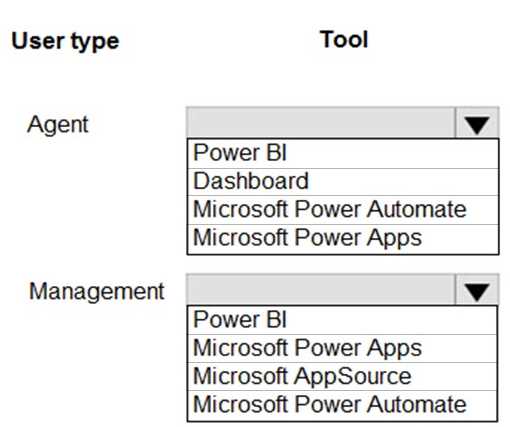
HOTSPOT You need to recommend tools for agents and management. Which tools should you recommend? To answer, select the appropriate option in the answer area. NOTE: Each correct selection is worth one point. PL-600 question

Your Answer
13 comments in the community discussion
7
Power Automate for agents (handles repetitive tasks fast), Power BI for management (for reporting and dashboards). Seen similar setups in official practice tests. Recommend focusing on Power Platform tool roles in the study guide.
2
Wouldn't Power Apps be better for agents in this scenario?
Q: 3

DRAG DROP You are assisting an engineering company with a project that will digitally transform the business with a new inspection app. You complete several requirements workshops with technicians and are in the process of confirming the requirements. You need to classify the functional and non-functional requirements for the client. How should you classify each requirement? To answer, move the appropriate classifications to the correct requirements. You may use each classification once, more than once, or not at all. You may need to move the split bar between panes or scroll to view content. NOTE: Each correct selection is worth one point. PL-600 question

Drag & Drop
13 comments in the community discussion
8
Automatically back up data for disaster recovery: Non-functionalAttach photos and videos to the current job: FunctionalClear job tasks in an inspection record as they are completed: FunctionalMaintain a response time of less than two seconds: Non-functional
5
Attach media and clear job tasks = Functional, backups and response time = Non-functional. Backup wording here is a trap since it's automatic (system feature), not user-driven. Not 100% but that's what's been on similar exam questions.
Q: 4

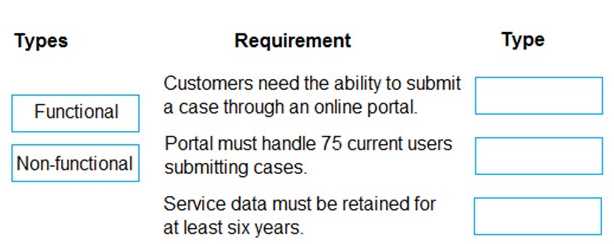
DRAG DROP You need to recommend methods for assigning security to each group of users. The customer provides the following requirements: Customers need the ability to submit a case through an online portal. Portal must handle 75 concurrent users submitting cases. Service data must be retained for at least six years. You need to determine which requirements are functional or non-functional. Which requirements are functional or non-functional? To answer, drag the appropriate types to the correct requirements. Each type may be used once, more than once, or not at all. You may need to drag the split bar between panes or scroll to view content. NOTE: Each correct selection is worth one point. PL-600 question

Drag & Drop
22 comments in the community discussion
5
Submit case through portal = Functional, 75 concurrent users = Non-functional, 6 years retention = Non-functional. Pretty sure that's correct since concurrency and retention are quality/constraint types, not specific behaviors. Easy to get tripped up thinking user count is functional though. Agree?
5
Submit case = Functional, 75 concurrent users = Non-functional, 6 years retention = Non-functional
Q: 5

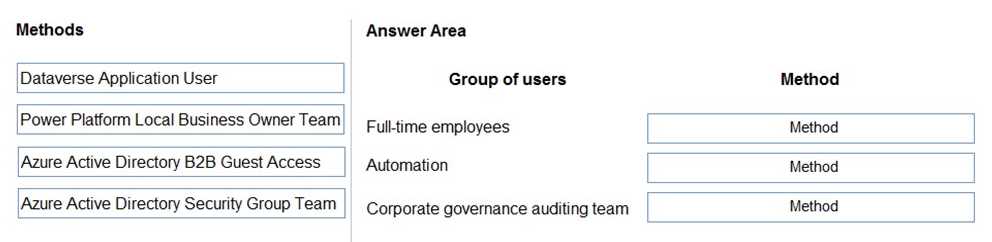
DRAG DROP You need to recommend methods for assigning security to each group of users. What should you recommend? To answer, drag the appropriate methods to the correct groups of users. Each method may be used once, more than once, or not at all. You may need to drag the split bar between panes or scroll to view content. NOTE: Each correct selection is worth one point. PL-600 question

Drag & Drop
19 comments in the community discussion
6
Careful here, if the corporate governance auditing team includes any B2B guests then you'd flip to Azure AD B2B Guest Access. Otherwise, keeping both employee and audit groups as Security Group Teams is correct, automation always maps to Dataverse Application User.
5
Full-time employees: Azure AD Security Group Team, Automation: Dataverse Application User, Corporate governance auditing team: Azure AD Security Group Team
Q: 6

DRAG DROP You need to configure Microsoft Dataverse to retrieve external data for the sales and construction departments. Which connection methods should you use? To answer, move the appropriate connection methods to the correct requirements. You may use each connection method once, more than once, or not at all. You may need to move the split bar between panes or scroll to view content. NOTE: Each correct selection is worth one point. PL-600 question

Drag & Drop
17 comments in the community discussion
6
dataflow → third-party marketing, virtual table → supplier data. Connector is the trap, not specific enough.
4
dataflow to marketing, virtual table to supplier. Saw similar in official guide, matches exam pattern.
Q: 7
A company is implementing Dynamics 365 Sales. The company has turned off out-of-the-box quote calculations in order to implement its own custom calculations. When users update a line item on a quote, they expect to see an updated total for the quote in real time. Users are reporting inconsistent behavior, with some aggregations taking up to two hours. You review the system design and notice many asynchronous workflows. You need to recommend a solution to enable the calculation in real time. Which two options should you recommend? Each answer presents a complete solution. NOTE: Each correct selection is worth one point.
Options
12 comments in the community discussion
2
Its A and D. Had something like this in a mock, only the synchronous workflows or plug-ins handle real-time updates after a line item changes. B stays async so won't fix it.
2
A vs D. If you need rollback within the transaction, only D (synchronous plug-in) truly guarantees that, not just any real-time workflow.
Q: 8
A company has a list of contacts in a Microsoft Excel file. The company wants to load the contact information into a Microsoft Power Platform solution. You need to recommend a data-loading solution. What should you recommend?
Options
13 comments in the community discussion
4
Option C. seen this on a few official practice tests and docs.
2
C here, B's Excel Template is just for structure but doesn't actually import data. C moves the contacts in directly.
Q: 9

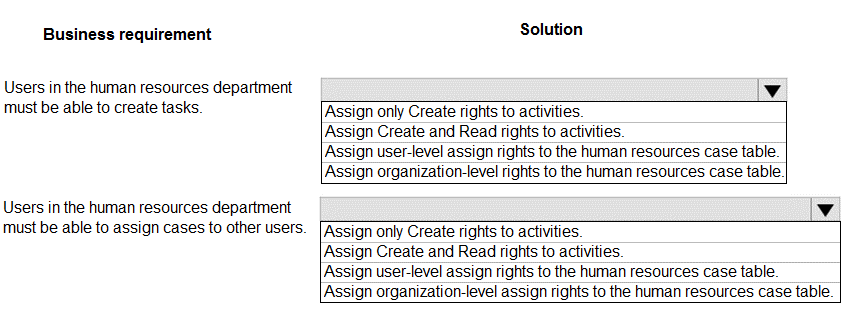
HOTSPOT You are designing a Power Platform solution for a company. You have the following requirements: Users in the human resources department must be able to create tasks. Users in the human resources department must be able to assign cases to other users. You need to recommend security settings to the company. What should you recommend? To answer, select the appropriate options in the answer area. NOTE: Each correct selection is worth one point. PL-600 question

Your Answer
13 comments in the community discussion
2
Assign, Create, Read on Activities plus org-level on HR Case-official docs and some exam labs cover this.
Assign, Create, and Read for Activities plus Organization-level on HR Case table is the way to go, I think. Sometimes 'user-level' tricks people here but it wouldn't let them assign any case, just their own. Anyone see a different angle?
Q: 10
You are a Microsoft Power Platform architect supporting the go-live phase of a canvas app. The canvas app accesses data on-premises and in the cloud. Users are reporting the app is very slow to respond, especially upon initial launch. You need to optimize the performance of the app. Which three actions should you complete? Each correct answer presents part of the solution. NOTE: Each correct selection is worth one point.
Options
16 comments in the community discussion
1
Its A, B, E. Not much doubt here. OnStart can really slow things down at launch, and bringing in too many rows hurts performance a lot. Checking the data gateway is also a classic step for on-prem issues. Open to being challenged but that's what I'd go with.
1
A B, E tbh. C is tempting but raising row limits makes it worse for app speed.
Q: 11

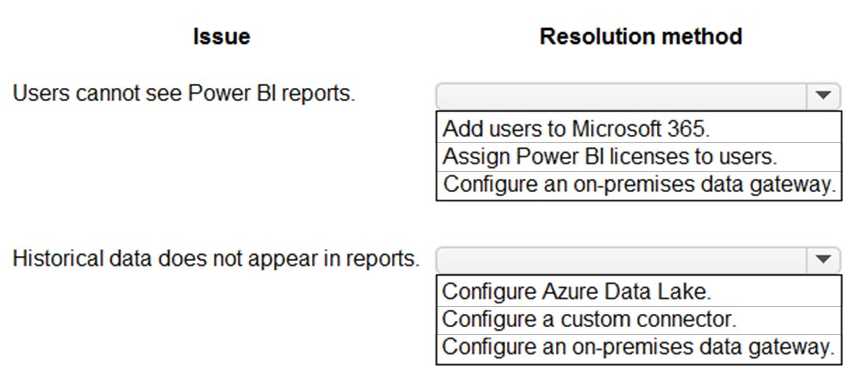
HOTSPOT You need to recommend methods to resolve the organization’s issues. What should you recommend? To answer, select the appropriate options in the answer area. NOTE: Each correct selection is worth one point. PL-600 question

Your Answer
5 comments in the community discussion
5
Assign licenses to users and configure an on-premises gateway. Clear options, matches what I saw in similar practice sets.
2
Assign licenses to users, set up an on-premises gateway. Had something like this in a mock-licensing is a must for Power BI access, and gateway covers the historical data from on-prem sources. Makes sense unless their data is fully in the cloud, but that's rarely the case.
Q: 12
You are creating a scope of work document for a solution. You have the following requirements: • Track support cases, first response time, and resolution time. • Include a chat-like interface that allows managers to check the status of cases with minimal manual searching. • Allow cases to have multiple different priority levels. You need to include the required Dynamics 365 and Microsoft Power Platform components. Which two components should you include? Each correct answer presents part of the solution. NOT: Each correct selection is worth one point.
Options
5 comments in the community discussion
D imo, since Customer Voice links with Dynamics and can collect feedback on cases, maybe it counts as a chat-like channel for updates? B is more for bots but the question isn't clear on real-time chat. Open to pushback.
Yeah, similar question showed up in my exam practice. A is for case management, tracking SLAs and priorities. B gives the chat interface with minimal manual searching. C and D wouldn't help with those direct requirements.
Q: 13

DRAG DROP You are designing a Microsoft Power Platform solution that will be deployed to two separate companies in the same Microsoft Office 365 tenant: Contoso, Ltd. and Contoso Pharmaceuticals. The solution must meet the following security requirements: • Restrict Contoso, Ltd. users from seeing the Contoso Pharmaceuticals company. • Restrict access to specific forms. • Restrict access to specific tables. What should you recommend? To answer, drag the appropriate security types to the correct restrictions. Each security type may be used once, more than once, or not at all. You may need to drag the split bar between panes or scroll to view content. NOTE: Each correct selection is worth one point. PL-600 question

Drag & Drop
5 comments in the community discussion
1
Security group -> Restrict Contoso, Ltd. users from seeing Contoso Pharmaceuticals; Security role -> Restrict access to specific forms & tables. Security groups are what actually block entire environments, but if these companies shared a Dataverse environment then Teams or Business Units could apply. Pretty s
Team → Restrict Contoso, Ltd. users from seeing Contoso Pharmaceuticals company. Security group doesn’t really control visibility at the company level in most app scenarios, I think Team makes more sense here. Security role for forms and tables is still right imo, but open to pushback.
Q: 14

DRAG DROP You are designing a solution to automate the following processes: • Import data into Microsoft Dataverse from systems that have an API available. • Import data into Microsoft Dataverse from systems that do not have an API available. • Validate that contacts in a Microsoft Excel file Dataverse forms in a specified order. You need to implement automation methods. Which components should you use' To answer, drag the appropriate components to the correct requirements. Each component may be used once, more than once, or not at all. You may need to drag the split bar between panes or scroll to view content. NOTE: Each correct selection is worth one point PL-600 question

Drag & Drop
5 comments in the community discussion
5
Man, I always get tripped up with these automation mapping ones. It should be:RPA → Interact with applications that do not have an API (since bots mimic user actions),Business process flow → Guide users through business steps in a specific order,Cloud flow → Inte
1
Pretty sure it's Robotic process automation for no API, Business process flow for guiding users, Cloud flow for API apps. Agree?
Q: 15

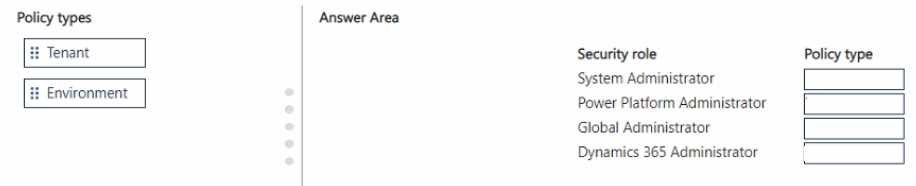
DRAG DROP A company plans to implement Microsoft Power Platform to provide data controls. The current implementation is complex and spans multiple environments. The IT team will implement DLP policies. Members of the team have different security roles applied to their user accounts, depending on their specified level of access. You need to identify which policies the IT team can apply for the different security roles. Which policy type should you recommend for each security role? To answer, move the appropriate policy types to the correct security roles. You may use each policy type once, more than once, or not at all. You may need to move the split bar between panes or scroll to view content. NOTE: Each correct selection is worth one point. PL-600 question

Drag & Drop
3 comments in the community discussion
Is the requirement to apply the most restrictive DLP policy first or just match their maximum authority? If they want least privilege or only environment-specific controls, that could switch a Tenant to Environment for some roles.
Q: 16

DRAG DROP A client plans to implement Microsoft Power Platform solutions. The client identifies the following requirements for handling opportunities: • Users must follow the same set of steps each time they process opportunities • For opportunities with values greater than $20,000, a follow-up date and second contact field must appear on the form. • An error message must display if a follow-up date is not within seven days of the opportunity creation date. You need to recommend tools to meet the client requirements. What should you recommend? To answer, drag the appropriate tools to the correct requirement. Each tool may be used once, more than once, or not at all. You may need to drag the split bar between panes or scroll to view content. NOTE: Each correct selection is worth one point. PL-600 question

Drag & Drop
6 comments in the community discussion
2
Saw something like this in a recent practice test. Mapping should be: Business process flow for same steps every time, Business Rule for both showing/hiding fields over $20k and enforcing the follow-up date rule. Pretty confident but open to other logic.
Business Rule -> steps users follow, Business process flow -> show fields, Workflows -> error message. Nice clear scenario setup.
Q: 17
A company is struggling to gather insights from won and lost opportunities. Users must be able to access the company's solution from mobile and desktop devices. The solution must meet the following requirements: • Track opportunities and reasons for the win or loss of opportunities in the context of other related data. • Display data to users as charts and tables and provide drill-through capabilities. You need to recommend a Microsoft Power Platform tool to help the client visualize the dat a. Which two technologies should you recommend? Each correct answer presents a complete solution. NOTE: Each correct selection is worth one point.
Options
5 comments in the community discussion
2
Pretty sure A and C. Power BI for visualization, Power Apps to collect and manage the opportunity data.
A is wrong, it's A and C. Power BI gives you all the drill-through reporting and flexible dashboards needed for insight. Power Apps is great for customizing data entry and managing opportunities on any device, so it checks the mobile/desktop access box. I've seen similar exam questions focus on these two tools. If a
Q: 18

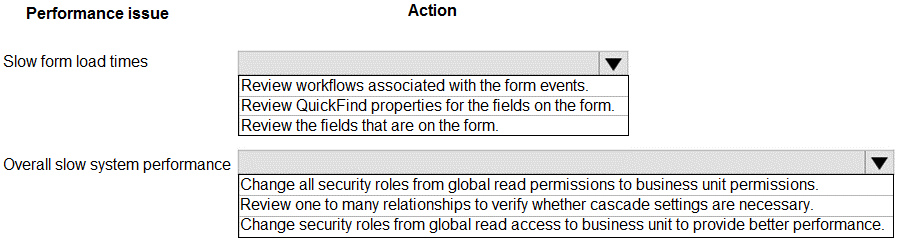
HOTSPOT You design a Power Platform solution for a customer. The solution uses Microsoft Dataverse as the data store. You are managing the go-live process for the solution. The customer reports the following performance issues: Form load time is much slower than it was during testing. Overall system performance has been significantly slower that it was during testing. You need to recommend how to troubleshoot system performance. Which actions should you recommend? To answer, select the appropriate options in the answer area. NOTE: Each correct selection is worth one point. PL-600 question

Your Answer
4 comments in the community discussion
3
Quick question: is "most" important here about what to check first, or is the focus on a complete troubleshooting checklist for all possible Dataverse slowness? Sometimes wording matters for whether you start with form fields or database relationships.
1
Review fields on form and review one to many relationships, especially cascade settings. Had something like this in a mock test.
Q: 19

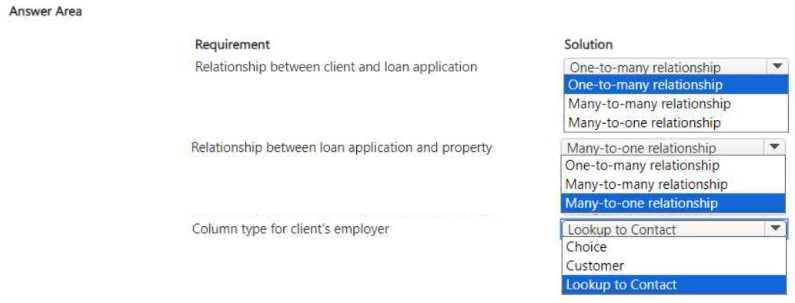
HOTSPOT You are designing a Microsoft Dataverse data model for a mortgage brokerage. The brokerage provides the following table and field information: The brokerage has the following data relationship requirements: • A client can have multiple loan applications, but each loan application must be associated with only one client • Each loan application must be associated with one property, but a property can be linked to multiple loan applications. • The employer the client works for must be added for employment verification. Employers are maintained in the Account table. You need to model the tables for Dataverse and set up relationships. Which data model solution should you use for each requirement? To answer, select the appropriate options in the answer area. NOTE: Each correct selection is worth one point. PL-600 question

Your Answer
3 comments in the community discussion
4
Kinda confused but here's what I think: for the client and loan app, it's one-to-many since one client can have several apps. For application-property, that's many-to-one (app ties to one property). And for employer column, I guess Customer type fits? Anyone else get the same?
2
Makes sense to me, it's one-to-many for client to applications, many-to-one for application to property, and Customer type for employer.
Q: 20

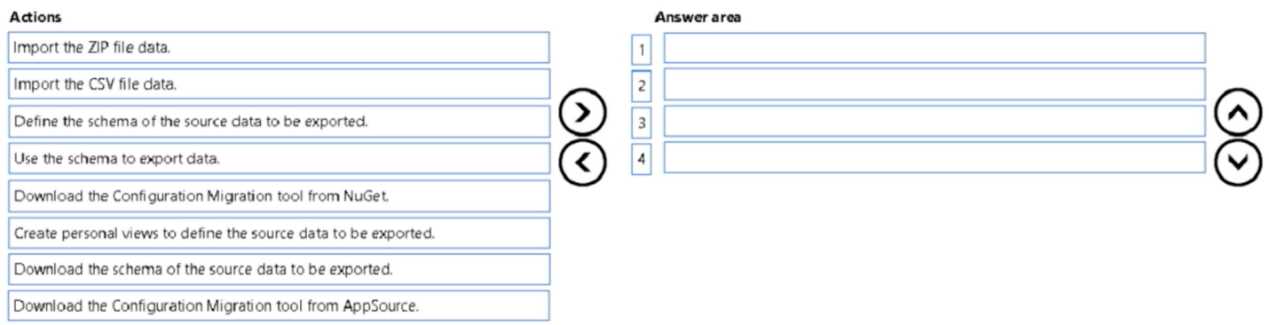
DRAG DROP You are a Microsoft Power Platform architect. You need to design a process to transport configuration and test data from one environment to a separate environment Which four actions should you recommend be performed in sequence? To answer, move the appropriate actions from the list of actions to the answer area and arrange them in the correct order. PL-600 question

Drag & Drop
4 comments in the community discussion
5
This drag drop is a mess, always throws me off. Mapping: Download from NuGet, define schema, export with schema, import ZIP file.
Define the schema, use schema to export data, import ZIP file, import CSV file. Had something like this in a mock.
Question 1 of 20

What's covered in this practice questions set

3: Implement the solution · 12 questions

📖 About this Domain

This domain covers the build and configuration phase of a Power Platform solution. It focuses on translating a solution design into functional components, configuring integrations, and implementing the security model. You will also learn the processes for testing the solution to ensure it meets requirements.

🎓 What You Will Learn

  • You will learn to configure Power Platform connectors, Azure services, and data synchronization processes for system integration.
  • You will learn to implement the Dataverse security model by configuring business units, security roles, and column security.
  • You will learn to create and configure solution components including model-driven apps, canvas apps, Power Automate flows, and Power BI reports.
  • You will learn to create test plans and perform functional, performance, and user acceptance testing (UAT) to validate the solution.

🛠️ Skills You Will Build

  • You will build the skill to implement complex integrations using connectors and Azure services like Azure Functions.
  • You will build the ability to configure a granular security architecture using business units, security roles, and hierarchy security.
  • You will build proficiency in low-code development of apps, flows, and reports to meet specified business logic.
  • You will build quality assurance skills by creating test cases, executing tests, and troubleshooting solution defects.

💡 Top Tips to Prepare

  • Gain hands-on experience configuring custom connectors and integrating with Azure services to handle complex data scenarios.
  • Master the Dataverse security model by building and testing different security role configurations in a development environment.
  • Practice building a complete solution with multiple components, such as a model-driven app interacting with a canvas app via a Power Automate flow.
  • Familiarize yourself with testing tools like Power Apps Test Studio and the Power Platform solution checker to automate and validate your work.

1: Perform solution envisioning and requirement analyses · 4 questions

📖 About this Domain

This domain covers the initial discovery phase of a Power Platform project. You will focus on translating stakeholder business problems into actionable functional and non-functional requirements. The core task is to envision a solution and assess its feasibility within the Power Platform ecosystem.

🎓 What You Will Learn

  • Learn to initiate solution planning by evaluating business requirements to propose high-level Power Platform solutions.
  • Master requirement gathering through stakeholder workshops, gap analysis, and prioritization using frameworks like MoSCoW.
  • Practice identifying and mapping business needs to specific Power Platform components including Dataverse, Power Apps, and Power Automate flows.
  • Understand how to perform a fit/gap analysis to determine where standard Power Platform capabilities meet requirements versus where custom development is needed.

🛠️ Skills You Will Build

  • Build proficiency in stakeholder engagement to elicit, document, and validate solution requirements.
  • Develop strong requirements engineering skills, creating artifacts like user stories, process flows, and data models.
  • Gain the ability to define a high-level solution architecture and scope, identifying all necessary Power Platform services.
  • Learn to perform comprehensive feasibility assessments, identifying project risks, constraints, and key dependencies.

💡 Top Tips to Prepare

  • Focus on the methodologies for conducting requirement elicitation workshops and performing a thorough gap analysis.
  • Deeply understand the capabilities and limitations of each Power Platform component to perform an accurate fit/gap analysis.
  • Practice requirement prioritization techniques like MoSCoW to define minimum viable product (MVP) scope.
  • Study official Microsoft documentation and case studies on translating business needs into Power Platform solution blueprints.

2: Architect a solution · 4 questions

📖 About this Domain

This domain covers the translation of business requirements into a functional and technical design for a Power Platform solution. It involves defining the overall solution architecture, including components, infrastructure, and data models. You will focus on creating a blueprint that guides the development and deployment lifecycle.

🎓 What You Will Learn

  • You will learn to evaluate business requirements and map them to specific Power Platform capabilities and solution components.
  • You will learn to design the solution infrastructure, including the security model, data migration, and integration strategies.
  • You will learn to architect a complete application lifecycle management (ALM) strategy, defining source control, deployment, and automation.
  • You will learn to validate the solution design, including the data model and overall component architecture for feasibility.

🛠️ Skills You Will Build

  • You will build the skill to create detailed solution architecture diagrams and design documents.
  • You will build proficiency in designing scalable Dataverse security models using business units, security roles, and teams.
  • You will build competency in formulating an ALM strategy that incorporates environment management, solutions, and source control.
  • You will build the ability to design complex integration patterns using connectors, custom APIs, and Azure services.

💡 Top Tips to Prepare

  • Master the capabilities and limitations of each Power Platform component to make correct architectural decisions.
  • Focus on environment strategy design as it is foundational to security, ALM, and governance.
  • Understand the different data migration and integration tools and patterns available for Dataverse.
  • Practice designing ALM processes using Azure DevOps or GitHub, including branching strategies and pipeline automation.

Premium Access Includes

  • Quiz Simulator
  • Exam Mode
  • Progress Tracking
  • Question Saving
  • Flash Cards
  • Drag & Drops
  • 3 Months Access
  • PDF Downloads
Get Premium Access
Scroll to Top

FLASH OFFER

Days
Hours
Minutes
Seconds

avail 10% DISCOUNT on YOUR PURCHASE