Here is the analysis of the provided question based on the specified guidelines.
1. Understand and Evaluate Provided Material
Question Intent: The question assesses the understanding of how Pega decision strategies interact with the rules they call, specifically scorecard rules. It tests the core Pega principles of modularity, rule resolution, and data context. The key scenario is an update to the internal logic of a called rule (the scorecard) and the resulting impact on the calling rule (the decision strategy). Technical Analysis: A decision strategy orchestrates the execution of various decisioning components. A scorecard component within a strategy executes a specific scorecard rule. Pega's architecture is built on dynamic rule resolution, meaning the strategy will automatically use the most appropriate version of the scorecard rule at runtime. Furthermore, rules executed within a strategy share a common data context, typically the strategy's primary page. If the scorecard is updated to use a property that is already present in this shared context, the strategy itself does not need to be modified.
2. Provide the Correct Answer
Correct Answer: C
Explanation: Pega rules are designed to be modular and reusable. A decision strategy provides the data context (the primary page) and invokes other rules, like scorecards, to perform specific calculations. The internal logic of the scorecard is encapsulated and independent of the strategy. Due to Pega's automatic rule resolution, when the strategy runs, it will execute the latest version of the scorecard rule. If the new property (customer income) is already available in the strategy's data context (e.g., as part of the customer data), no changes are required in the strategy itself for the updated scorecard logic to be used. Why Incorrect Options are Wrong:
A. Remap the scorecard property in the decision strategy for the change to take effect. This is only necessary if the scorecard uses explicit parameters that are not yet mapped. A common and valid design pattern relies on a shared data context, which would not require remapping.
B. Add a new Group By component for the mortgage limit calculation. The Group By component is used for data aggregation (e.g., sum, count, average) across multiple records, which is not relevant to updating the inputs for a single score calculation.
D. A new proposition filter needs to be configured in the strategy to filter on customer income. A Proposition Filter component is used to include or exclude propositions from the decision process. It does not provide input data for a scorecard calculation.
3. References
1. Pega Platform 8.8 Help, "Scorecard component": This document states, "The scorecard rule runs in the context of the strategy that calls it. The results of the scorecard rule are placed on the strategy's primary page and can be accessed by the other components of the strategy." This supports the principle of a shared data context, where the scorecard can access data prepared by the strategy without explicit parameter passing for every property.
2. Pega Platform 8.8 Help, "How the system finds rules at run time": This document details the rule resolution algorithm. It explains, "At run time, the system uses the rule resolution algorithm to find and run the correct version of a rule." This confirms that the strategy will automatically invoke the updated scorecard without needing to be manually changed to reference the new version. The linkage is dynamic.
3. Pega Academy, Decisioning Consultant 8.8, "Invoking a scorecard" module: This courseware demonstrates that while explicit mapping is an option in the scorecard component's properties, scorecards operate on the primary page context established by the strategy. If the required data is already on this page, changes to the scorecard's internal logic to use more of that data do not necessitate a change in the strategy that establishes the context.

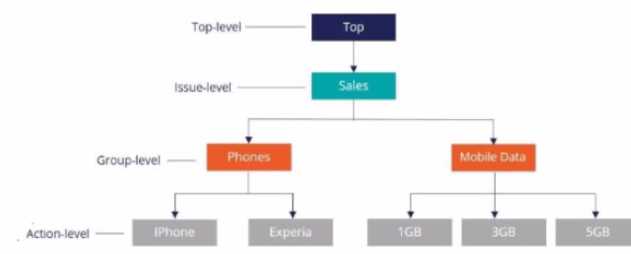 The company wants to present offers from both the groups and arbitrate across the two groups to
select the best offer based on customer behavior.
As a decisioning architect, what must you do to present offers from the two groups?