Free MB-500 Practice Test Questions and Answers (2026)

View Mode
Q: 1

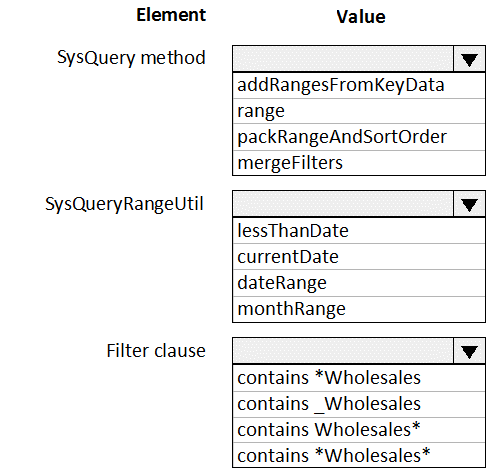
HOTSPOT You have a Dynamics 365 Finance and Operations development environment. You must add default filters to the fleet management form. You must view only sales that occur in the current sales period and where the Customer name field contains the next Wholesales. You need to configure filtering. What should you do? To answer, select the appropriate options in the answer area. NOTE: Each correct selection is worth one point. MB-500 question

Your Answer
Q: 2

You are a Dynamics 365 Finance developer. You have a table named FMVehicle that contains a field named Vehicleld. The table has a clustered index named Vehicleldldx on the Vehicleld field. You declare a table buffer named vehicle to refer to the table. You need to select all records from the FMVehicle table in ascending order based on Vehicleld field in the vehicle variable. Which embedded-SQL statement should you use? MB-500 question

Options
Q: 3

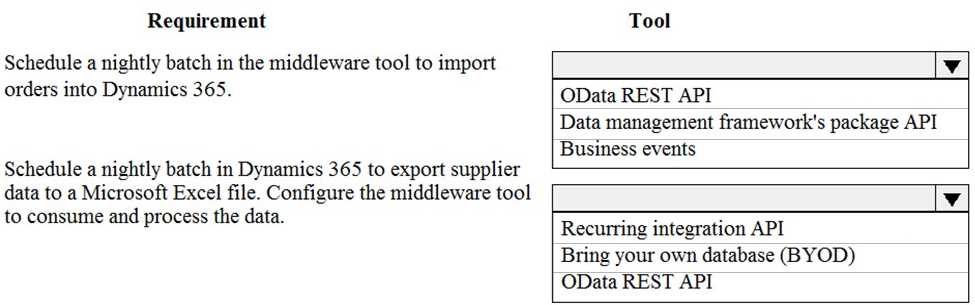
HOTSPOT A company has a cloud-based Dynamics 365 Finance environment and uses an e-commerce website for retail operations. The website has business to business (B2B) capabilities. The company uses a middleware integration tool to process data. You must create a batch job to automate some operations. The batch job must be able to process several thousand transactions in each run. You need to configure the environment. Which tools should you use? To answer, drag the appropriate tools to the correct requirements. Each tool may be used once, more than once, or not at all. You may need to drag the split bar between panes or scroll to view content. NOTE: Each correct selection is worth one point. MB-500 question

Your Answer
Q: 4
You are a Dynamics 365 Finance developer. You create a class. You need to mark the class to ensure that when code is compiled, the process fails if a specific method is called in the source code. Which attribute should you use?
Options
Q: 5

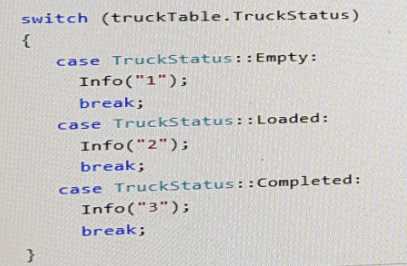
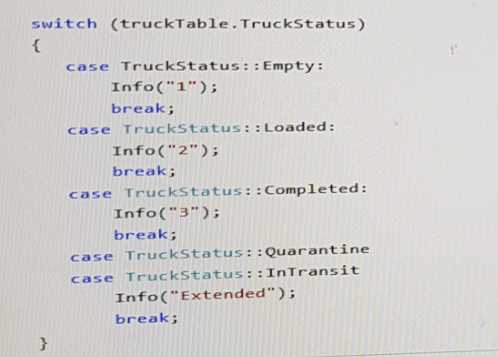
You have an enumeration named truckStatus that has the following statuses: • Empty • Loaded • Completed You have the following code: MB-500 question You need to extend this (enumeration and add the following statuses to the enumeration: Quarantine, InTransit. You must then modify code that validates the switch statement. Solution: Add a new case statement in the model of the existing code. MB-500 question Does the solution meet the goal?
Options
Q: 6

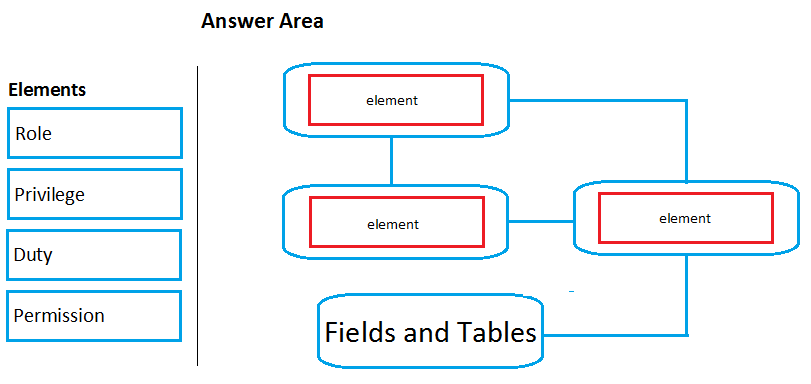
DRAG DROP A company uses Dynamics 365 Unified Operations. You need to implement role-based security for a set of fields in a table. How should you arrange the security elements? To answer, drag the appropriate security elements to the correct locations. Each element may be used once, more than once, or not at all. You may need to drag the split bar between panes or scroll to view content. NOTE: Each correct selection is worth one point. MB-500 question

Drag & Drop
Q: 7

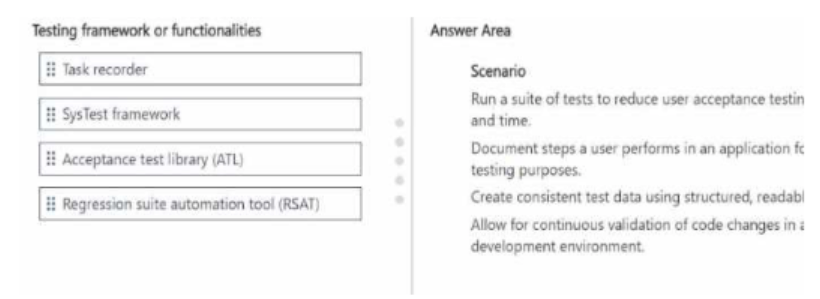
DRAG DROP A company uses Dynamics 365 finance and operations apps. The company must ensure employees use best practices when performing data validation and functional, regression, and user acceptance testing in the finance and operations apps. You need to select the correct testing framework or functionality. Which testing framework or functionality should you use in each scenario? To answer, drag the appropriate testing frameworks or functionalities to the correct scenarios. Each testing framework or functionality may be used once, more than once, or not at all. You may need to drag the split bar between panes or scroll to view content. NOTE: Each correct selection is worth one point..

Drag & Drop
Q: 8
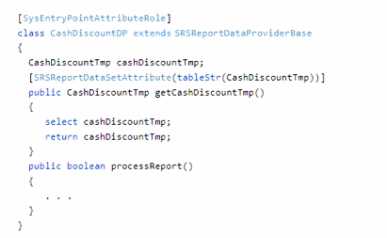
You need to update the CashDisc report to meet the requirements. What should you do?
Options
Q: 9

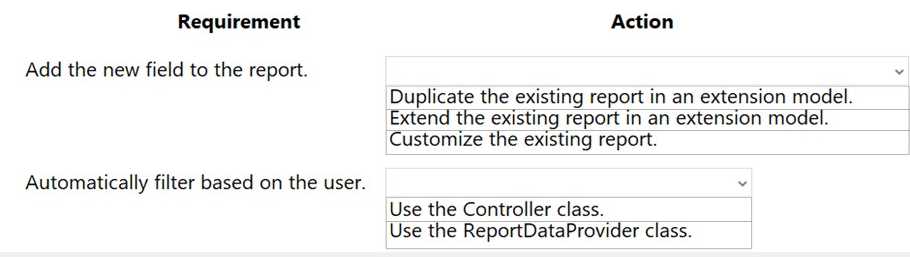
HOTSPOT A company requires a change to one of the base Microsoft SQL Server Reporting Services (SSRS) reports. The report must include a new field that automatically filters the report based on the user who opens the report. You need to add the new field as specified. What should you do? To answer, select the appropriate options in the answer area. NOTE: Each correct selection is worth one point. MB-500 question

Your Answer
Q: 10
You are using the SysTest framework to test code in Visual Studio. You need to create a unit test class. Which three attributes can you use to create the class? Each correct answer presents a complete solution. NOTE: Each correct selection is worth one point.
Options
Q: 11

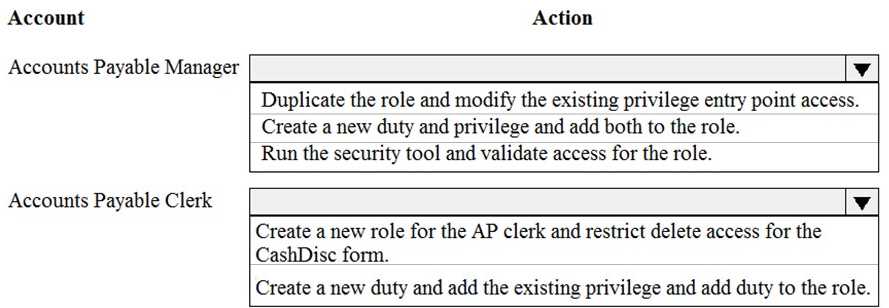
HOTSPOT You need to configure security for the CashDisc form. What changes should you make? To answer, select the appropriate options in the answer area. NOTE: Each correct selection is worth one point. MB-500 question

Your Answer
Q: 12

DRAG DROP A company uses Dynamics 365 Finance. The company plans to send banking information by using Electronic reporting (ER). You need to create an ER data model. In which order should you perform the actions? To answer, move all actions from the list of actions to the answer area and arrange them in the correct order. NOTE: More than one order of answer choices is correct. You will receive credit for any of the correct orders you select.


Drag & Drop
Q: 13

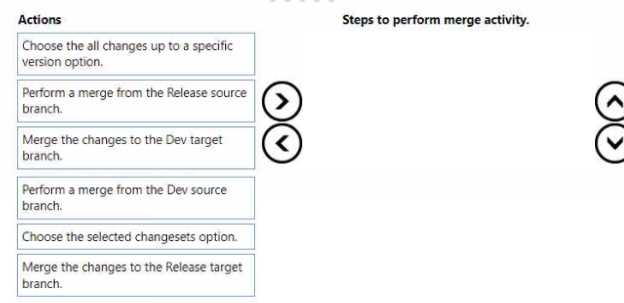
DRAG DROP You must merge the code change that you performed and which was tested by QA to the production environment. You need to merge a specific changeset. Which three actions should you perform in sequence? To answer, move the appropriate actions from the list of actions to the answer area and arrange them in the correct order. MB-500 question

Drag & Drop
Q: 14

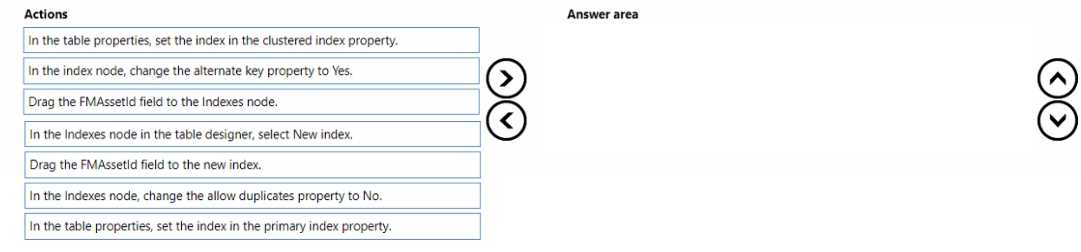
DRAG DROP You create a table in Dynamics 365 Finance. You must create a unique index from an existing field named FMAssetld You need to set the index as the primary key of the table after you create the index. Which four actions should you perform in sequence? To answer, move the appropriate actions from the list of actions to the answer area and arrange them in the correct order. MB-500 question

Drag & Drop
Q: 15

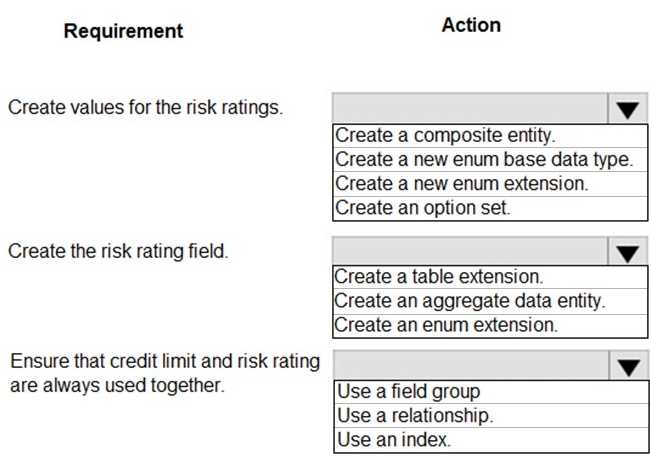
HOTSPOT A company is implementing Dynamics 365 Finance. Vendors receive a risk rating that is determined by their on-time delivery performance as well as their credit rating. You need to implement the following risk rating functionality: The risk rating must accompany the credit rating when the credit rating is used. The risk rating must be able to be used in other areas of the solution to determine processing outcomes. The risk rating must consist of the following values: 1 = Good 2 = Medium 3 = Risky The risk rating must be displayed in the Miscellaneous Details tab below the Credit Rating and Credit Limit fields in the Vendor form. What should you do? To answer, select the appropriate options in the answer area. NOTE: Each correct selection is worth one point. MB-500 question

Your Answer
Q: 16
Note: This question is part of a series of questions that present the same scenario. Each question in the series contains a unique solution that might meet the stated goals. Some question sets might have more than one correct solution, while others might not have a correct solution. After you answer a question in this section, you will NOT be able to return to it. As a result, these questions will not appear in the review screen. You are adding a new field to the SalesTable form. You must use an extension to add a status field onto the form. You need to create the extension in the Application Object Tree (AOT) and add the extension to the demoExtensions model. Solution: Navigate to the user interface forms section for the SalesTable form and create a customization. Does the solution meet the goal?
Options
Q: 17
You have a table in which multiple properties must be changed. Multiple table properties are locked down at the base table and must not be overwritten. You need to modify the table properties by extending the table. Which table property can you populate in a table extension by using the property sheet?
Options
Q: 18

HOTSPOT You have the following code: MB-500 question For each of the following statements, select Yes if the statement is true. Otherwise, select No. NOTE: Each correct selection is worth one point. MB-500 question

Your Answer
Q: 19

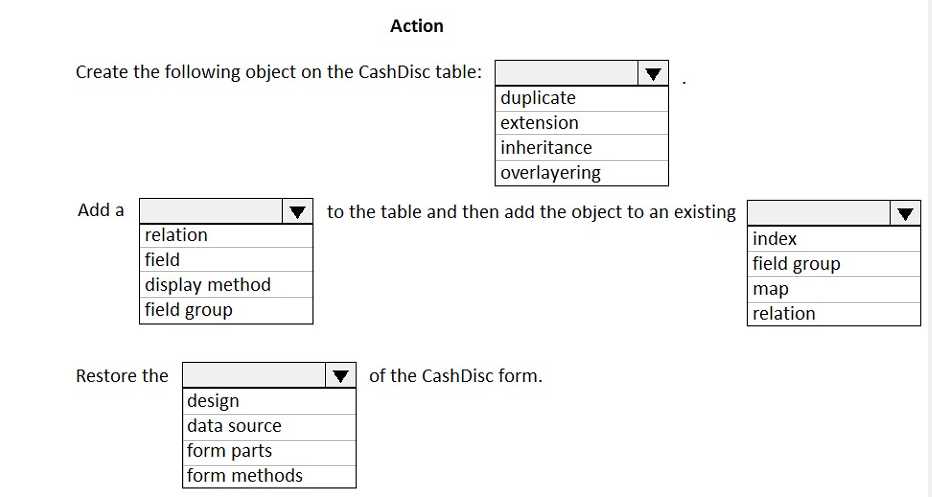
HOTSPOT You need to modify the CashDisc form to meet the requirements. Which objects should you use? To answer, select the appropriate options in the answer area. NOTE: Each correct selection is worth one point. MB-500 question
Your Answer
Q: 20

You are a Dynamics 365 Finance developer. You make changes to an existing class. You need to compare the code that is in source control with the updated class. In Visual Studio, you display Team Explorer. What are three possible ways to achieve the goal? Each correct answer presents a complete solution. NOTE: Each correct selection is worth one point.

Options
Question 1 of 20

What's covered in this practice questions set

4: Develop and test code · 10 questions

📖 About this Domain

This domain covers the implementation of X++ business logic and objects within the Finance and Operations development environment. You will focus on creating and extending application elements, applying coding standards, and executing unit tests to validate functionality.

🎓 What You Will Learn

  • You will learn to develop X++ code by creating tables, forms, and classes using Visual Studio development tools.
  • You will learn to implement object-oriented programming principles, including inheritance and polymorphism, within the X++ language.
  • You will learn to extend application functionality using extensions, event handlers, and Chain of Command (CoC).
  • You will learn to implement the SysTest framework to create and execute unit and component tests for your code.

🛠️ Skills You Will Build

  • You will build the skill to write, debug, and optimize X++ code for business logic and data manipulation.
  • You will build the skill to create and modify user interface elements, including forms, menus, and reports.
  • You will build the skill to apply the extension model to customize standard application artifacts without overlayering.
  • You will build the skill to author automated tests using the test framework to ensure code quality and regression prevention.

💡 Top Tips to Prepare

  • Focus on hands-on practice in a development environment to build and extend AOT elements like tables, forms, and classes.
  • Master the Chain of Command (CoC) and event handler patterns as they are critical for extensibility and frequently tested.
  • Understand the structure and implementation of the SysTest framework for creating and running unit tests.
  • Review Microsoft's best practices for X++ development, including naming conventions and performance optimization patterns.

7: Implement security and optimize performance · 3 questions

📖 About this Domain

This domain covers implementing role-based security and segregation of duties in Finance and Operations apps. It also details performance optimization using tools like the Performance SDK and Trace Parser for system monitoring.

🎓 What You Will Learn

  • Learn to implement role-based security by creating and modifying security roles, duties, and privileges.
  • Learn to configure and validate segregation of duties (SoD) rules to meet compliance requirements.
  • Learn to use the Performance SDK for load testing and Trace Parser to analyze performance traces for bottlenecks.
  • Learn to monitor system health and performance using Lifecycle Services (LCS) tools and telemetry.

🛠️ Skills You Will Build

  • Build skills in designing and implementing security models using the Security Configuration form and Extensible Data Security (XDS) policies.
  • Build skills to diagnose performance issues by capturing and analyzing traces with Trace Parser and SQL Profiler.
  • Build skills to execute performance and load testing scenarios using the Performance SDK and Azure DevOps.
  • Build skills in proactive system monitoring through LCS Environment Monitoring and telemetry analysis.

💡 Top Tips to Prepare

  • Get hands-on experience in a dev environment creating custom security roles, duties, and privileges.
  • Practice using the Performance SDK to simulate user loads and become proficient with Trace Parser to dissect performance captures.
  • Familiarize yourself with the monitoring and diagnostics tools in Lifecycle Services (LCS), including SQL insights.
  • Study the security architecture, focusing on the hierarchy of roles, duties, privileges, and permissions.

6: Integrate and manage data solutions · 3 questions

📖 About this Domain

This domain covers the technical implementation of data integration and management within Dynamics 365 Finance and Operations apps. It focuses on the Data Management Framework (DMF), integration patterns like OData and business events, and the dual-write framework for Dataverse synchronization. You will learn to manage data entities and execute data migration strategies.

🎓 What You Will Learn

  • You will learn to implement synchronous and asynchronous integration patterns using OData, custom services, and business events for real-time and batch data exchange.
  • You will learn to create and configure data entities, manage data projects, and execute data import/export jobs using the Data Management Framework (DMF).
  • You will learn to configure and troubleshoot the dual-write framework for bidirectional, near-real-time integration between Finance and Operations apps and Dataverse.
  • You will learn to plan and execute data migration from legacy systems by using DMF, data packages, and data validation processes.

🛠️ Skills You Will Build

  • You will build skills in creating, extending, and securing data entities in Visual Studio to expose application data for integration and data management.
  • You will build skills to configure and consume OData endpoints and custom services for external application integration.
  • You will build skills to set up, map entities, and troubleshoot data synchronization issues within the dual-write framework.
  • You will build skills to orchestrate complex data migration scenarios using DMF, including sequencing, error handling, and performance tuning.

💡 Top Tips to Prepare

  • Gain hands-on experience creating data entities, configuring data projects, and running import/export jobs in a development environment to master the Data Management Framework (DMF).
  • Focus on the setup process, entity mapping, and common troubleshooting steps for dual-write integration with Dataverse.
  • Use tools like Postman to interact with Finance and Operations OData endpoints and understand how to create and expose custom services.
  • Learn how to configure business events in Finance and Operations and consume them using Azure Logic Apps for event-driven integration scenarios.

3: Design and develop AOT elements · 2 questions

📖 About this Domain

This domain covers core development within the Application Object Tree (AOT) using Visual Studio. You will create and extend metadata elements defining the application's data structure, user interface, and business logic. These skills are fundamental for customizing Dynamics 365 Finance and Operations.

🎓 What You Will Learn

  • You will learn to define data models by creating new tables, adding fields, and extending existing tables using table extensions.
  • You will learn to design user interfaces by creating forms, adding data sources, and arranging controls using form patterns.
  • You will learn to implement base and extended data types (EDTs) and enumerations (enums) to enforce data consistency.
  • You will learn to write X++ business logic by creating new classes, extending standard classes, and utilizing event handlers.

🛠️ Skills You Will Build

  • You will build the skill to design relational data models by creating tables, defining relations, and setting table properties.
  • You will build the skill to construct responsive forms by applying form patterns, data sources, and control properties.
  • You will build the skill to implement business logic using X++ classes, inheritance, and event-driven programming.
  • You will build the skill to create and modify security artifacts like duties, privileges, and permissions to control user access.

💡 Top Tips to Prepare

  • Focus on the correct use of table extensions and event handlers instead of overlayering, as this is the standard extensibility model.
  • Practice applying form patterns as they are critical for building consistent user interfaces and are heavily tested.
  • Gain hands-on experience creating and modifying security roles, duties, and privileges in Visual Studio to understand the security framework.
  • Spend significant time navigating the AOT in Visual Studio to understand the properties of different elements like EDTs, tables, and forms.

5: Implement reporting · 1 questions

📖 About this Domain

This domain focuses on designing, creating, and deploying reporting solutions within Dynamics 365 Finance and Operations apps. It covers key reporting frameworks like SSRS, Electronic reporting (ER), and the Financial reporting tool. You will manage the full lifecycle of reporting artifacts.

🎓 What You Will Learn

  • You will learn to design and create custom reports using Visual Studio, SSRS, and Report Data Provider (RDP) classes.
  • You will learn to implement and configure Electronic reporting (ER) for business documents and statutory reporting.
  • You will learn to configure and generate financial statements using the Financial reporting tool's row definitions and column definitions.
  • You will learn to manage the lifecycle of reporting artifacts, including migration and deployment via deployable packages.

🛠️ Skills You Will Build

  • You will build skills in developing complex SSRS reports by creating data contracts, RDP classes, and designing layouts.
  • You will build proficiency in configuring the ER framework by defining data models, model mappings, and format configurations.
  • You will build the ability to generate dynamic financial statements by manipulating building blocks within the Financial reporting tool.
  • You will build skills in executing report deployment strategies using Application Lifecycle Management (ALM) and deployable packages.

💡 Top Tips to Prepare

  • Gain hands-on experience by building a complete SSRS report, from the AOT query to the final design deployment.
  • Practice creating a full ER configuration for a common business document like a vendor payment file.
  • Manipulate default financial reports and create a new one using the Financial reporting tool in a dev environment.
  • Thoroughly review the Microsoft Learn modules on reporting and analytics for Finance and Operations apps.

2: Apply developer and administration tools · 1 questions

📖 About this Domain

This domain covers the essential developer and administration tools used in Dynamics 365 Finance and Operations apps. You will explore Visual Studio for X++ development, Lifecycle Services (LCS) for environment management, and Azure DevOps for source control. Mastering these tools is critical for managing the application lifecycle management (ALM) process.

🎓 What You Will Learn

  • Utilize Visual Studio and its specific extensions to develop and debug X++ code, create models, and manage application objects.
  • Implement version control strategies using Azure DevOps to manage source code, track changes, and collaborate on development projects.
  • Leverage Lifecycle Services (LCS) to deploy and maintain cloud-hosted environments, manage assets, and use monitoring and diagnostics tools.
  • Use performance and monitoring tools, including Trace Parser and Performance SDK, to diagnose and resolve system performance issues.

🛠️ Skills You Will Build

  • Configure and manage a complete Application Lifecycle Management (ALM) process using Azure DevOps and Lifecycle Services (LCS).
  • Develop, debug, and test custom X++ solutions within the Visual Studio integrated development environment (IDE).
  • Administer and maintain D365 F&O environments, including deploying packages and monitoring system health through LCS.
  • Execute source code management tasks, such as branching, merging, and resolving conflicts using TFVC or Git in Azure DevOps.

💡 Top Tips to Prepare

  • Gain hands-on experience by deploying a cloud-hosted development environment through LCS and connecting it to an Azure DevOps project.
  • Practice creating a new model, adding AOT elements like tables and forms in Visual Studio, and checking the code into version control.
  • Familiarize yourself with the LCS Business process modeler (BPM) and the various tools available in the Asset library.
  • Review the process for creating and applying a deployable package to a UAT or sandbox environment from LCS.

1: Plan architecture and solution design

📖 About this Domain

This domain covers gathering business requirements and performing a gap-fit analysis. You will define the solution architecture using Lifecycle Services (LCS) and create design documents. It is the foundational planning phase for a Dynamics 365 Finance and Operations implementation.

🎓 What You Will Learn

  • Learn to conduct a gap-fit analysis to identify required extensions versus standard functionality.
  • Learn to design a solution architecture, including application components and infrastructure requirements.
  • Learn to create functional design documents (FDDs) that detail customizations for developers.
  • Learn to map business requirements to specific D365 F&O application modules and features.

🛠️ Skills You Will Build

  • Build skills in translating business needs into a technical solution architecture for D365 F&O.
  • Build proficiency in using Lifecycle Services (LCS) for environment planning and business process modeling.
  • Build the ability to document solution designs, including FDDs for extensions and integrations.
  • Build competence in planning data management strategies for migration and integration scenarios.

💡 Top Tips to Prepare

  • Master the Lifecycle Services (LCS) toolset, focusing on the Business process modeler (BPM) and environment planning.
  • Thoroughly understand the gap-fit analysis process and how to document outcomes for customizations.
  • Practice creating a Functional Design Document (FDD) for a common extension scenario.
  • Review Microsoft's solution architecture patterns and implementation methodologies for D365 F&O.

Premium Access Includes

  • Quiz Simulator
  • Exam Mode
  • Progress Tracking
  • Question Saving
  • Flash Cards
  • Drag & Drops
  • 3 Months Access
  • PDF Downloads
Get Premium Access
Scroll to Top

FLASH OFFER

Days
Hours
Minutes
Seconds

avail 10% DISCOUNT on YOUR PURCHASE