
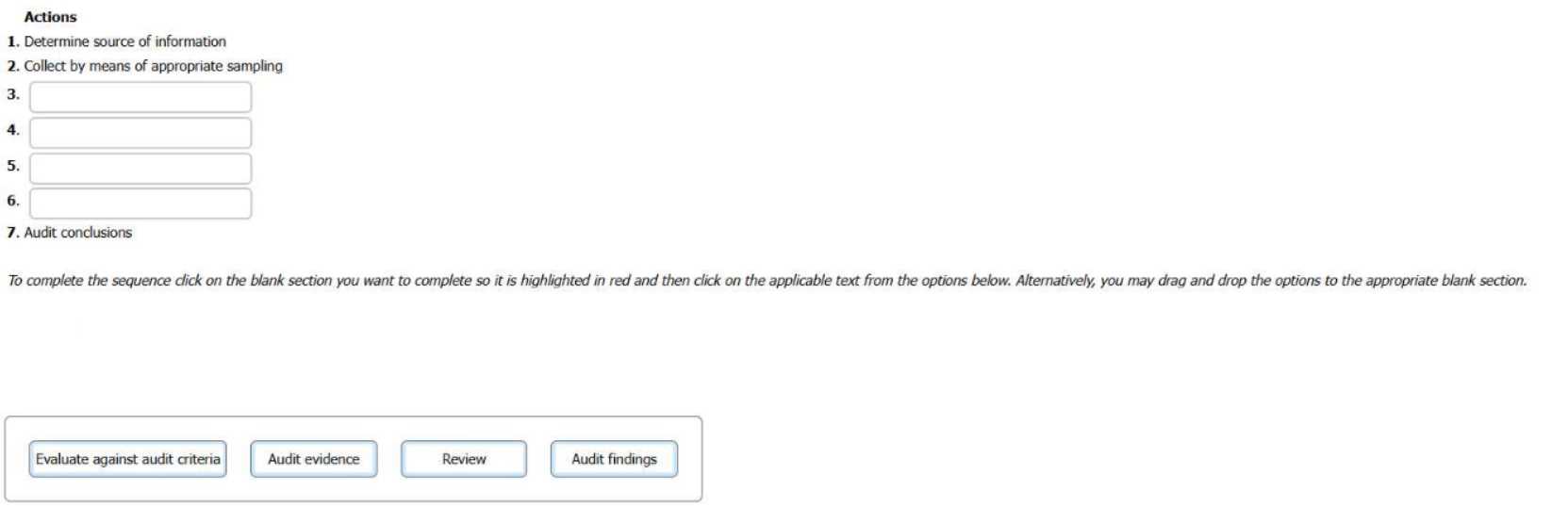
DRAG DROP A key audit process is the way auditors gather information and determine the findings' characteristics. Put the actions in the correct order to complete this process.
Drag & Drop
Discussion
No comments yet. Be the first to comment.
Be respectful. No spam.
Correct Answer:
Answer Area
Bucket 1: B. Audit evidence
Bucket 2: A. Evaluate against audit criteria
Bucket 3: D. Audit findings
Bucket 4: C. Review
Explanation
Q: 2
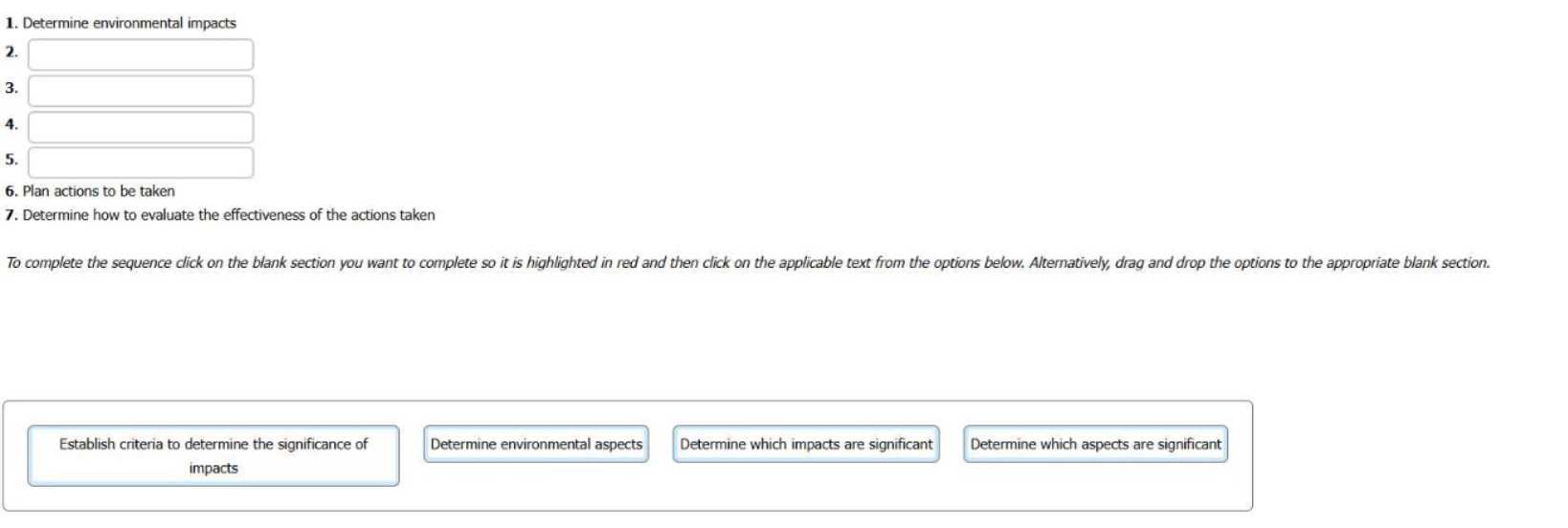
DRAG DROP Considering the requirements of clauses 6.1.2 and 6.1.4 of ISO 14001:2015, put the actions in the correct order to complete a process/task.
Drag & Drop
Discussion
No comments yet. Be the first to comment.
Be respectful. No spam.
Correct Answer:
Answer Area
Bucket 1: B. Determine environmental aspects
Bucket 2: A. Establish criteria to determine the significance of impacts
Bucket 3: D. Determine which aspects are significant
Bucket 4: C. Determine which impacts are significant
Explanation
Q: 3
An audit team leader arrives at a steel fabrication organisation that manufactures fire escape stairs to
carry out a Stage 2 certification audit. At a meeting with the EMS Manager, she is told that they have
won their biggest contract from a construction organisation to manufacture and install fire escape
stairs. They appointed a subcontractor to perform the installation work. The EMS Manager wants the
ISO 14001 audit extended to cover the installation site.
Select which one of the options is the correct response by the auditor.
Options
Discussion
No comments yet. Be the first to comment.
Be respectful. No spam.
Correct Answer:
B
Q: 4
Which two of the following phrases would apply to "audit criteria"?
Options
Discussion
No comments yet. Be the first to comment.
Be respectful. No spam.
Correct Answer:
A, F
Q: 5
The audit lifecycle describes the ISO 19011 process for conducting an individual audit.
Which two of the following are part of conducting the audit activities?
Options
Discussion
No comments yet. Be the first to comment.
Be respectful. No spam.
Correct Answer:
A, F
Q: 6
Which two of the following documents are not required for documentation review by an auditor
conducting a Stage 1 certification audit to ISO 14001?
Options
Discussion
No comments yet. Be the first to comment.
Be respectful. No spam.
Correct Answer:
C, D
Q: 7
A management system meeting ISO 14001:2015 requirements is based on the Plan-Do-Check-Act
(PDCA) cycle.
Which two elements of the management system are part of the 'Check' stage of the PDCA cycle?
Options
Discussion
No comments yet. Be the first to comment.
Be respectful. No spam.
Correct Answer:
D, F
Q: 8
You are conducting a Stage 2 certification audit of VitalSpark, a pharmaceutical organisation
manufacturing vitamins and other healthcare medicines. In a separate area in the centre of their
large site, a supplier produces oxygen supplies piped directly into the manufacturing processes of
VitalSpark. They also deliver oxygen in bulk tankers to other customers. When you review the
environmental aspects register, you find that the only environmental aspect recorded for this
arrangement relates to the heavy goods vehicles of the supplier transiting the site.
You ask the EMS Manager about the environmental consequences to VitalSpark of this arrangement
and are told that they are not significant since the supplier has its own services for water, sewage,
waste and energy. The EMS Manager tried unsuccessfully to communicate with the supplier who is
located inside the VitalSpark site and outside the scope of the EMS.
You raise a non-conformance against clause 6.1.2 of ISO 14001:
"VitalSpark does not maintain documented information on aspects/impacts related to activities,
products and services of the oxygen supplier."
Which combination of two of the following actions proposed by VitalSpark would permit you to close
out the nonconformity?
Options
Discussion
No comments yet. Be the first to comment.
Be respectful. No spam.
Correct Answer:
A, B
Q: 9
Showitoff is an organisation specialising in the design and production of wall decorating materials for the domestic market. During an ISO 14001 certification audit of the site, the auditor comes across an open, walled area just outside the maintenance department. It contains various scraps of wood and metal as well as several rusty components. They are lying on an oily floor. When asked about it, the EMS Manager states that he presumes that the materials come from maintenance work. The auditor interviews the Maintenance Manager in his department. He notes that shelves containing various spares are well labelled and neatly stacked. He asked about the "dump" outside and is told that it contains some excess materials that the Manager likes to keep in case they come in handy at some stage. The auditor points out that the "dump" might be classed under regulations as a landfill site, which requires an operating licence. The Maintenance Manager is not aware of such a licence. Which three statements represent good audit practice?
Options
Discussion
No comments yet. Be the first to comment.
Be respectful. No spam.
Correct Answer:
A, D, F
Q: 10
Which one of the following options best describes the main purpose of a Stage 2 third-party audit?