Free Databricks Certified Data Engineer Associate Practice Test Questions and Answers (2026)

View Mode
Q: 1
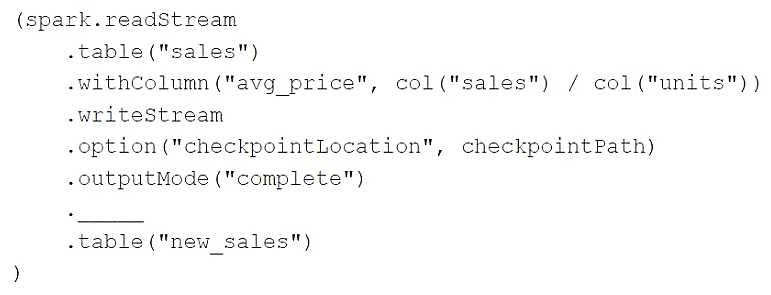
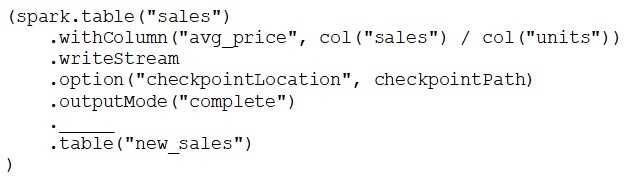
A data engineer has configured a Structured Streaming job to read from a table, manipulate the data, and then perform a streaming write into a new table. The code block used by the data engineer is below: DATABRICKS CERTIFIED DATA ENGINEER ASSOCIATE question If the data engineer only wants the query to process all of the available data in as many batches as required, which of the following lines of code should the data engineer use to fill in the blank?
Options
30 comments in the community discussion
3
Makes sense to pick B here. trigger(availableNow=True) is meant for processing all available data in multiple batches if needed.
2
Ugh, Databricks changing syntax again. Option B
Q: 2
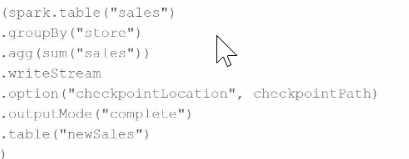
A data engineer has configured a Structured Streaming job to read from a table, manipulate the data, and then perform a streaming write into a new table. The cade block used by the data engineer is below: DATABRICKS CERTIFIED DATA ENGINEER ASSOCIATE question If the data engineer only wants the query to execute a micro-batch to process data every 5 seconds, which of the following lines of code should the data engineer use to fill in the blank?
Options
25 comments in the community discussion
3
D. Some folks might get tricked by E but that's for continuous, not actual micro-batching. Only D uses processingTime and matches Databricks docs. If anyone thinks otherwise, open to hearing it.
2
D
Q: 3
Which of the following code blocks will remove the rows where the value in column age is greater than 25 from the existing Delta table my_table and save the updated table?
Options
28 comments in the community discussion
1
Gotta be C for this, but honestly not 100 percent since E sometimes trips me up.
1
Yeah makes sense, C is the actual delete in Delta Lake so that's what I'd pick.
Q: 4
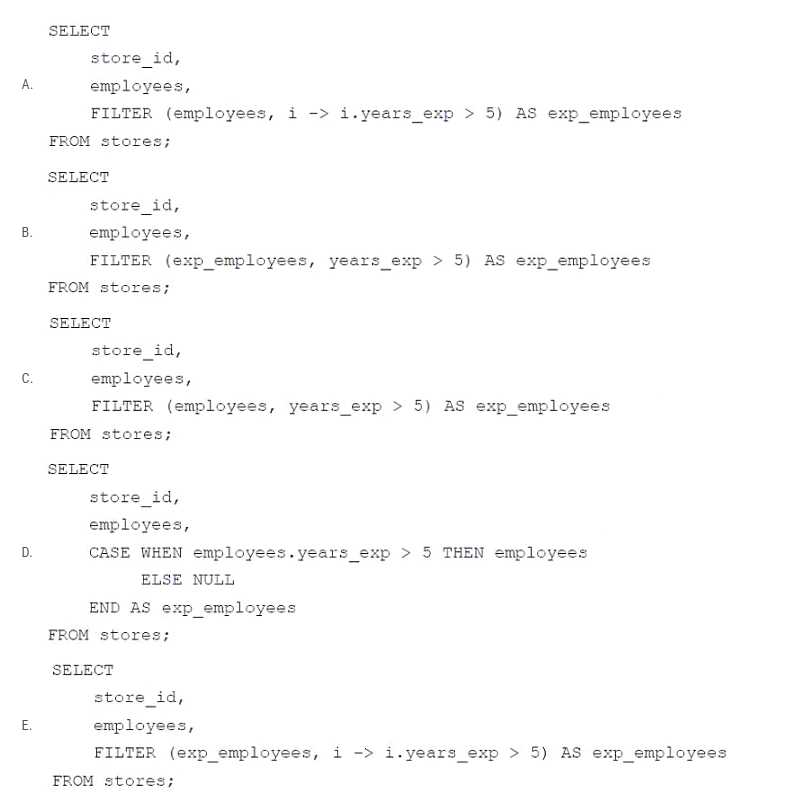
A data engineer needs to apply custom logic to identify employees with more than 5 years of experience in array column employees in table stores. The custom logic should create a new column exp_employees that is an array of all of the employees with more than 5 years of experience for each row. In order to apply this custom logic at scale, the data engineer wants to use the FILTER higher- order function. Which of the following code blocks successfully completes this task? DATABRICKS CERTIFIED DATA ENGINEER ASSOCIATE question
Options
22 comments in the community discussion
2
Likely H, ad something like this in a mock, picked A because the lambda checks for strictly > 5 years. That's exactly what the question asks. Pretty sure that's right but if it was 35 or more', then C would fit.
1
Probably A, code block syntax is super clear and matches what I saw in a similar Databricks practice. Solid question format here.
Q: 5
In order for Structured Streaming to reliably track the exact progress of the processing so that it can handle any kind of failure by restarting and/or reprocessing, which of the following two approaches is used by Spark to record the offset range of the data being processed in each trigger?
Options
25 comments in the community discussion
6
Option A, I don’t think it’s C-checkpointing and WALs are the offset tracking pieces, idempotent sinks trip folks up here.
2
Yeah that's A. Checkpointing and write-ahead logs are the Spark way to keep track of offsets every trigger.
Q: 6
A data analyst has a series of queries in a SQL program. The data analyst wants this program to run every day. They only want the final query in the program to run on Sundays. They ask for help from the data engineering team to complete this task. Which of the following approaches could be used by the data engineering team to complete this task?
Options
28 comments in the community discussion
4
Pretty straightforward, I'd pick B. Wrapping the SQL in PySpark lets you use Python's datetime to check for Sunday, so you only run that last query when you want. Not seeing another option that's as clean for scheduling.
3
Wait, wouldn't this break if the program uses just SQL and no Python kernel? If they can't move it to PySpark, option B wouldn't apply. Are we sure Python is allowed here, or is there a native SQL scheduling trick in Databricks I missed?
Q: 7
A data organization leader is upset about the data analysis team’s reports being different from the data engineering team’s reports. The leader believes the siloed nature of their organization’s data engineering and data analysis architectures is to blame. Which of the following describes how a data lakehouse could alleviate this issue?
Options
35 comments in the community discussion
6
Option B. not D. Real-time collab (D) sounds nice but lakehouse architecture is really about both teams using the same data as source of truth. Seen similar question in practice sets.
6
Option B is correct since a lakehouse lets both teams pull from the same single source of truth. Official Databricks docs mention this as a main benefit for resolving siloed data issues. Seen this approach in practice exams too.
Q: 8
A data engineer and data analyst are working together on a data pipeline. The data engineer is working on the raw, bronze, and silver layers of the pipeline using Python, and the data analyst is working on the gold layer of the pipeline using SQL. The raw source of the pipeline is a streaming input. They now want to migrate their pipeline to use Delta Live Tables. Which of the following changes will need to be made to the pipeline when migrating to Delta Live Tables?
Options
21 comments in the community discussion
1
D tbh
1
A . Delta Live Tables doesn't force you to drop the medallion layers or change from streaming, so B and D are traps here. You can keep mixing Python and SQL too, so C and E don't fit. Pretty sure it's A unless there's some hidden caveat I'm missing.
Q: 9
A new data engineering team team has been assigned to an ELT project. The new data engineering team will need full privileges on the table sales to fully manage the project. Which of the following commands can be used to grant full permissions on the database to the new data engineering team?
Options
23 comments in the community discussion
6
Maybe A. Saw a similar question in a mock and it matched option A for full access.
2
A. but only because "sales" is a table here. If the team needed database-level rights, GRANT ALL PRIVILEGES ON DATABASE would be needed instead. Kinda nitpicky but that switch flips the answer. Anyone disagree?
Q: 10
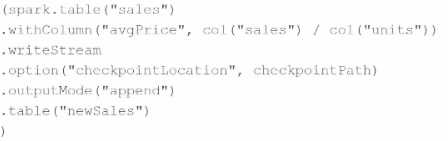
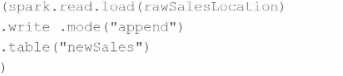
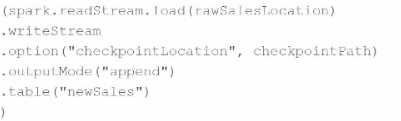
Which query is performing a streaming hop from raw data to a Bronze table? A) DATABRICKS CERTIFIED DATA ENGINEER ASSOCIATE question B) DATABRICKS CERTIFIED DATA ENGINEER ASSOCIATE question C) DATABRICKS CERTIFIED DATA ENGINEER ASSOCIATE question D) DATABRICKS CERTIFIED DATA ENGINEER ASSOCIATE question
Options
27 comments in the community discussion
2
Had something like this in a mock and picked C.
2
C/D? The question asks about a streaming hop specifically, so unless readStream and writeStream are both used (like in D), it's technically not streaming. C would only fit if batch was acceptable for Bronze loads. Seen some practice sets trip people up on this.
Q: 11
A dataset has been defined using Delta Live Tables and includes an expectations clause: CONSTRAINT valid_timestamp EXPECT (timestamp > '2020-01-01') ON VIOLATION FAIL UPDATE What is the expected behavior when a batch of data containing data that violates these constraints is processed?
Options
9 comments in the community discussion
1
B , but not 100% sure. The wording around 'FAIL UPDATE' makes me think the whole batch fails if there's a violation, so A feels more likely. If it was 'DROP RECORD', it'd probably be C instead. Open to correction if I'm off.
I don't think it's C here. With 'ON VIOLATION FAIL UPDATE', the whole job fails if any bad record is found, so A fits better. C's a common trap for 'DROP RECORD' cases. Pretty sure on this, correct me if I'm missing something.
Q: 12
Which file format is used for storing Delta Lake Table?
Options
15 comments in the community discussion
6
Option A Official guide and Databricks docs both confirm Parquet is used for Delta Lake storage format.
5
Option A. Under the hood Delta Lake tables are stored as Parquet files, just with extra metadata and transaction log. Pretty sure about this, seen it in official guide and labs.
Q: 13
Which of the following describes a scenario in which a data team will want to utilize cluster pools?
Options
11 comments in the community discussion
6
A . B is tempting if you're only thinking about reproducibility, but pools are really for speed (minimizing cluster startup time). If the report needs to run ASAP, A makes sense here.
1
C or D? I remember a similar question from the official practice test, and both testing (C) and versioning (D) come up a lot. Might be missing something but the guide wasn't super clear here.
Q: 14
Identify how the count_if function and the count where x is null can be used Consider a table random_values with below data. What would be the output of below query? select count_if(col > 1) as count_ a. count(*) as count_b.count(col1) as count_c from random_values col1 0 1 2 NULL - 2 3
Options
13 comments in the community discussion
4
A. official exam guide covers count_if and their quirks pretty well. Practice sets can help with NULL logic too.
1
A for sure. count_if only tallies up when the condition is true, not just non-null, and count(*) always gives the total rows even if there are NULLs. Pretty sure that fits the expected values. If someone sees it differently let me know.
Q: 15
Which of the following is stored in the Databricks customer's cloud account?
Options
16 comments in the community discussion
1
D seen same logic in official guide and practice test sets. Official docs clarify this.
1
D imo. Saw similar question in practice exams, data is the only thing actually in the customer's cloud account.
Q: 16
Which of the following Git operations must be performed outside of Databricks Repos?
Options
10 comments in the community discussion
8
Option E
1
E here. Had something like this in a mock and merge was always outside Repos, while commits, pulls, and pushes worked fine inside. Pretty sure that's right, but open if anyone's seen different on recent exams.
Q: 17
A data engineer needs to determine whether to use the built-in Databricks Notebooks versioning or version their project using Databricks Repos. Which of the following is an advantage of using Databricks Repos over the Databricks Notebooks versioning?
Options
15 comments in the community discussion
1
C vs B, but B is the real advantage here. Databricks Repos actually lets you use multiple branches like you would expect with any proper Git integration, supports team workflows. C sounds tempting since both tools offer some rollback features, but Notebooks versioning doesn't support branching at all. Pretty sure it's
I don’t think it’s D. B gives you multi-branch workflows, which Notebooks versioning lacks, so B.
Q: 18
Which of the following commands can be used to write data into a Delta table while avoiding the writing of duplicate records?
Options
15 comments in the community discussion
1
C is the one that handles deduplication since MERGE lets you match on keys and only updates or inserts if needed. APPEND or INSERT could just write duplicates straight in. Pretty sure C is right here, but curious if anyone sees a use case I missed.
Why do Databricks questions always sneak in MERGE for this? C
Q: 19
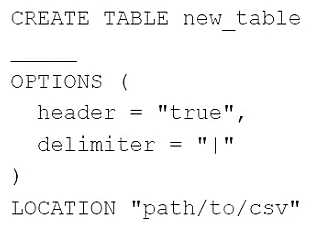
A data engineer needs to create a table in Databricks using data from a CSV file at location /path/to/csv. They run the following command: DATABRICKS CERTIFIED DATA ENGINEER ASSOCIATE question Which of the following lines of code fills in the above blank to successfully complete the task?
Options
9 comments in the community discussion
1
B , USING CSV is right for Databricks. FROM CSV is an easy trap, seen that in similar practice sets before.
1
B , Databricks SQL expects USING CSV to define the file format when creating an external table. FROM is for specifying the path but not the format, so using FROM CSV wouldn't make sense syntactically. Seen this in practice tests too, but open to correction if I'm missing something.
Q: 20
Which of the following statements regarding the relationship between Silver tables and Bronze tables is always true?
Options
18 comments in the community discussion
1
No way it's C, the amount of data in Silver can change depending on transformations or joins. D is the one that's always true since Silver tables are meant to be more refined and cleaner than Bronze. Unless someone thinks Bronze has better data quality, which doesn't make sense here.
1
D imo
Question 1 of 20

Premium Access Includes

  • Quiz Simulator
  • Exam Mode
  • Progress Tracking
  • Question Saving
  • Flash Cards
  • Drag & Drops
  • 3 Months Access
  • PDF Downloads
Get Premium Access
Scroll to Top

FLASH OFFER

Days
Hours
Minutes
Seconds

avail 10% DISCOUNT on YOUR PURCHASE