Free Cybersecurity Architecture and Engineering Practice Test Questions and Answers (2026)

View Mode
Q: 1
Which risk management strategy will help prevent cheating using a learning management system as a platform?
Options
1 comment in the community discussion
1
C tbh. Secure user authentication is key here because it stops students from logging in as someone else. MFA or strong passwords make impersonation way harder. Not 100% sure if that covers every angle but it’s the main control for cheating.
Q: 2
A financial institution conducted a cybersecurity assessment, which identified several vulnerabilities including outdated software and weak password policies. The company also needs to implement a new core banking system that can handle a large number of transactions while ensuring the security of customer data. Which risk mitigation process is the most effective approach to address these vulnerabilities, and what is the best topology for the new core banking system?
Options
1 comment in the community discussion
Probably A, matches well with both the assessment findings and what core banking really needs for security and scalability. Clear scenario.
Q: 3
A company has recently implemented a hybrid cloud deployment. The security team has been notified about thousands of failed attempts to connect to routers and switches in the on-premises network. A solution must be implemented to block connections after three unsuccessful SSH attempts on any network device. Which solution meets the requirements in this scenario?
Options
1 comment in the community discussion
C fits here. IPS can spot multiple failed SSH logins and take action like dropping/blocking the attempts automatically. Saw a similar question in some recent exam reports, so pretty sure C is it. Open to correction if I missed something.
Q: 4
Which algorithm is suitable for ensuring the integrity of digital documents and detecting any unauthorized modifications?
Options
2 comments in the community discussion
BHashing is the key for integrity here, not encryption. If the question mentioned digital signatures, then maybe RSA could be a contender, but as written it's definitely SHA-256.
It’s B, SHA-256. Hash functions like SHA-256 are made exactly for checking integrity because they generate unique digests. Encryption (like DES or AES) protects confidentiality but doesn't verify if something changed. Pretty sure about this one, but open if anyone disagrees.
Q: 5
An e-commerce company has recently experienced a data breach in which the personal and financial information of its customers was stolen. The company is concerned about the potential for future data breaches. What is the most important factor to consider when evaluating the potential for future data breaches in this scenario?
Options
1 comment in the community discussion
D vs B here. Both are key, but since the question is asking about the "potential" for future breaches, D (Likelihood) fits best-it's about how probable it is another incident happens. Official study guides and risk management practice questions explain this well if you want to review. Pretty sure on D but open if someo
Q: 6
A company is moving its applications to the cloud and is concerned about cyber security threats. The security team has been tasked with providing a comprehensive view of how attackers gainaccess, move through networks, and carry out attacks. Which framework identifies the seven phases of an attack, from initial infiltration to post- exploitation?
Options
1 comment in the community discussion
1
Its C. Cyber kill chain specifically breaks down attacks into seven stages from start to finish. MITRE ATT&CK lists techniques but doesn't use those phases, so it's a common trap option here. Are they asking for a phase-based model, or just for attack technique mapping? That would flip it.
Q: 7
A company is developing a new system to process personal information about its customers, including their names, addresses, and purchase histories. Which term describes the process of identifying and evaluating the potential effects that the new system may have on the privacy of personal information and developing strategies to mitigate those risks?
Options
1 comment in the community discussion
C imo
Q: 8
What is a component of IT infrastructure?
Options
2 comments in the community discussion
1
Probably C. Networks are actually a direct component of IT infrastructure, while people interact with it but aren't technically part of its architecture. The question's a bit tricky since people are crucial, but networks are the real infrastructure piece here. Seen similar wording in practice sets.
Its B. People are a big part of any IT operation since users and admins interact with the systems daily. I think they're considered a core part of the infrastructure because without people, nothing gets configured or maintained. Not totally sure though, maybe networks is more accurate officially. Anyone disagree?
Q: 9
A company has discovered a vulnerability in its lightweight directory access protocol (LDAP) implementation, which could potentially allow unauthorized access to sensitive information. The company has decided to implement risk mitigation strategies to reduce the risk associated with this vulnerability. Which risk mitigation strategy will meet the needs of the company?
Options
2 comments in the community discussion
1
C tbh. IDPS can spot suspicious LDAP traffic and raise alerts for potential attacks, so it feels like a solid mitigation move if you want monitoring and rapid response. I think direct hardening (like D) is stronger, but based on the wording, C isn't a bad pick either. Open to pushback if I'm off.
C/D? If the question means the "most effective" way to address unauthorized LDAP access, D makes more sense, but if it's asking for the "first step" or something more general, C could also apply. Does it specify best or first?
Q: 10
What is the vocabulary and set of rules for instructing a computer to perform certain tasks?
Options
1 comment in the community discussion
C or D, kind of tricky but both relate to computer instructions.
Q: 11
A company is concerned about the potential risks associated with unauthorized modifications to the Basic Input/Output System (BIOS) firmware on its servers. The company has decided to implement hardening techniques and endpoint security controls to mitigate the risk. Which technique will prevent unauthorized modifications to the BIOS firmware on a server?
Options
Q: 12
A financial institution conducted a cybersecurity assessment, which identified several vulnerabilities, including outdated software and weak password policies. The company also needs to implement a new core banking system that can handle a large number of transactions while ensuring the security of customer data. Which risk mitigation process is the most effective approach to address these vulnerabilities, and what is the best topology for the new core banking system?
Options
Q: 13

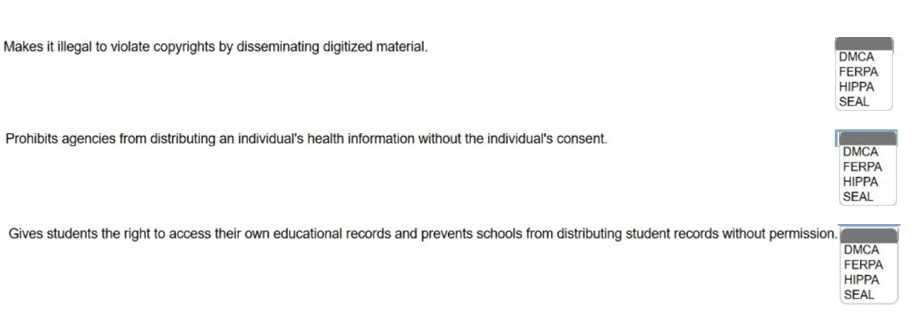
HOTSPOT Match the legislative purpose with the corresponding legislation. Answer options may be used more than once or not at all. WGU Cybersecurity Architecture and Engineering question

Your Answer
1 comment in the community discussion
If the question said "federal agencies only" instead of all organizations, would DMCA still apply or would that go to another law?
Q: 14
A company has recently experienced a data breach in which customer information was stolen. The company is concerned about the potential for future data breaches. A review of the incident revealed that the breach originated from stolen credentials. Which security measure will meet the needs of this company?
Options
1 comment in the community discussion
A imo, since MFA would stop attackers even if credentials get stolen.
Q: 15
Which stream cipher is a variant of the Salsa20 cipher, designed to be fast, secure, and resistant to cryptanalysis, and is commonly used in combination with the Poly1305 authentication mode?
Options
1 comment in the community discussion
1
A is just a mode, not a cipher. Before picking, are we supposed to focus on what's commonly used in TLS or just general stream ciphers?
Q: 16
An IT organization recently implemented a hybrid cloud deployment. The security team must be able to correlate event data combined from different sources in a central location. What is the best solution?
Options
Q: 17
Which encryption technique can be used to enable a third-party provider to perform calculations on encrypted data without decrypting the data?
Options
1 comment in the community discussion
A
Q: 18
In which generation were computers first built with transistors?
Options
2 comments in the community discussion
Pretty sure it's B since the first gen was vacuum tubes, not transistors. Second gen is when those small, more efficient transistors started getting used. Anyone think C could make sense here?
B
Q: 19
An IT organization has recently implemented a hybrid cloud deployment. The server team is deploying a new set of domain-joined Windows servers on cloud-based virtual machines. Users must be able to use their Active Directory credentials to sign in to applications regardless of whether they are running on Windows servers in the cloud or on-premises.
Options
Q: 20
How are IT and globalization related?
Options
Question 1 of 20

What's covered in this practice questions set

1: Cybersecurity Principles · 7 questions

📖 About this Domain

This domain establishes the foundational tenets of information security that govern all cybersecurity architecture. It covers the core models, frameworks, and design philosophies essential for engineering resilient and secure systems.

🎓 What You Will Learn

  • You will learn the CIA triad (Confidentiality, Integrity, Availability) and supplementary principles like non-repudiation and authenticity.
  • You will analyze access control models like Bell-LaPadula for confidentiality and the Biba model for integrity.
  • You will understand the application of secure design principles, including least privilege, defense in depth, and fail-safe defaults.
  • You will explore the fundamentals of risk management, including threat modeling and vulnerability identification within the system development lifecycle (SDLC).

🛠️ Skills You Will Build

  • You will build the skill to apply theoretical security models to practical system architecture and engineering problems.
  • You will develop proficiency in threat modeling to identify and mitigate potential attack vectors in system designs.
  • You will gain the ability to align technical security controls with foundational principles and governance frameworks like NIST.
  • You will learn to articulate and derive specific security requirements from abstract principles for implementation.

💡 Top Tips to Prepare

  • Memorize the precise definitions and objectives of the core security models, such as Bell-LaPadula's simple security property and *-property.
  • Practice applying the principle of least privilege and defense in depth to various network and system architecture diagrams.
  • Use case studies from the course material to connect abstract principles to real-world security control implementations.
  • Create comparison charts for concepts like the Biba model versus the Clark-Wilson model to understand their distinct use cases.

2: Security Architecture · 7 questions

📖 About this Domain

This domain covers the foundational frameworks, models, and principles for designing and implementing secure systems. You will focus on enterprise security architecture, including methodologies like SABSA and TOGAF, to align security with business objectives. The core is translating security requirements into resilient architectural designs.

🎓 What You Will Learn

  • Analyze and compare security architecture frameworks like SABSA, TOGAF, and the Zachman Framework for enterprise application.
  • Apply secure design principles such as defense-in-depth, least privilege, and fail-secure to system components.
  • Evaluate security models including Bell-LaPadula for confidentiality and Biba for integrity in system design.
  • Understand the components and implementation of a Zero Trust Architecture (ZTA) to minimize the attack surface.

🛠️ Skills You Will Build

  • Designing secure network architectures using segmentation, firewalls, and intrusion detection systems.
  • Developing threat models using methodologies like STRIDE to identify and mitigate potential vulnerabilities.
  • Integrating security controls across various layers of the OSI model and cloud service models (IaaS, PaaS, SaaS).
  • Mapping business requirements to technical security controls and architectural patterns for compliance and risk reduction.

💡 Top Tips to Prepare

  • Memorize the core principles and differences between major architecture frameworks like SABSA and TOGAF.
  • Practice diagramming secure network and system architectures, labeling all security controls and zones.
  • Focus on the practical application of secure design principles to given scenarios, not just their definitions.
  • Understand how to apply threat modeling to a system to identify attack vectors and required countermeasures.

4: Cryptography · 3 questions

📖 About this Domain

This domain covers the core principles of modern cryptography and its application in cybersecurity architecture. You will analyze cryptographic systems, including encryption algorithms, hashing functions, and digital signatures. The focus is on engineering secure solutions by implementing appropriate cryptographic controls.

🎓 What You Will Learn

  • Differentiate symmetric key ciphers like AES from asymmetric key algorithms like RSA and ECC for confidentiality and key exchange.
  • Analyze cryptographic hash functions such as SHA-256 and their role in ensuring data integrity and creating digital signatures.
  • Understand the components and hierarchy of a Public Key Infrastructure (PKI), including Certificate Authorities (CAs) and certificate lifecycle management.
  • Examine the implementation of cryptographic protocols like TLS and IPsec to secure data-in-transit and data-at-rest.

🛠️ Skills You Will Build

  • Architecting cryptosystems by selecting appropriate algorithms, key lengths, and modes of operation for specific security requirements.
  • Engineering and managing a PKI framework to issue, validate, and revoke digital certificates for authentication.
  • Developing secure key management strategies, including generation, storage in Hardware Security Modules (HSMs), and rotation.
  • Assessing cryptographic implementations for vulnerabilities like weak cipher suites, improper key handling, or protocol downgrade attacks.

💡 Top Tips to Prepare

  • Focus on the specific use cases for symmetric, asymmetric, and hashing algorithms in system design.
  • Memorize the end-to-end PKI workflow, from certificate signing request (CSR) generation to certificate revocation list (CRL) checking.
  • Understand the critical role of key management and the security benefits of using an HSM for key storage.
  • Distinguish between different cryptographic attacks and their corresponding countermeasures within a security architecture.

3: Identity and Access Management · 3 questions

📖 About this Domain

This domain covers the frameworks and technologies for managing digital identities and their access to resources. You will explore the core principles of authentication and authorization to enforce security policies within an enterprise architecture.

🎓 What You Will Learn

  • You will learn to differentiate between authentication protocols like Kerberos and authorization frameworks like OAuth 2.0.
  • You will learn to implement identity federation using standards such as SAML and OpenID Connect for seamless SSO.
  • You will learn to apply various access control models, including Role-Based Access Control (RBAC) and Attribute-Based Access Control (ABAC).
  • You will learn the components of a Privileged Access Management (PAM) solution to secure administrative accounts.

🛠️ Skills You Will Build

  • You will build the skill to architect a zero-trust IAM solution using multi-factor authentication (MFA) and conditional access policies.
  • You will build the skill to design an identity lifecycle management process, including user provisioning and de-provisioning workflows.
  • You will build the skill to integrate third-party identity providers (IdP) with service providers (SP) for federated access.
  • You will build the skill to conduct access reviews and audits to ensure compliance with the principle of least privilege.

💡 Top Tips to Prepare

  • Memorize the specific use cases and message flows for SAML, OAuth, and OIDC.
  • Practice scenario-based questions that require you to select the most appropriate access control model like RBAC vs. ABAC.
  • Focus on the technical implementation details of Privileged Access Management (PAM) and session monitoring.
  • Understand how IAM is implemented in major cloud platforms, including the structure of roles and policies.

5: Security Operations

📖 About this Domain

This domain focuses on the core functions of a Security Operations Center (SOC). It covers the processes, procedures, and technologies used for continuous monitoring, incident response, and threat management. You will explore the operational aspects of maintaining a secure enterprise environment.

🎓 What You Will Learn

  • You will learn the incident response lifecycle, including preparation, detection, analysis, containment, eradication, and recovery.
  • You will learn to integrate threat intelligence feeds and indicators of compromise (IOCs) into security monitoring tools.
  • You will learn the vulnerability management process, from discovery and scanning to remediation and validation.
  • You will learn digital forensics principles, including evidence handling, chain of custody, and data acquisition from volatile and non-volatile memory.

🛠️ Skills You Will Build

  • You will build skills in log analysis and event correlation using Security Information and Event Management (SIEM) platforms.
  • You will build the ability to develop and implement security playbooks for Security Orchestration, Automation, and Response (SOAR).
  • You will build proactive threat hunting capabilities by forming hypotheses and searching for advanced persistent threats (APTs).
  • You will build proficiency in disaster recovery (DR) and business continuity planning (BCP) to ensure operational resilience.

💡 Top Tips to Prepare

  • Focus on understanding the NIST SP 800-61 framework for incident handling and the NIST Cybersecurity Framework (CSF).
  • Practice interpreting SIEM alerts and understand the difference between true positives, false positives, and false negatives.
  • Memorize the order of volatility for forensic data collection to ensure evidence integrity.
  • Understand the key metrics used in a SOC, such as Mean Time to Detect (MTTD) and Mean Time to Respond (MTTR).

Premium Access Includes

  • Quiz Simulator
  • Exam Mode
  • Progress Tracking
  • Question Saving
  • Flash Cards
  • Drag & Drops
  • 3 Months Access
  • PDF Downloads
Get Premium Access
Scroll to Top

FLASH OFFER

Days
Hours
Minutes
Seconds

avail 10% DISCOUNT on YOUR PURCHASE