
ISTQB CTFL AUT
Q: 1
Which of the following statements regarding the application of standards is true?
Options
Q: 2
Which statement regarding the contribution of the tester to a safety culture is true?
Options
Q: 3
In the release process, which of the following work products. Information and documents are the
typical output of the tester?
Options
Q: 4
Which example describes a typical application of a closed-loop system?
Options
Q: 5
Which statement regarding the objective of ASPICE and ISO 26262 Is true?
Options
Q: 6
The following methods table shows a partial functional safety guideline of an OEM (Car Maker):
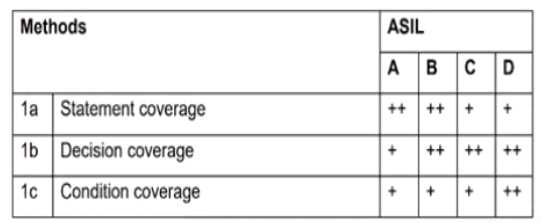 What do the plus symbols in the table mean for the taster of the supplier?
What do the plus symbols in the table mean for the taster of the supplier?Options
Q: 7
Which statement regarding the test levels In a test environment is true?
Options
Q: 8
Which of the following options describes a combination of typical parts of a HiL environment?
Options
Q: 9
Which statement regarding coding standards Is most true?
Options
Q: 10
You are working as a .module tester* (syn. unit tester, component tester) in an automotive project
for the development of a control unit for an electric window. During white-box lest design, you come
atomic requirements: B1 AND (B2 OR B3). The task for you is to design test cases according to the
principle of the modified condition/decision testing (MOOC). You have already designed three test
cases:
1) B1 = TRUE, B2 = TRUE, B3 = FALSE
2) B1 = TRUE, B2 = FALSE, B3 = TRUE
3) B1 = FALSE, B2 = TRU, B3 = FALSE
Which of the following test cases is necessary to achieve 100% modified condition/decision
coverage?
Options
Question 1 of 10
