
C++ Institute CPA 21 02
Q: 1
What happens when you attempt to compile and run the following code?
#include
using namespace std;
class BaseClass
{
public:
int *ptr;
BaseClass(int i) { ptr = new int(i); }
~BaseClass() { delete ptr; delete ptr;}
void Print() { cout << *ptr; }
};
void fun(BaseClass x);
int main()
{
BaseClass o(10);
fun(o);
o.Print();
}
void fun(BaseClass x) {
cout << "Hello:";
}
Options
Q: 2
What happens when you attempt to compile and run the following code?
#include
using namespace std;
class A {
public :
void print() {
cout << "A ";
}
};
class B {
public :
void print() {
cout << "B ";
}
};
int main() {
B sc[2];
B *bc = (B*)sc;
for (int i=0; iprint();
return 0;
}
Options
Q: 3
What happens when you attempt to compile and run the following code?
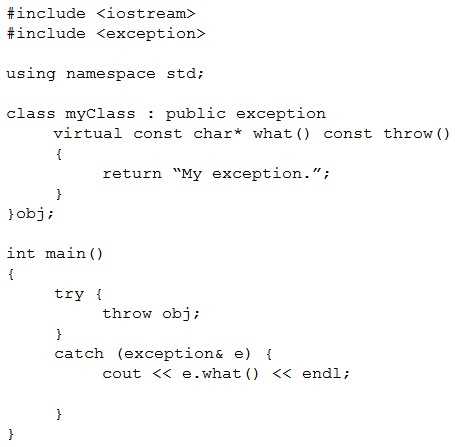
Options
Q: 4
Which of the following is a user defined data type?
1:
struct person
{
char name[20];
int age;
};
2:
int l=2;
3:
enum color {red,blue, green};
Options
Q: 5
What happens when you attempt to compile and run the following code?
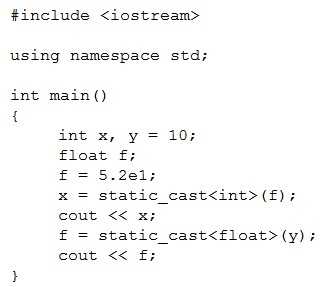
Options
Q: 6
What happens when you attempt to compile and run the following code?
#include
using namespace std;
int main (int argc, const char * argv[])
{
int tab[5]={1,2,3};
for (int i=0; i<5; i++)
cout <<tab[i];
return 0;
}
Options
Q: 7
What happens when you attempt to compile and run the following code?
#include
using namespace std;
int main()
{
const char *s;
char str[] = "Hello";
s = str;
while(*s) {
cout << *s++;
}
return 0;
}
Options
Q: 8
What happens when you attempt to compile and run the following code?
#include
#include
using namespace std;
int main()
{
string s1[]= {"H" , "t" };
string s;
for (int i=0; i<2; i++) {
s = s1[i];
s.insert(1,"o");
cout << s;
}
return( 0 );
}
Options
Q: 9
What happens when you attempt to compile and run the following code?
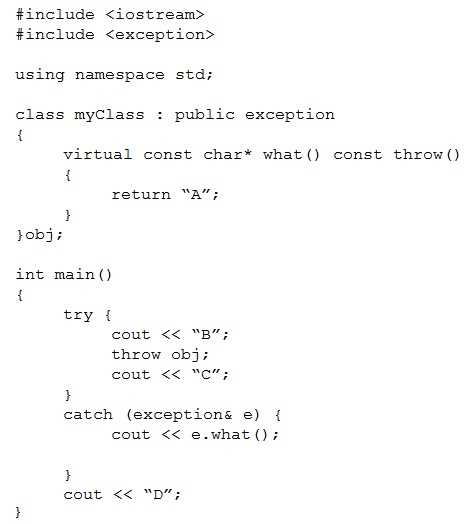
Options
Q: 10
Which code, inserted at line 18, generates the output "AB"
#include
using namespace std;
class A
{
public:
void Print(){ cout<< "A";}
void Print2(){ cout<< "a";}
};
class B:public A
{
public:
void Print(){ cout<< "B";}
void Print2(){ cout<< "b";}
};
int main()
{
B ob2;
//insert code here
ob2.Print();
}
Options
Question 1 of 10
