Free 820-605 Practice Test Questions and Answers (2026)

View Mode
Q: 1
The customer wants to increase their market share and protect brands reputation. Which two business outcomes are critical to the company’s success? (Choose two.)
Options
26 comments in the community discussion
1
B/C? I've seen similar on a practice test and for market share plus protecting brand, credibility and business growth were both picked as outcomes. Not completely sure, since risk management seems tempting too, but I think B and C are closer here.
1
B and C imo. Fits with market share and reputation focus, can't see risk management being as direct here.
Q: 2
What is a lagging indicator?
Options
27 comments in the community discussion
7
Option D had this in my exam last year.
5
D. Lagging indicators show the results after actions have been taken, like net promoter score changes following adoption. The others (A, B, C) are more about activities or leading indicators. Pretty sure about D from similar practice sets, but sometimes wording trips people up.
Q: 3
What is the main objective of customer success?
Options
22 comments in the community discussion
4
Option D is right here. It's all about making sure customers get the outcomes they want with the product, not just knowing features or lowering risk. That outcome focus is basically core to customer success, at least in Cisco's eyes. Agree?
1
Guessing D since outcomes trap people sometimes but that's what Cisco focuses on for customer success, not investment or features.
Q: 4
What is a key driver that is creating the need for customer success?
Options
24 comments in the community discussion
1
Yeah, this always comes up as B. The shift to a subscription economy forces vendors to focus on delivering value over time since customers can leave more easily. Not 100% but that's how it's framed in most Cisco practice stuff.
1
C/D? Official practice tests sometimes mention portfolio management as a factor too, not just the subscription economy.
Q: 5
Which activity reduces the risk of churn?
Options
20 comments in the community discussion
4
Option D as educating customers lowers churn risk, but if they're already power users, answer might flip.
2
Yeah, D. Educating on product features keeps people invested with what they already bought, so less chance they drop out.
Q: 6
Which list of components of a Customer Success Quarterly Success Review is common?
Options
27 comments in the community discussion
6
B . Benchmarking and action tracking always come up in those Cisco QSR practice sets and the official guide.
3
B. the benchmarking piece is standard for quarterly reviews from what I've seen. If anyone's had a QSR without it, let me know, but I think this is right.
Q: 7
In an onboarding session, introductions to new stakeholders were made, new KPIs were collated, and desired use cases were discussed. Which step does the Customer Success Manager take next?
Options
28 comments in the community discussion
3
B . After the onboarding chat, building a success plan using those KPIs is what Cisco wants CSMs to do next.
2
B . After onboarding, success plan is the CSM move per Cisco playbooks, not just documentation or tech setup.
Q: 8
In which stage of the Customer Lifecycle does the Success Plan get updated for the first time?
Options
25 comments in the community discussion
4
Option B
2
B , Cisco always puts the first official Success Plan update at Use. If we're splitting hairs on definitions, open to correction.
Q: 9
Which type of KPI is of the most interest to Customer Success?
Options
29 comments in the community discussion
2
Makes sense as A. Customer Success is all about business outcome KPIs, not revenue or ops metrics. Pretty sure that's what Cisco wants here, unless the question focused on renewals or cost-cutting.
1
Probably A is right here. Customer Success cares about outcomes tied to the customer's goals, so business KPIs matter most. Revenue and IT/service KPIs (B/C) are tracked by other teams. Pretty sure that's what Cisco expects, but let me know if you see it differently.
Q: 10
Why should a customer’s success be documented?
Options
31 comments in the community discussion
5
C . Documenting the actual value achieved is what Cisco wants here, unless they specifically ask about growth or sales.
4
C . The main reason to document customer success is to show the value that was actually achieved, not necessarily for sales expansion (which would be D). I think some might confuse D here, but Cisco's usual angle is value awareness. Open to thoughts though.
Q: 11
Your customer’s business outcome is to drive employee efficiencies. Which key metrics measure this outcome?
Options
11 comments in the community discussion
Activities completed makes it measurable for efficiency, not just cost driven. E
C or E? Reduction in support costs feels like an efficiency gain too, not just activities completed. Maybe missing something here.
Q: 12
A large university has deployed a new IT solution designed to improve the overall student and staff experience. Which approach will best measure success?
Options
10 comments in the community discussion
1
Probably C. Metrics plus surveys covers both user satisfaction and technical effectiveness, which is what exam feedback usually suggests.
I remember a similar scenario from labs, from labs, and C was always the recommended approach. Anyone see a better reason to pick D here?
Q: 13
Which metric is used to determine how much should be spent to acquire a customer?
Options
11 comments in the community discussion
7
Going With C Had something like this in a mock, C is LTV (Lifetime Value) which helps decide customer acquisition spend. Makes sense here, pretty sure that's what they want.
6
Option C Saw similar in some official practice sets, LTV is what guides how much you invest per customer.
Q: 14
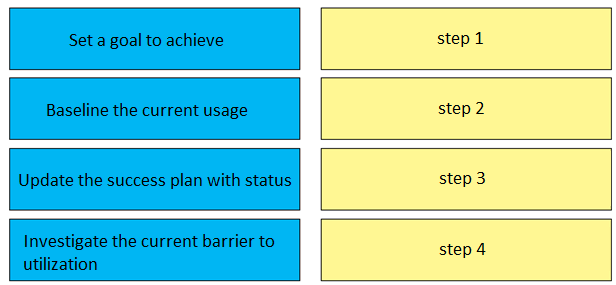
DRAG DROP The customer wants to increase the utilization of their video conferencing system. Drag and drop the actions from the left into the correct sequence on the right. CISCO 820-605 question
Your Answer
14 comments in the community discussion
6
Promote internally → schedule training → monitor usage → review feedback. Internal promotion gets users interested first, then training ramps up skills, usage tracking sees the impact, and finally feedback drives improvements. Pretty sure that's the order most Cisco adoption guides suggest.
1
Schedule training → promote internally → review feedback → monitor usage. I figured putting training first helps users get comfortable with the system right away, then internal promotion boosts excitement once skills are in place. Feedback helps shape improvements before you drill into usage stats. Not 100% sure, but I
Q: 15
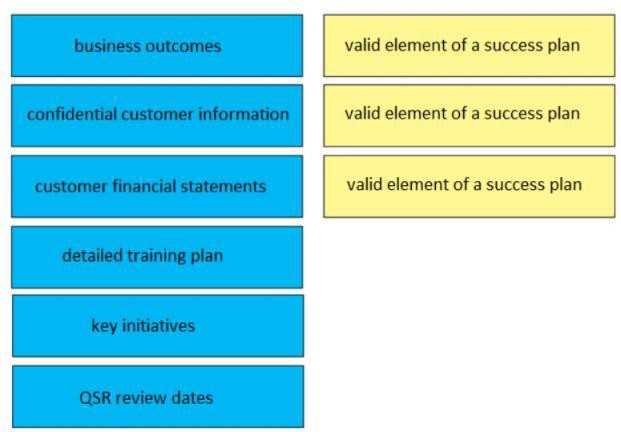
DRAG DROP Drag and drop three valid elements of a success plan from the left to the right. Not all options are used. Select and Place: CISCO 820-605 question
Your Answer
12 comments in the community discussion
6
Yeah, every guide I’ve seen lists customer objectives, key stakeholders, and implementation timeline as core elements for Cisco success plans. Critical risks and constraints aren’t picked unless the question says otherwise. This matches what shows up on most practice tests.
5
Not quite buying the idea that 'critical risks' is part of the core success plan here, looks more like 'customer objectives', 'key stakeholders', and 'implementation timeline' are what Cisco expects. Saw this mix pop up on similar practice sets. Anyone think constraints should be in?
Q: 16
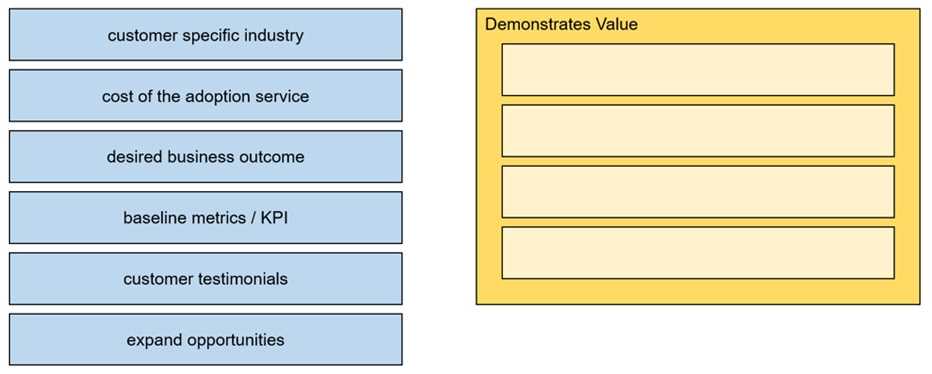
DRAG DROP An external customer case study is being created. Drag and drop the contents which show value from the left onto the right. Not all content choices are used. CISCO 820-605 question
Your Answer
10 comments in the community discussion
6
saw pretty similar problem in my exam. before, tricky with what counts as actual value. Usually, measurable outcomes (like increased uptime, cost savings, reduced deployment time) belong on the 'value shown' side, not just general quotes or generic praise. So stuff like ROI percentage or specific metrics are in. It'
3
Cost savings maps to value shown, same with uptime increase and ROI. Actual numbers matter more than generic feedback or praise here.
Q: 17
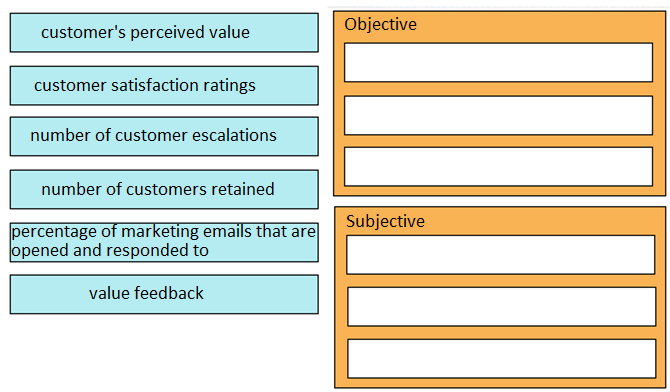
DRAG DROP The Customer Success Manager is preparing for a review meeting. The customer has asked for a balance between subjective and objective metrics. Drag and drop the inputs from the left onto the correct subjective and objective categories on the right. CISCO 820-605 question
Your Answer
7 comments in the community discussion
6
CSAT, NPS under subjective and case count, feature adoption rate as objective.
4
Yeah, seen similar on practice tests. Subjective is CSAT and NPS since they measure perception or sentiment, not hard data. Objective would be case count and adoption rate since they're number-based. Not 100% sure but most exam guides split it like that. Disagree?Subjective: CSAT, NPSObjective:
Q: 18
What is the order of the key elements of process improvement for Customer Success?
Options
12 comments in the community discussion
1
D , since sometimes you see analysis coming first in certain Cisco internal workflows, especially with troubleshooting. Process improvement can get mixed up with those steps if the context isn't clear. Could be wrong though, curious if others think B is safer.
1
I think B, classic DMAIC order. Saw something like this in a recent exam report.
Q: 19
What is the term for the gap between the features and functions that customers purchase and the features and functions that they use?
Options
13 comments in the community discussion
1
Its C
Option C No explanation from me, just what I picked.
Q: 20
Which of these is included in a success plan?
Options
11 comments in the community discussion
Pretty sure it's B and D, but if the plan focuses only on customer value sometimes D could be skipped.
Yeah, success plans are all about tracking business outcomes and showing value, so B and D.
Question 1 of 20

Premium Access Includes

  • ✓Quiz Simulator
  • ✓Exam Mode
  • ✓Progress Tracking
  • ✓Question Saving
  • ✓Flash Cards
  • ✓Drag & Drops
  • ✓3 Months Access
  • ✓PDF Downloads
Get Premium Access
Scroll to Top

FLASH OFFER

Days
Hours
Minutes
Seconds

avail 10% DISCOUNT on YOUR PURCHASE