Free 3V0-25.25 Practice Test Questions and Answers (2026)

View Mode
Q: 1
The administrator is implementing a multi-location VMware Cloud Foundation (VCF) environment. The design requires centralized security and networking policies across multiple VCF instances. What action must the administrator take to satisfy the requirements?
Options
1 comment in the community discussion
I think B. Seems like resizing through the API could work since APIs can adjust VM settings, right? Not totally sure but I don't think a full redeploy should be required.
Q: 2
An administrator has noticed an issue in a freshly deployed VMware Cloud Foundation (VCF) environment where the BGP neighborship between the Tier-0 gateway and a physical router remains in the Idle state. Pings between the uplink IPs are successful. What is the issue?
Options
2 comments in the community discussion
2
Its B? Not really sure because ping works, but maybe the ToR routers just aren't sending traffic back right. Can anyone confirm?
Q: 3
Which two requirements are part of the registration process for Local Manager (LM) to a Global Manager (GM) in NSX for centralized management of network and security services across different workload domains deployed in separate locations? (Choose two.)
Options
3 comments in the community discussion
1
A, Love how clear this one is, seen similar on other VMware practice sets.
B, not A
Q: 4
An administrator has a standalone vSphere 8.0 Update 1a deployment that is running with VMware NSX 4.1.0.2 and has to converge the deployment into a new VMware Cloud Foundation (VCF) instance. How can the administrator accomplish this task?
Options
3 comments in the community discussion
BI don't think D is strictly required for initial federation setup-I've seen in some environments you just need the BGP AS numbers to match across Tier-0 gateways to facilitate routing between sites. Option B could be a trap because people focus on versioning, but AS number mismatch can break connectivity. Mayb
Probably D, all sites need to run the same NSX version and build for federation to work right. Otherwise you’ll get sync or compatibility issues. Pretty sure on this, anyone disagree?
Q: 5
An administrator is tasked to enable users to configure an individual VPC, but not create subnets. What three NSX roles would the administrator assign to allow access without the ability to create subnets? (Choose three.)
Options
2 comments in the community discussion
Yeah, you'd use C here. VCF lets you onboard existing vSphere and NSX setups first, upgrades after.
Option D if the question was asking for a clean install rather than a converge/in-place upgrade process, right? Does it specifically require keeping current NSX config or is that up for redesign?
Q: 6

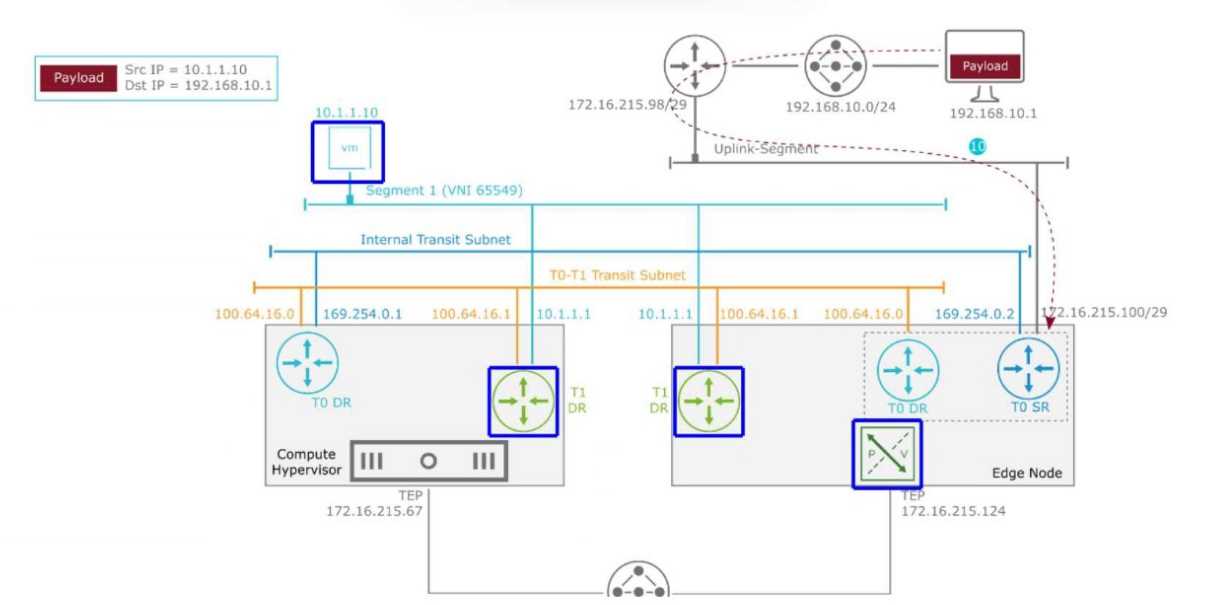
HOTSPOT An administrator is troubleshooting the packet flow of an incoming response to an ICMP Reply payload destined for 10.1.1.10 in the diagram. The packet arrived at the Tier-0 SR at 172.16.215.100/29. Which highlighted location identifies the next hop in the path to the destination? VmWare 3V0 25 question

Your Answer
4 comments in the community discussion
7
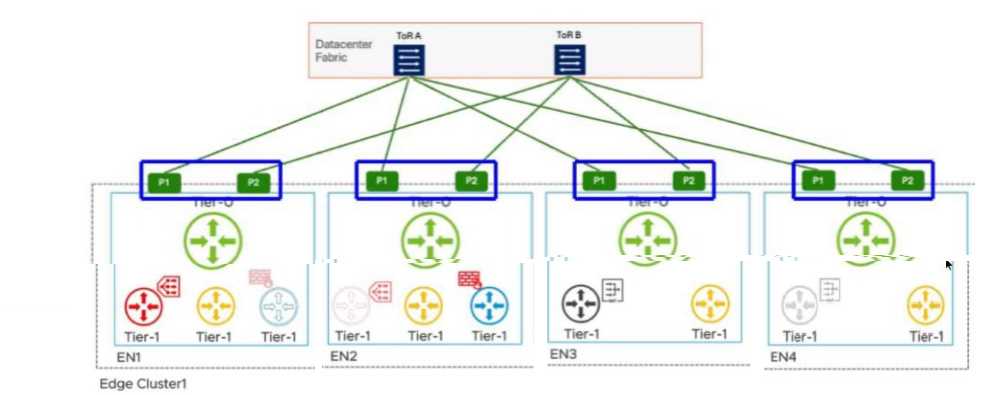
Not totally sure, but I think it's P1 and P2 on EN2. Can someone confirm if that's right?
2
Nah, it wouldn't be P1/P2 on EN1 or any other edge node. Has to be EN2 since the active Tier-1 GFW is locked to that node. Lots of folks pick the wrong uplinks here because Tier-0 is A/A, but that's a trap.
Q: 7

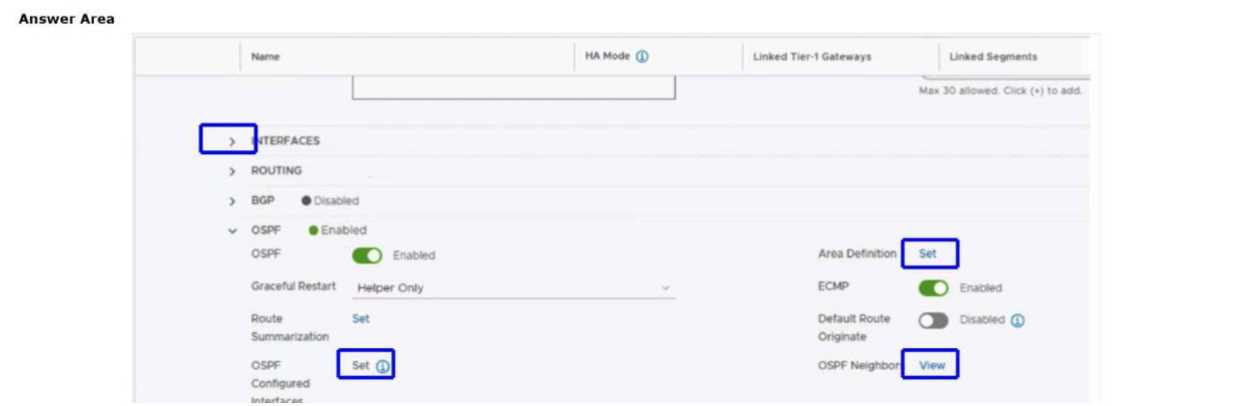
HOTSPOT An administrator has been tasked with enabling OSPF as the routing protocol for a Tier-0 Gateway. Which two items must be configured to enable OSPF for a Tier-0 Gateway? Mark two answers by clicking the two correct locations on the image. (Choose two.) VmWare 3V0 25 question

Your Answer
2 comments in the community discussion
VM vnic, had something like this in a mock. Not sure it's right.
Q: 8

HOTSPOT The network team has decided to use a single Edge Cluster to provide Tier-0 A/A Gateway routing and Tier-1 Gateway A/S services. The active Tier-1 with a Gateway Firewall service is on EN2. Which highlighted options will show the ECMP paths used by that Tier-1 GFW? VmWare 3V0 25 question

Your Answer
2 comments in the community discussion
9
On the logical link between the Tier-0 gateways. That's where you'd control which prefixes are shared for route leaking, so east-west traffic stays local to NSX and avoids hitting the physical routers. Makes sense considering oversubscription concerns.
Route-maps should go on the logical link between the Tier-0 gateways. I don't think you put them on the physical L3 devices-if you do that, you're back to sending traffic northbound, which defeats the point. Pretty sure this is one of those trick questions where people choose the wrong spot out of habit. Correct me if
Q: 9

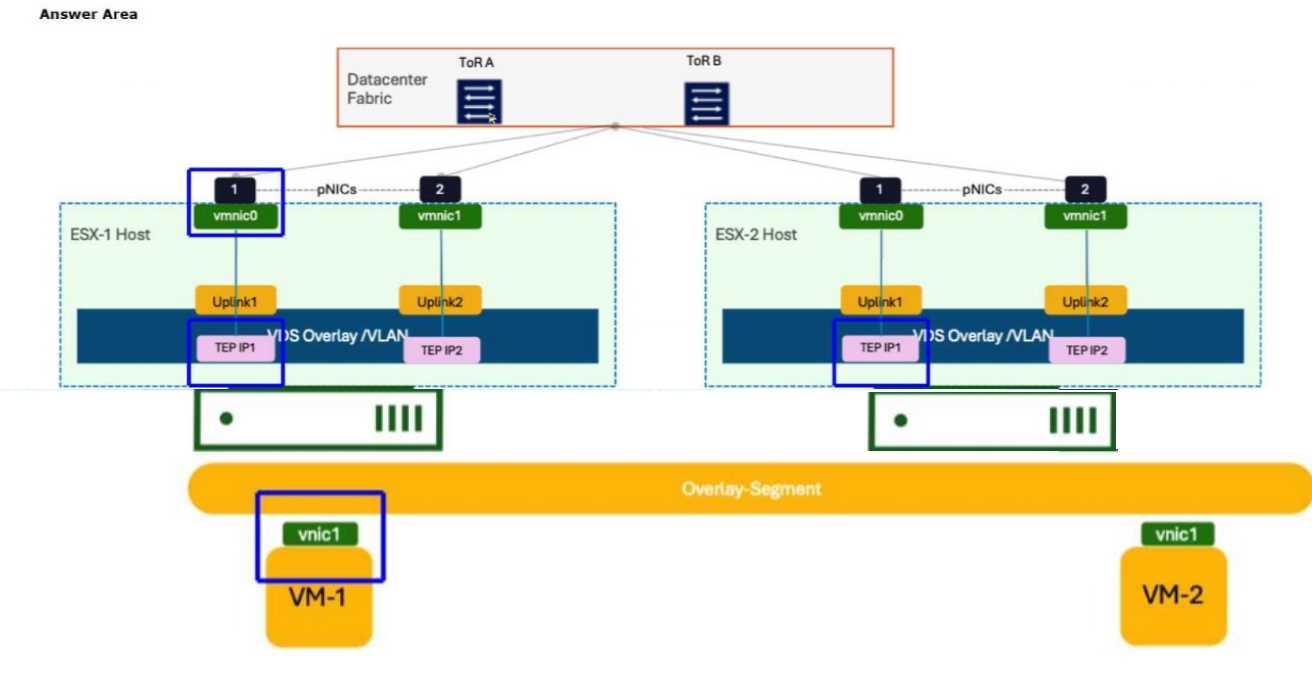
HOTSPOT The administrator is working to ascertain the encapsulation of GENEVE by reviewing the capture on Wireshark. The administrator instructed VM-1 to send a continuous ICMP request directed at VM-2. Click to highlight where the administrator should observe the GENEVE encapsulated packet. VmWare 3V0 25 question

Your Answer
2 comments in the community discussion
7
Area definition and the interfaces used for OSPF peering. Needs both so OSPF can form neighbor relationships. Pretty sure that's what VMware wants in NSX Manager for Tier-0 config, but open to correction if there's a nuance I'm missing.
6
Area definition and OSPF interfaces are the two required configs here. That matches what I keep seeing in exam reports.
Q: 10

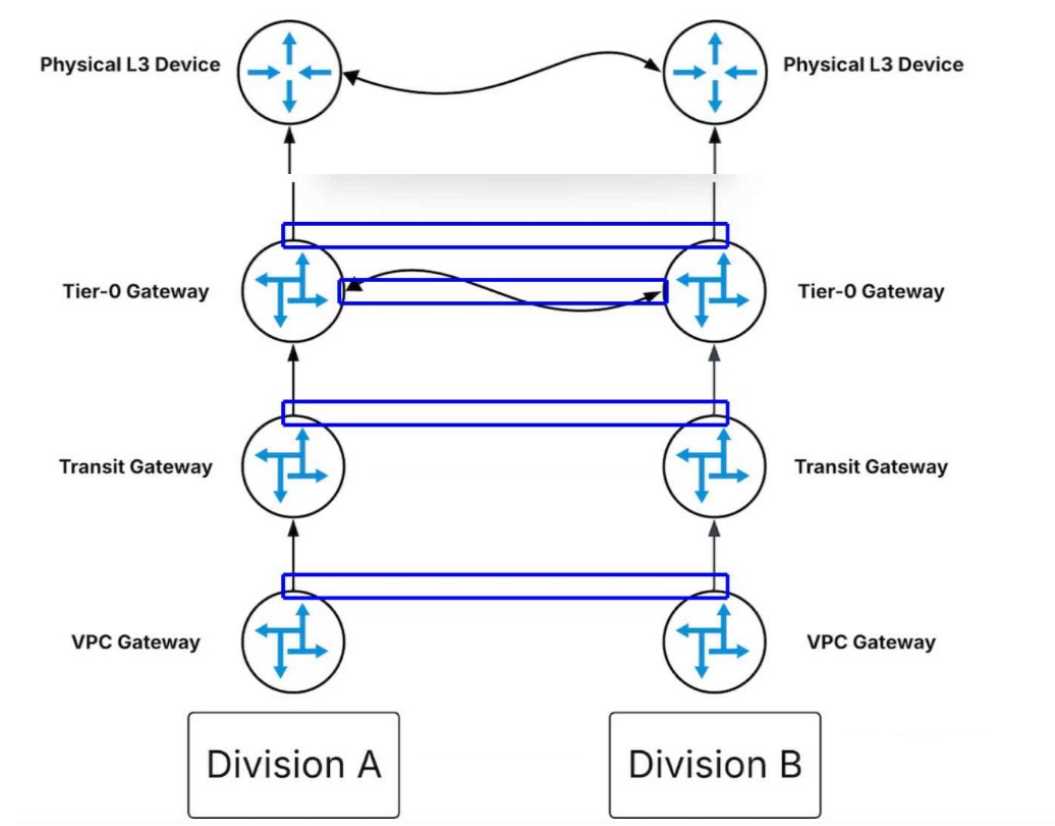
HOTSPOT An administrator implements route leaking between the Tier-0 gateways to enhance east/west communication because the physical L3 devices are oversubscribed. Where should route-maps be configured based on the architecture observed in the diagram? VmWare 3V0 25 question

Your Answer
3 comments in the community discussion
5
Makes sense, the correct next hop is the Tier-1 DR on the Edge Node.
4
Tier-1 DR on the Edge Node. Some folks might pick the TEP but that's only after the local Tier-1 DR processes it.
Q: 11

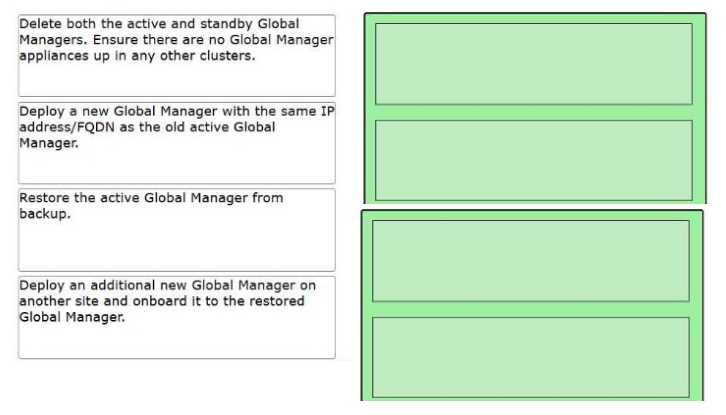
DRAG DROP An administrator has noticed that both the active and standby Global Managers have gone offline. What is the correct sequence of events to restore the Global Managers? VmWare 3V0 25 question

Drag & Drop
2 comments in the community discussion
4
I think I got these right but not 100% sure. I matched NSX Edge cluster for Tier-0, configuration at workload domain deployment, stateful services, and the streamlined network/limited NSX part. That fits from what I remember about centralized mode in VCF. Someone verify?
Q: 12

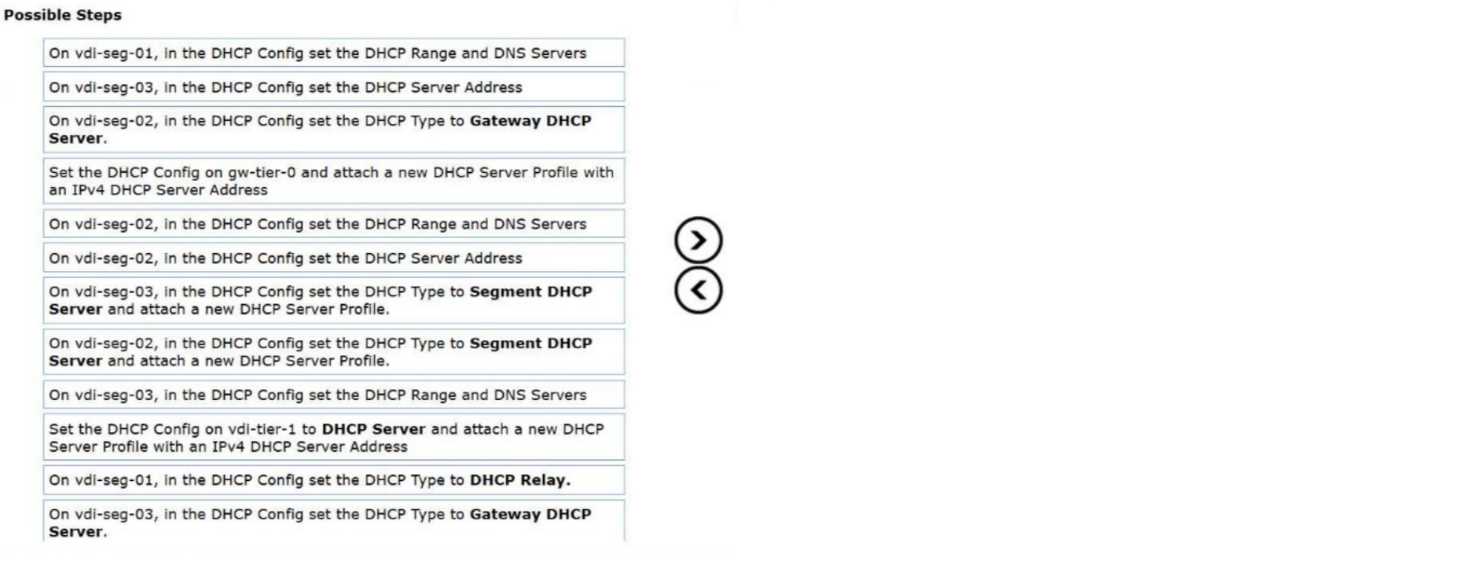
DRAG DROP An administrator is responsible for managing a VMware Cloud Foundation (VCF) Private Cloud consisting of a single VCF Fleet with a single Workload Domain. The administrator has been tasked with configuring NSX to support the new Virtual Desktop Infrastructure (VDI) solution that allows users to securely access a mainframe- based application located on the physical network. The VDI solution will use a dedicate DHCP solution for each of the the desktop pool segments and static addresses for all VDI management components. The administrator completes the following steps towards configuring DHCP: 1. Creates a new tier-1 gateway (vdi-tier-1) and links it to the tier-0 gateway (gw-tier-0). 2. Creates one new segment for vdi management (vdi-seg-01) and connects it to vdi-tier-1. 3. Creates two new segments for virtual desktops (vdi-seg-02 and vdi-seg-03) and connects them to vdi-tier-1. Drag and drop the six steps from the list of Possible Steps on the left and place them in order in to the Solution Steps. (Choose six.) VmWare 3V0 25 question

Drag & Drop
3 comments in the community discussion
1
Delete both Global Managers, deploy new GM with old IP/FQDN, restore from backup, then deploy and onboard standby. Such a pain, but that's the order.
Saw similar on an official practice, I matched: restore backup before deploying new GM. Maybe double check guide or lab for process.
Q: 13

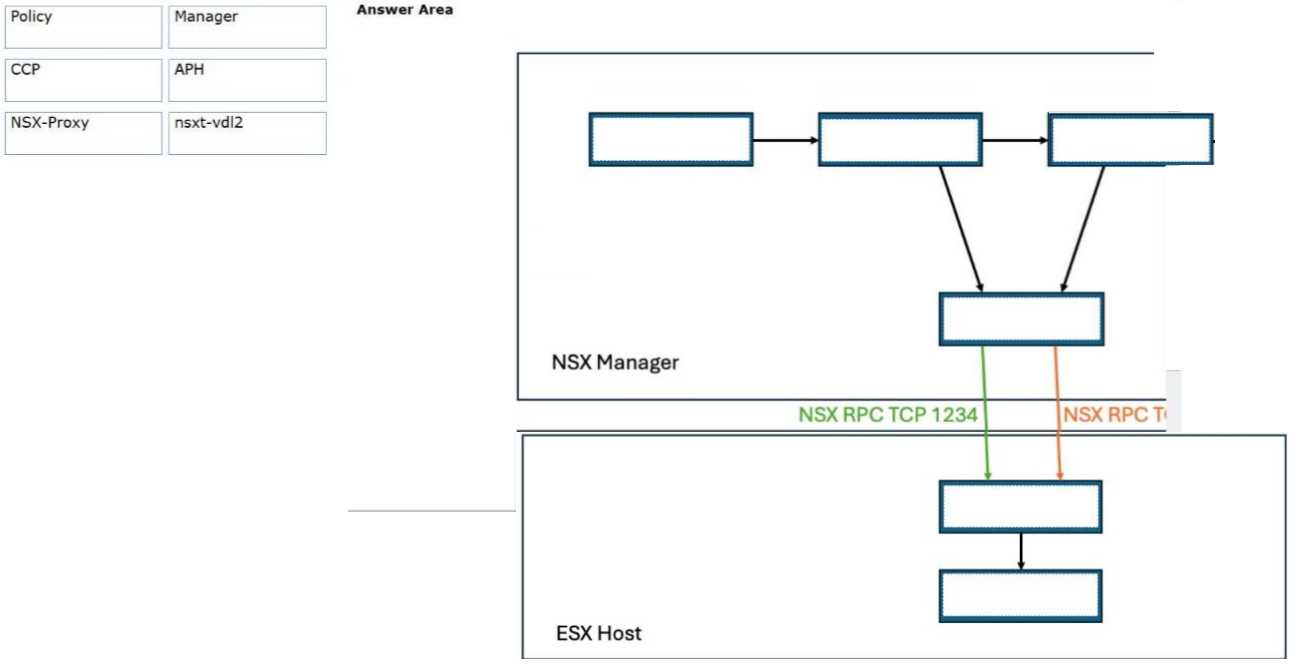
DRAG DROP An administrator is creating NSX segments in an environment. The NSX segment on an ESX Host is not realized. To troubleshoot the issue, the administrator needs to track the communication of components in the environment. Drag and drop the component to the appropriate location in the diagram to track the path from desired state to completed state. VmWare 3V0 25 question

Drag & Drop
2 comments in the community discussion
5
Uplink to Tier-0 SR → Tier-0 DR inter-tier → Tier-1 DR inter-tier on Edge → TEP to destination ESXi host → Tier-1 DR downlink to segment → VM vNIC. Pretty sure that's the right flow for NSX ingress.
3
Uplink to Tier-0 SR, then Tier-0 DR, then Tier-1 DR on Edge, TEP to host, Tier-1 DR downlink, VM vNIC.
Q: 14

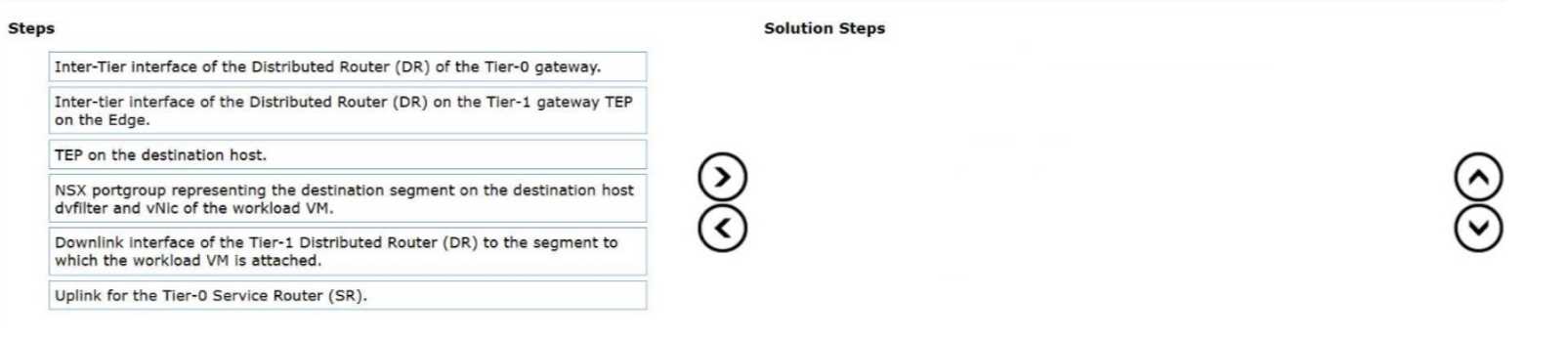
DRAG DROP An administrator is responsible for a VMware Cloud Foundation (VCF) Private Cloud. The administrator has been tasked with identifying why there is no data ingress into a workload domain. The workload domain has been configured with: . A dedicated NSX Edge Cluster. . A Tier 0 gateway. . A Tier-1 gateway that is configured for Distributed Routing only. . An NSX segment where a test virtual machine is located. As part of the exercise, the administrator must map the traffic flow for data ingress into the workload domain to identify the steps that external network traffic will take to ingress into the workload domain and reach the virtual machine. Drag and drop the six steps from the Steps list on the right and place them in order in the Solution Steps. (Choose six.) VmWare 3V0 25 question

Drag & Drop
1 comment in the community discussion
1
This looks like: Set DHCP config on vdi-tier-1 as DHCP Server & attach a new server profile, then for vdi-seg-02 and seg-03 set type to Gateway DHCP Server and define range/DNS, finally set vdi-seg-01 to DHCP Relay. Not 100 percent but lines up with typical VCF/NSX VDI builds.
Q: 15

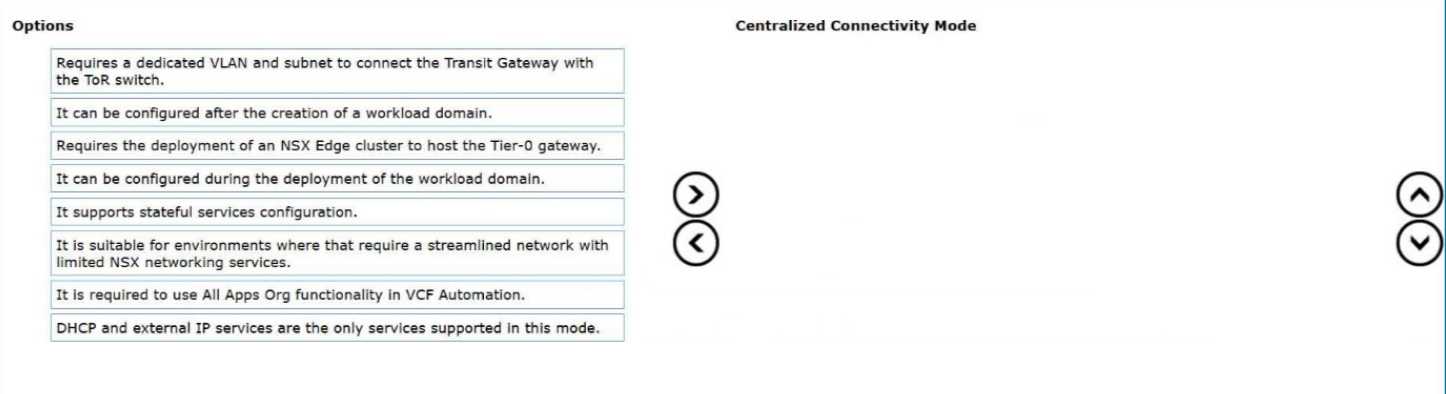
DRAG DROP An administrator was asked to explain the characteristic and requirements of Centralized Connectivity Mode which is planned to be configured in one of the workload domains in VMware Cloud Foundation (VCF) environment. Drag and drop four options from the Options list on the left and place them into the Centralized Connectivity Mode on the right in any order. (Choose four.) VmWare 3V0 25 question

Drag & Drop
3 comments in the community discussion
8
VPC Gateway: route to 100.64.0.0, Transit Gateway: default route via 0.0.0.0 and /32 next-hop, ESXi Host: packet capture with src 172.20.13.65 and ICMP.
1
I think the ESXi Host would actually show the default route to 100.64.0.0, not the VPC Gateway. Then the VPC Gateway should have the packet capture with src 172.20.13.65 and ICMP, and Transit GW gets the 0.0.0.0/32 next hop entry. Not totally sure, maybe missing something here?
Question 1 of 20

Premium Access Includes

  • ✓Quiz Simulator
  • ✓Exam Mode
  • ✓Progress Tracking
  • ✓Question Saving
  • ✓Flash Cards
  • ✓Drag & Drops
  • ✓3 Months Access
  • ✓PDF Downloads
Get Premium Access
Scroll to Top

FLASH OFFER

Days
Hours
Minutes
Seconds

avail 10% DISCOUNT on YOUR PURCHASE