Free 2v0-21.23 Practice Test Questions and Answers (2026)

View Mode
Q: 1
An administrator wants to use tag-based placement rules on their virtual machine disks using VMware vCenter. Which option would allow the administrator to achieve this?
Options
12 comments in the community discussion
1
Nah, C is tempting if you're thinking about VASA and external arrays, but for tag-based disk placement it's A every time.
1
A
Q: 2
A vSphere environment is experiencing intermittent short bursts of CPU contention, causing brief production outages for some of the virtual machines (VMs). To understand the cause of the issue, the administrator wants to observe near real-time statistics for all VMs. Which two vSphere reporting tools could the administrator use? (Choose two.)
Options
16 comments in the community discussion
1
D , but not convinced since D (Overview) isn't as granular or real-time as A, right?
1
Yeah, A and E are good picks here. Advanced Performance Charts show near real-time stats in the client, and esxtop gives live data from the CLI. C (resxtop) is more for remote hosts, not always all VMs. Correct me if I missed something.
Q: 3
An administrator creates a virtual machine that contains the latest company-approved software, tools and security updates. Company policy requires that only full clones are allowed for server workloads. A combination of which two tasks should the administrator complete to prepare for the deployment of this virtual machine for multiple users? (Choose two.)
Options
14 comments in the community discussion
1
Option D and B. Snapshots (E) look tempting but they're mainly for backup or rollback, not prepping for full clone rollouts. Template plus customization spec is what VMware guides recommend for this scenario, at least from what I've seen in labs and practice.
Makes sense to use D and B, since templates are standard for full clone rollouts and the customization spec helps ensure unique configs per user. I saw a similar question on a practice exam and these steps were needed.
Q: 4
A company has two sites: Site A and Site B. The administrator would like to manage the VMware vCenter inventories in both sites from a single vSphere Client session. Which vCenter feature must be configured?
Options
14 comments in the community discussion
3
D. had exactly similar question in my mock. Enhanced Linked Mode is what links vCenter inventories in the same session.
2
D. not C. Enhanced Linked Mode is needed for cross-site inventory in vSphere Client, SSO alone won't show both inventories together.
Q: 5
An administrator is tasked with installing VMware vCenter. The vCenter Server Appliance must support an environment of: • 400 hosts • 4000 virtual machines Which two resources must be allocated, at a minimum, to meet the requirements? (Choose two.)
Options
17 comments in the community discussion
1
I'd pick B and D too. 8 vCPUs (D) and 30 GB memory (B) match the Medium deployment specs for vCenter, which is needed for that many hosts. Not completely sure if this changed recently but that's how I remember it.
1
D and B. A is overkill, C/E would undersize for 400 hosts. Pretty sure that's what VMware guides list for Medium size.
Q: 6
An administrator enables Secure Boot on an ESXi host. On booting the ESXi host, the following error message appears: Fatal error: 39 (Secure Boot Failed)
Options
16 comments in the community discussion
1
Why does error 39 always map to the kernel and not VIB/driver issues? Just want to be sure I'm not missing a nuance in Secure Boot chain for ESXi.
1
I don’t think it’s D. A is correct for error 39, kernel tamper triggers this specific Secure Boot fail.
Q: 7
An administrator has mapped three vSphere zones to three vSphere clusters. Which two statements are true for this vSphere with Tanzu zonal Supervisor enablement? (Choose two.)
Options
14 comments in the community discussion
1
B/E from what I've seen in the official docs and practice tests.
1
Maybe D and A. I saw something similar on a practice exam where it indicated Supervisors could be mapped per zone, and Namespaces would stay inside that zone. Not totally sure, anybody else see it this way?
Q: 8
An administrator is completing the configuration of a new vSphere cluster and has enabled vSphere High Availability (HA) and vSphere Distributed Resource Scheduler (DRS). After adding the ESXi hosts to the cluster, which networking information will the administrator be prompted to provide when using the Cluster Quickstart workflow?
Options
15 comments in the community discussion
1
Yeah, it's A. Quickstart specifically wants you to set up vMotion networking right after adding hosts if you have HA and DRS, so the cluster can actually balance workloads and recover from failures. You aren't prompted for vSAN or VM network unless you've enabled those features. Unless I'm missing a new UI change, I
1
A tbh
Q: 9
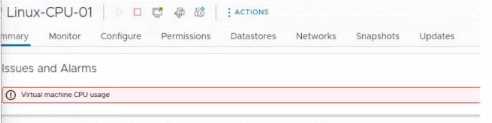
Refer to the exhibit. VMware 2V0 21 question After removing an ESXi host from a cluster for maintenance, a number of virtual machines have encountered the warning seen in the exhibit. After re-adding the ESXi, the issue is resolved. Which step should the administrator take to move the triggered alarm to its normal state?
Options
14 comments in the community discussion
2
I've always just acknowledged these alarms and they go away, so C.
1
I don’t think C is right, it’s got to be B. Acknowledge only stops the pop-up, doesn’t change the alarm itself in vSphere.
Q: 10
An administrator is tasked with configuring vSphere Trust Authority. The administrator has completed the following steps: • Set up the workstation • Enabled the Trust Authority Administrator • Enabled the Trust Authority State • Collected information about the ESXi hosts and vCenter to be trusted Which step does the administrator need to complete next?
Options
12 comments in the community discussion
1
A tbh. You need to get the ESXi host info into the Trust Authority Cluster before you can set up the trust relationship. That's what establishes which hosts are actually being attested. Correct me if I'm wrong, but that's how the workflow goes.
1
Probably A. Process flow matches what I've seen in similar questions, nice and clear structure here.
Q: 11
An administrator is planning to upgrade a VMware vCenter instance to version 8. It is currently integrated with the following solutions: * VMware Aria Automation * VMware Cloud Director Which tool can the administrator use to run Interoperability reports before the upgrade process?
Options
5 comments in the community discussion
2
Option C for sure. vCenter Server Update Planner is built into the vSphere Client and checks compatibility with other VMware products before upgrading. Works well especially when dealing with integrations like Aria and Cloud Director. Anyone disagree?
Is B actually useful for interoperability checks, or is it more for managing Aria suite lifecycles? Official guide might help clarify.
Q: 12
An administrator is tasked with looking into the disaster recovery (DR) options for a software-defined data center (SDDC). The following requirements must be met: • All virtual machines (VMs) must be protected to a secondary site. • The source VMs must remain online until the failover. • When failing over to the secondary site, application downtime is allowed • The DR failover must be managed from the vSphere Client. • Costs must remain as low as possible. How can the administrator accomplish this task?
Options
6 comments in the community discussion
2
Maybe B. SRM with vSphere Replication is cheaper than using array-based replication and it works right from the vSphere Client. Not totally sure if VCDR (A) could apply, but I think B hits all the requirements.
Its B
Q: 13
A VMkernel port is labelled PROD01 and uses the default TCP/IP stack. Currently, this VMkernel port is configured for supporting live virtual machine (VM) migrations. Which configuration change should the administrator make to isolate live VM migration traffic from other network traffic?
Options
6 comments in the community discussion
4
Option A
1
A tbh, saw similar question in exam reports. You can't switch stack after creation so need to recreate.
Q: 14
Refer to Exhibit: VMware 2V0 21 question An environment has the following configuration: • Resource Pool “RP-MOM? has a reservation of 6GHz and one running virtual machine (VM) "VM-M1? with 1 GHz reserved • Resource Pool ^RP-KID? has a reservation of 2GHz, and expandable reservations is activated The administrator creates two VMs, “VM-K1? and 'VM-K2?, in the ''RP-KID? resource pool with 2GHz reserved for each, and turns on “VM-M1 ? Given this scenario, which statement is true?
Options
5 comments in the community discussion
1
Probably C. Expandable reservations let RP-KID borrow from RP-MOM's pool, so VM-K2 can get powered on even if RP-KID itself doesn’t have enough reserved at the moment.
Its C. Expandable reservations lets the child pool use extra resources from the parent. VM-K2 can grab what's needed from RP-MOM.
Q: 15
An administrator is tasked with configuring an appropriate Single Sign-On (SSO) solution for VMware vCenter based on the following criteria: • The solution should support the creation of Enhanced Link Mode groups. • All user accounts are stored within a single Active Directory domain and the solution must support only this Active Directory domain as the identity source. • All user account password and account lockout policies must be managed within the Active Directory domain. • The solution should support token-based authentication. Which SSO solution should the administrator choose based on the criteria?
Options
6 comments in the community discussion
Option D
Looks like this is same as a common exam questions on exam reports. A fits since it uses ADFS for token-based auth like SAML/OIDC, which is needed per the requirements. Option C and B don't provide token-based federation, and D's just using LDAP, so pretty sure it's A.
Q: 16
Refer to the exhibit. VMware 2V0 21 question An administrator is tasked with adding new capacity to an existing software-defined data center (SDDC). • The SDDC currently hosts two vSphere clusters (ClusterA and ClusterB) with different CPU compatibilities. • vSphere vMotion and vSphere Distributed Resource Scheduler (DRS) are currently in use in the SDDC. • The new capacity will be implemented by provisioning four ESXi hosts running a new generation of Intel Skylake CPUs. • All workload virtual machines (VMs) must support live migration to any cluster in the SDDC. The administrator noticed the running critical "ever virtual machine (VM) shown in the exhibit is not migrating using vSphere vMotion to the original Clusters A or B. Which three steps must the administrator take to support this functionality? (Choose three.)
Options
6 comments in the community discussion
1
A reboot won't trigger the EVC baseline update, so C is wrong, ADE matches what I saw on a recent practice exam.
ADE tbh. Need to power off (E) before changing EVC on both clusters (D), then power on again (A) for the new baseline. C isn't enough for an EVC baseline change, you have to fully power cycle. Agree?
Q: 17
What are two use cases for VMware vSphere+? (Choose two.)
Options
6 comments in the community discussion
1
Probably A and E. Both are core features for vSphere+ with the cloud console management and lifecycle automation. The others don't really fit with vSphere+ use cases from what I remember.
Makes sense to pick A and E here.
Q: 18
Which feature would allow for the non-disruptive migration of a virtual machine between two clusters in a single VMware vCenter instance?
Options
3 comments in the community discussion
This is vSphere vMotion for sure, so A. Lets you move VMs live across clusters if they're part of the same vCenter. Storage vMotion only handles disks, not compute state. Unless I'm missing something, should be A-open to other ideas if anyone disagrees.
Had something like this in a mock, pretty sure it's A. vSphere vMotion does non-disruptive moves within a single vCenter, even across clusters, as long as requirements are met. Storage vMotion is only for disk files. Could be missing something, but A looks right to me.
Q: 19
Which three vSphere features are still supported for Windows-based virtual machines when enabling vSphere's -virtualization-based security feature? (Choose three.)
Options
10 comments in the community discussion
C. A and E tbh. FT isn’t supported with VBS from what I’ve read, so not D.
A C, and E are it. VBS breaks compatibility with Fault Tolerance and PCI passthrough because of how it handles VM execution-FT needs full control of VM state, but VBS changes the way that's managed. vMotion, HA, and DRS are still good since those just manage the VM container. Pretty confident but open to other views if
Q: 20
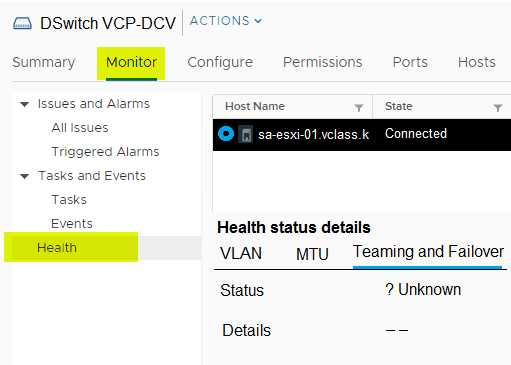
Exhibit switch VMware 2V0 21 question An administrator configures a distributed switch and adds the first VMware ESXi server to it. The administrator also performs the following activities: • The administrator assigns two uplinks to the distributed switch. • The administrator enables uplink teaming. When attempting to perform a health check of the teaming policy, the health status of the Teaming and Failover reports as ' Unknown?, as seen in the exhibit. What can the administrator changes in the distributed switch for the health status to report correctly?
Options
11 comments in the community discussion
1
A is wrong, B. You need at least two hosts so the distributed switch can send health check traffic between them, and each host has to have 2 uplinks or the teaming policy can't be validated. Pretty sure that's all they're asking here. Correct me if I'm missing something.
Classic exam gotcha, since it says minimum requirements you just need two hosts with two uplinks each for the teaming/failover health check to work. So B. I've seen this in practice labs and the official guide backs it up, but open to other takes if anyone's seen differently.
Question 1 of 20

Premium Access Includes

  • Quiz Simulator
  • Exam Mode
  • Progress Tracking
  • Question Saving
  • Flash Cards
  • Drag & Drops
  • 3 Months Access
  • PDF Downloads
Get Premium Access
Scroll to Top

FLASH OFFER

Days
Hours
Minutes
Seconds

avail 10% DISCOUNT on YOUR PURCHASE