Q: 1
An administrator has deployed a workload domain in VMware Cloud Foundation (VCF). The workload
domain was deployed with NSX managers using the XL form factor. After deployment, the
administrator realizes the NSX manager is oversized and needs to change to a smaller form factor.
What should the administrator do to accomplish this task?
Options
Discussion
I think B. Seems like resizing through the API could work since APIs can adjust VM settings, right? Not totally sure but I don't think a full redeploy should be required.
Be respectful. No spam.
Q: 2
An administrator is troubleshooting a BGP connectivity issue on a Tier-0 Gateway (Active/Active).
The Tier-0 has the following configuration:
• Uplink VLAN 100: 192.168.100.0/24
• Uplink VLAN 101: 192.168.101.0/24
• BGP neighbors configured: 192.168.100.1 and 192.168.101.1
• A single static default route (0.0.0.0/0) exists with next-hop 192.168.100.1.
Symptoms observed on both Edge Nodes:
• Get BGP neighbors —> both neighbors stuck in Idle (Connect) — "No route to peer"
• Ping to 192.168.100.1 and 192.168.101.1 succeeds from the Edge nodes
• Get route shows the default route present only on VLAN 100 interface (fp-eth0), missing on VLAN
101 (fp-eth1)
What is the root cause of both BGP sessions remaining in Idle state?
Options
Discussion
Its B? Not really sure because ping works, but maybe the ToR routers just aren't sending traffic back right. Can anyone confirm?
Be respectful. No spam.
Q: 3
When using a DHCP Relay on a segment, which design restriction must be considered?
Options
Discussion
A, Love how clear this one is, seen similar on other VMware practice sets.
B, not A
Be respectful. No spam.
Q: 4
An administrator is tasked to configure NSX Federation between separate VMware Cloud Foundation
(VCF) Fleets. Which requirement must all sites meet before being added to a Global Manager (GM)
for NSX Federation?
Options
Discussion
B
I don't think D is strictly required for initial federation setup-I've seen in some environments you just need the BGP AS numbers to match across Tier-0 gateways to facilitate routing between sites. Option B could be a trap because people focus on versioning, but AS number mismatch can break connectivity. Maybe I'm missing something but open to corrections.
Probably D, all sites need to run the same NSX version and build for federation to work right. Otherwise you’ll get sync or compatibility issues. Pretty sure on this, anyone disagree?
Be respectful. No spam.
Q: 5
An administrator has a standalone vSphere 8.0 Update 1a deployment that is running with VMware
NSX 4.1.0.2 and has to converge the deployment into a new VMware Cloud Foundation (VCF)
instance. How can the administrator accomplish this task?
Options
Discussion
Yeah, you'd use C here. VCF lets you onboard existing vSphere and NSX setups first, upgrades after.
Option D if the question was asking for a clean install rather than a converge/in-place upgrade process, right? Does it specifically require keeping current NSX config or is that up for redesign?
Be respectful. No spam.
Q: 6
HOTSPOT
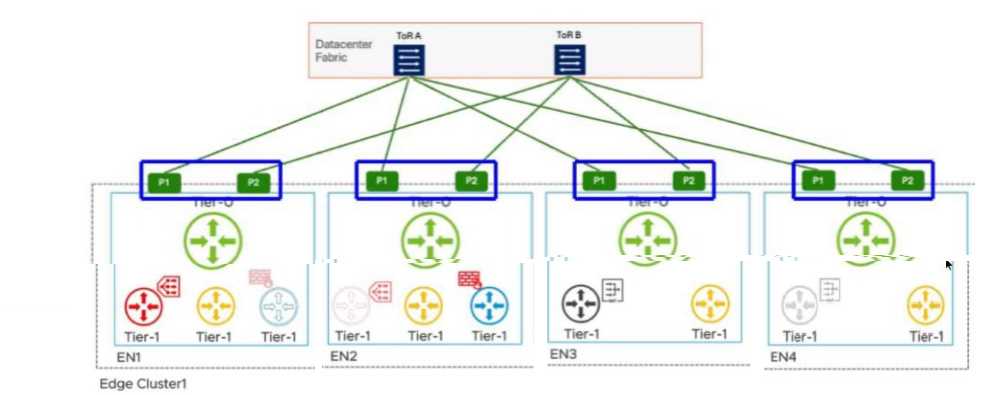
The network team has decided to use a single Edge Cluster to provide Tier-0 A/A Gateway routing
and Tier-1 Gateway A/S services.
The active Tier-1 with a Gateway Firewall service is on EN2.
Which highlighted options will show the ECMP paths used by that Tier-1 GFW?


Your Answer
Discussion
Not totally sure, but I think it's P1 and P2 on EN2. Can someone confirm if that's right?
Nah, it wouldn't be P1/P2 on EN1 or any other edge node. Has to be EN2 since the active Tier-1 GFW is locked to that node. Lots of folks pick the wrong uplinks here because Tier-0 is A/A, but that's a trap.
Yeah, it's P1 and P2 on EN2. With Tier-1 in A/S and running on EN2, only that node's uplinks handle the firewall traffic, even though Tier-0 is A/A. Confirmed by VCF docs.
Be respectful. No spam.
Q: 7
HOTSPOT
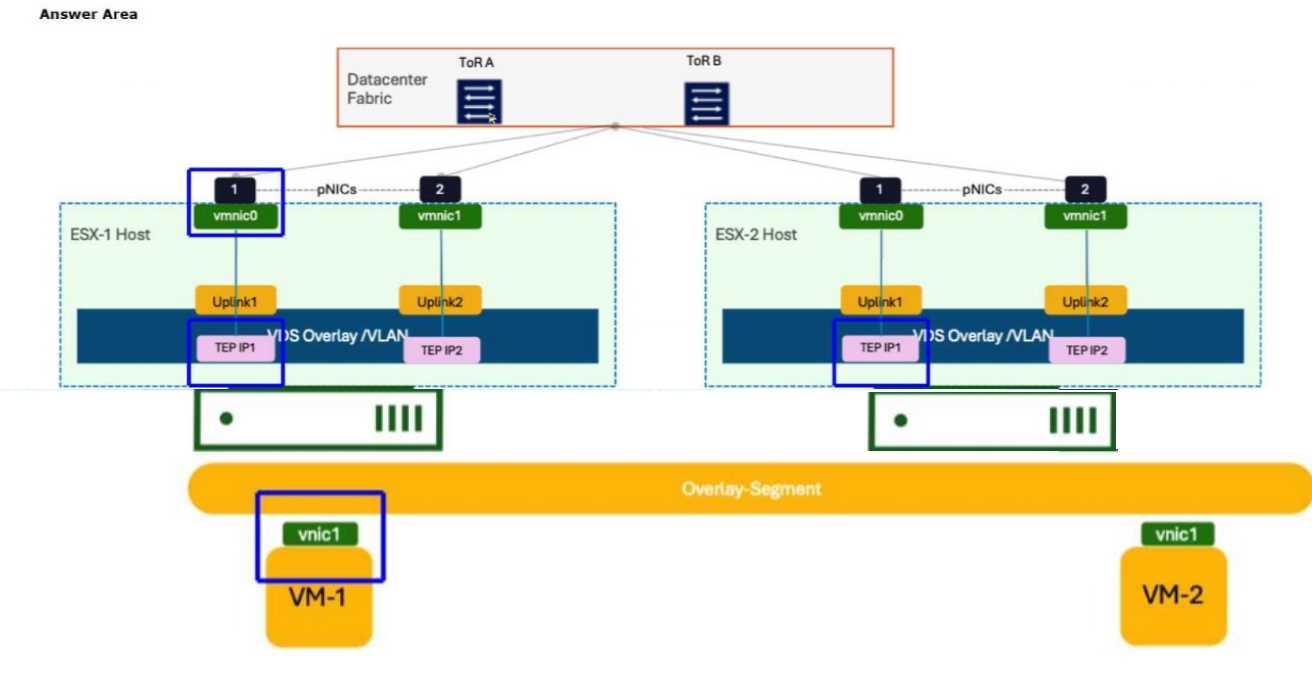
The administrator is working to ascertain the encapsulation of GENEVE by reviewing the capture on
Wireshark.
The administrator instructed VM-1 to send a continuous ICMP request directed at VM-2.
Click to highlight where the administrator should observe the GENEVE encapsulated packet.


Your Answer
Discussion
VM vnic, had something like this in a mock. Not sure it's right.
Be respectful. No spam.
Q: 8
HOTSPOT
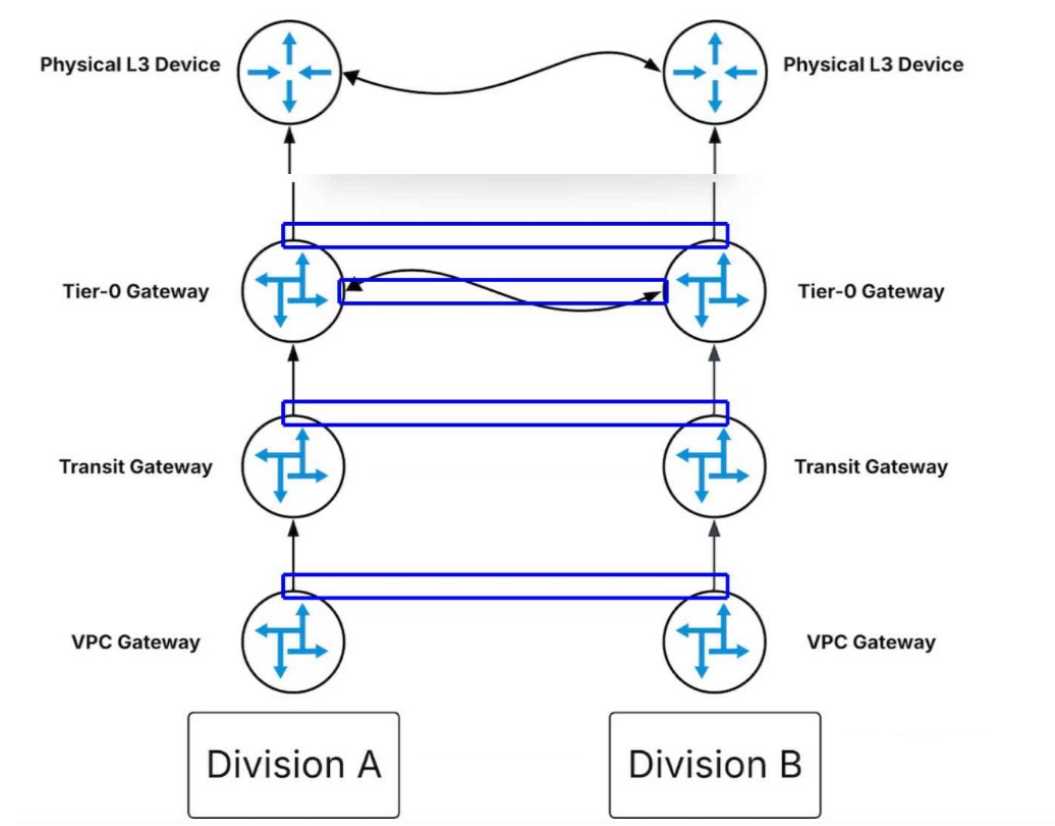
An administrator implements route leaking between the Tier-0 gateways to enhance east/west
communication because the physical L3 devices are oversubscribed.
Where should route-maps be configured based on the architecture observed in the diagram?


Your Answer
Discussion
On the logical link between the Tier-0 gateways. That's where you'd control which prefixes are shared for route leaking, so east-west traffic stays local to NSX and avoids hitting the physical routers. Makes sense considering oversubscription concerns.
Route-maps should go on the logical link between the Tier-0 gateways. I don't think you put them on the physical L3 devices-if you do that, you're back to sending traffic northbound, which defeats the point. Pretty sure this is one of those trick questions where people choose the wrong spot out of habit. Correct me if I'm missing something specific from the diagram though.
Be respectful. No spam.
Q: 9
HOTSPOT
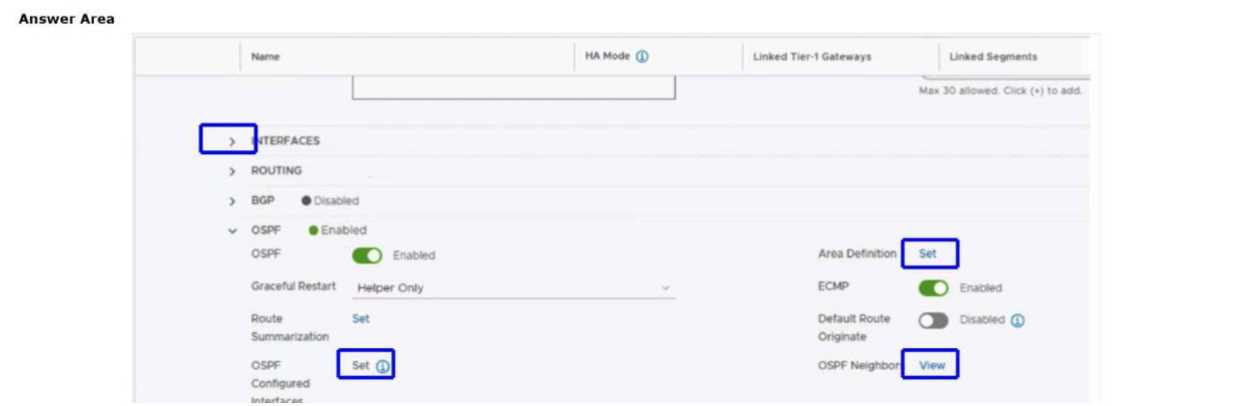
An administrator has been tasked with enabling OSPF as the routing protocol for a Tier-0 Gateway.
Which two items must be configured to enable OSPF for a Tier-0 Gateway?
Mark two answers by clicking the two correct locations on the image. (Choose two.)


Your Answer
Discussion
Area definition and the interfaces used for OSPF peering. Needs both so OSPF can form neighbor relationships. Pretty sure that's what VMware wants in NSX Manager for Tier-0 config, but open to correction if there's a nuance I'm missing.
Area definition and OSPF interfaces are the two required configs here. That matches what I keep seeing in exam reports.
Be respectful. No spam.
Q: 10
HOTSPOT
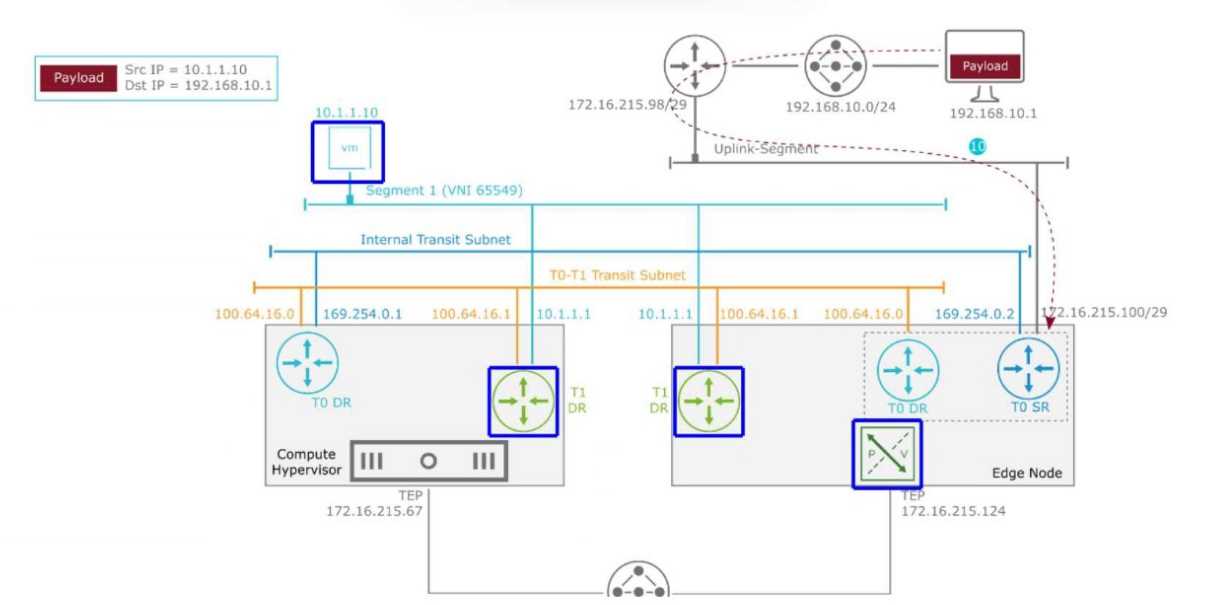
An administrator is troubleshooting the packet flow of an incoming response to an ICMP Reply
payload destined for 10.1.1.10 in the diagram.
The packet arrived at the Tier-0 SR at 172.16.215.100/29.
Which highlighted location identifies the next hop in the path to the destination?


Your Answer
Discussion
Makes sense, the correct next hop is the Tier-1 DR on the Edge Node.
Tier-1 DR on the Edge Node. Some folks might pick the TEP but that's only after the local Tier-1 DR processes it.
Be respectful. No spam.
Question 1 of 20 · Page 1 / 2