1. ISTQB Advanced Level Test Manager Syllabus (Version 2012):
Section 3.3, Risk Mitigation, Page 21: "The results of the risk assessment are used to... define the test strategy, prioritizing the testing of the high-risk items... Test execution may also be prioritized based on risk." This supports executing tests for items with higher RPNs first.
Section 3.2.2, Risk Analysis, Page 20: This section describes the process of determining the level of risk as a combination of likelihood and impact, which is the method used to calculate the RPN in the question.
2. Black, R. (2019). Advanced Software Testing - Vol. 2 (2nd ed.): Guide to the ISTQB Advanced Certification as an Advanced Test Manager. Rocky Nook.
Chapter 3, Section "Risk-Based Prioritization of Tests", Page 105: "In a risk-based approach, we prioritize our tests based on the level of risk... When test execution resources are constrained, we should execute the highest-priority tests first." This directly validates the approach of ordering tests by their calculated risk level.
3. University of Toronto, Department of Computer Science. (2012). CSC444/2108: Software Engineering, Lecture 11: Quality Assurance.
Slide 25, "Risk Exposure": The lecture notes define Risk Exposure (RE) as Prob(Failure) Cost(Failure), which is analogous to Likelihood Impact. It further states that testing should be prioritized to focus on areas with the highest RE, confirming the principle of testing high-risk items first. Available via course archives.

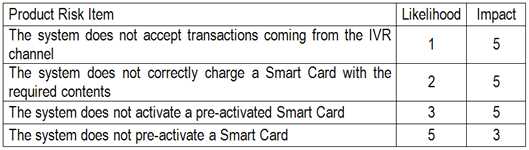 Which of the following answers describes the best execution schedule in this scenario? Number of correct responses: 1