1. Black, R. (2009). Managing the Testing Process: Practical Tools and Techniques for Managing Hardware and Software Testing (3rd ed.). John Wiley & Sons. In Chapter 7, "Developing the Test Plan," Black discusses risk-based test prioritization. The principle is to order tests to find the most important defects as early as possible. The strategy in option B is an advanced application of this principle, adapted for conditions of high uncertainty and time pressure, ensuring early feedback across all risk categories rather than focusing deeply on a potentially misidentified top-priority area.
2. Ammann, P., & Offutt, J. (2016). Introduction to Software Testing (2nd ed.). Cambridge University Press. Chapter 2, Section 2.4 ("Test Case Selection and Adequacy") discusses criteria for selecting and prioritizing tests. The scenario requires a strategy that maximizes coverage diversity early on, a common heuristic in time-constrained projects to mitigate the risk of poor initial prioritization. The breadth-first approach directly serves this goal.
3. University of Waterloo. (n.d.). ECE 453: Software Testing, Quality Assurance, and Maintenance Course Notes. Lecture on Test Case Prioritization. University courseware on software testing often describes prioritization techniques beyond simple linear ordering. The "round-robin" or breadth-first method is a standard heuristic used to ensure broad coverage and mitigate risks when test execution time is limited or when there is uncertainty about where the most critical defects lie.

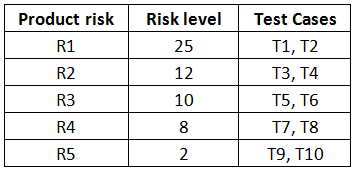 Which of the following answers describes the best test execution schedule in this scenario? Number of correct responses: 1