
Q: 8
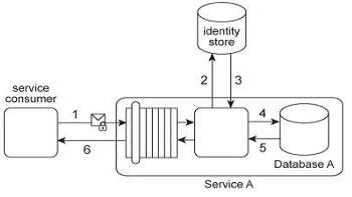
Service A provides a data access capability that can be used by a variety of service consumers. The
database records accessed by Service A are classified as either private or public. There are two types
of service consumers that use Service A:
Service consumers with public access permissions (allowed to access only public data records) and
service consumers with private access permissions (allowed to access all data records). For
performance reasons the Service A architecture uses a single database, named Database A .Each
record in Database A is classified as either private or public. After Service A is invoked by a service
consumer (1), it authenticates the request message using an identity store and retrieves the
corresponding authorization (2, 3). Once authorized, the service consumer's request is submitted to
Database A (4), which then returns the requested data (5) If the service consumer has private access
permissions, all of the returned data is included in Service A's response message (6). If the service
consumer has public access permissions, then Service A first filters the data in order to remove all
unauthorized private data records before sending to the response message to the service consumer
(6). In addition to retrieving data, Service A's data access capability can be used to update database
records. An investigation recently revealed an information leakage problem that can occur when
service consumers with public access permissions attempt to update the ID value of a database
record The ID values of all database records (private or public) must be unique. When a service
consumer with public access permissions updates a public database record with an ID value that is
already assigned to a private database record, the database returns an error message describing this
conflict. This error text reveals confidential information by stating that the ID value submitted by the
service consumer with public access permissions already exists within a private database record.
What steps can be taken to avoid this problem while preserving the requirement that all database
records (private and public) have unique ID values?

Options
Discussion
No comments yet. Be the first to comment.
Be respectful. No spam.
