
Q: 10
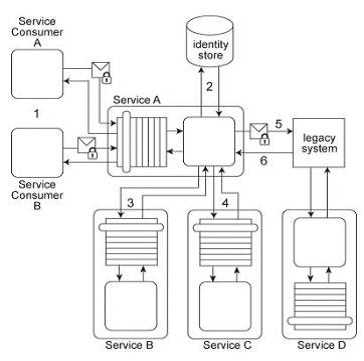
Service A has two specific service consumers, Service Consumer A and Service Consumer B (1). Both
service consumers are required to provide security credentials in order for Service A to perform
authentication using an identity store (2). If a service consumer's request message is successfully
authenticated, Service A processes the request by exchanging messages with Service B (3) and then
Service C (4). With each of these message exchanges, Service A collects data necessary to perform a
query against historical data stored in a proprietary legacy system. Service A's request to the legacy
system must be authenticated (5). The legacy system only provides access control using a single
account. If the request from Service A is permitted, it will be able to access all of the data stored in
the legacy system. If the request is not permitted, none of the data stored in the legacy system can
be accessed. Upon successfully retrieving the requested data (6), Service A generates a response
message that is sent back to either Service Consumer A or B .The legacy system is also used
independently by Service D without requiring any authentication. Furthermore, the legacy system
has no auditing feature and therefore cannot record when data access from Service A or Service D
occurs. If the legacy system encounters an error when processing a request, it generates descriptive
error codes. This service composition architecture needs to be upgraded in order to fulfill the
following new security requirements:
1. Service Consumers A and B have different access permissions and therefore, data received from
the legacy system must be filtered prior to issuing a response message to one of these two service
consumers.
2. Service Consumer A's request messages must be digitally signed, whereas request messages from
Service Consumer B do not need to be digitally signed. Which of the following statements describes a
solution that fulfills these requirements?

Options
Discussion
No comments yet. Be the first to comment.
Be respectful. No spam.
