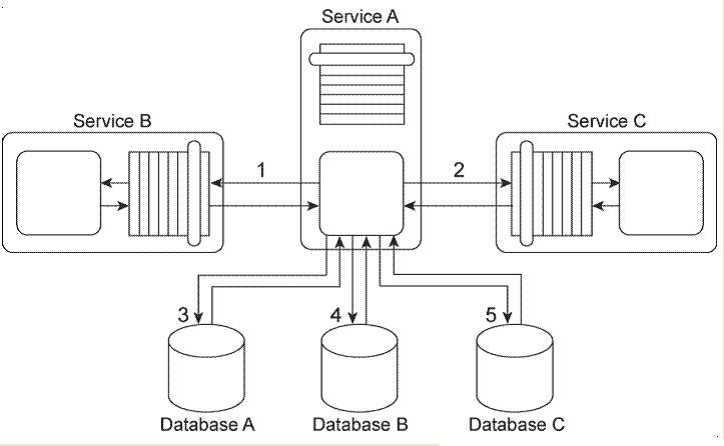
Q: 1
Service A sends a message to Service B (1). After Service B writes the message contents to Database
A (2) it issues a response message back to Service A (3). Service A then sends a message to Service C
(4). Upon receiving this message, Service C sends a message to Service D (5), which then writes the
message contents to Database B (6) and issues a response message back to Service C (7). Service A
and Service D are in Service Inventory A . Service B and Service C are in Service Inventory B .
 You are told that in this service composition architecture, all four services are exchanging invoice
related data in an XML format. However, the services in Service Inventory A are standardized to use a
different XML schema for invoice data than the services in Service Inventory B . Also, Database A can
only accept data in the Comma Separated Value (CSV) format and therefore cannot accept XML
formatted data. Database B only accepts XML formatted data. However, it is a legacy database that
uses a proprietary XML schema to represent invoice data that is different from the XML schema used
by services in Service Inventory A or Service Inventory B . What steps can be taken to enable the
planned data exchange between these four services?
You are told that in this service composition architecture, all four services are exchanging invoice
related data in an XML format. However, the services in Service Inventory A are standardized to use a
different XML schema for invoice data than the services in Service Inventory B . Also, Database A can
only accept data in the Comma Separated Value (CSV) format and therefore cannot accept XML
formatted data. Database B only accepts XML formatted data. However, it is a legacy database that
uses a proprietary XML schema to represent invoice data that is different from the XML schema used
by services in Service Inventory A or Service Inventory B . What steps can be taken to enable the
planned data exchange between these four services?
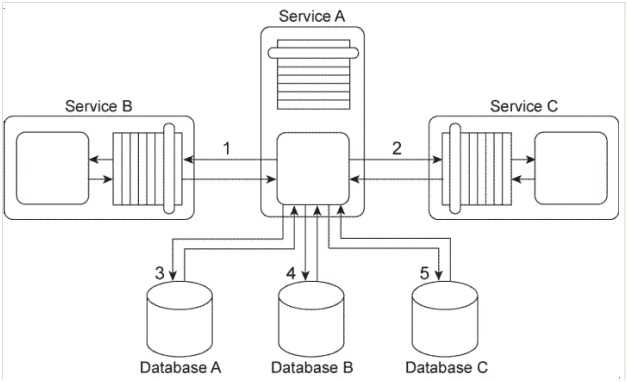 You are told that in this service composition architecture, all four services are exchanging invoice
related data in an XML format. However, the services in Service Inventory A are standardized to use a
different XML schema for invoice data than the services in Service Inventory B . Also, Database A can
only accept data in the Comma Separated Value (CSV) format and therefore cannot accept XML
formatted data. Database B only accepts XML formatted data. However, it is a legacy database that
uses a proprietary XML schema to represent invoice data that is different from the XML schema used
by services in Service Inventory A or Service Inventory B . What steps can be taken to enable the
planned data exchange between these four services?
You are told that in this service composition architecture, all four services are exchanging invoice
related data in an XML format. However, the services in Service Inventory A are standardized to use a
different XML schema for invoice data than the services in Service Inventory B . Also, Database A can
only accept data in the Comma Separated Value (CSV) format and therefore cannot accept XML
formatted data. Database B only accepts XML formatted data. However, it is a legacy database that
uses a proprietary XML schema to represent invoice data that is different from the XML schema used
by services in Service Inventory A or Service Inventory B . What steps can be taken to enable the
planned data exchange between these four services?Options
Discussion
No comments yet. Be the first to comment.
Be respectful. No spam.
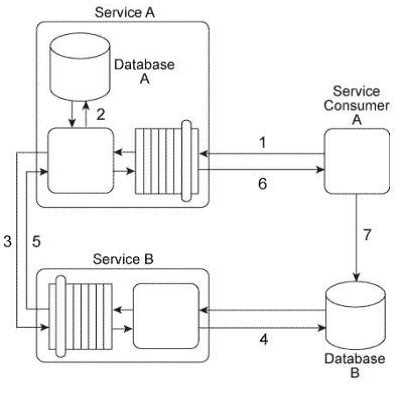 You are told that the database updates performed by Service A and Service B must be either both
successful or they cannot happen at all. The database update performed by Service Consumer A
must happen after it is given the outcome of the database updates performed by Service A and
Service B . Given that Service Consumer A must also update Database B as part of this service
composition architecture, how is it possible to fulfill these requirements?
You are told that the database updates performed by Service A and Service B must be either both
successful or they cannot happen at all. The database update performed by Service Consumer A
must happen after it is given the outcome of the database updates performed by Service A and
Service B . Given that Service Consumer A must also update Database B as part of this service
composition architecture, how is it possible to fulfill these requirements?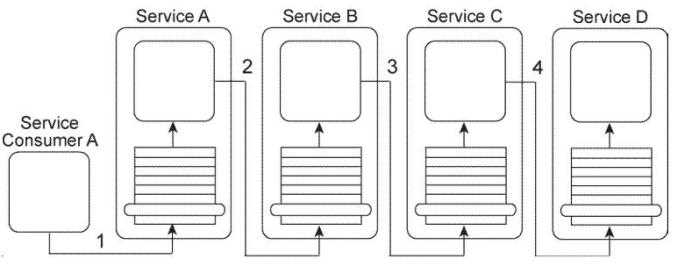 You are told that the current service composition architecture is having performance problems
because of two specific reasons. First, too many services need to be explicitly invoked in order for the
message to arrive at its destination. Secondly, because each of the intermediary services is required
to read the entire message contents in order to determine where to forward the message to, it is
taking too long for the overall task to complete. What steps can be taken to solve these problems
without sacrificing any of the functionality that currently exists?
You are told that the current service composition architecture is having performance problems
because of two specific reasons. First, too many services need to be explicitly invoked in order for the
message to arrive at its destination. Secondly, because each of the intermediary services is required
to read the entire message contents in order to determine where to forward the message to, it is
taking too long for the overall task to complete. What steps can be taken to solve these problems
without sacrificing any of the functionality that currently exists?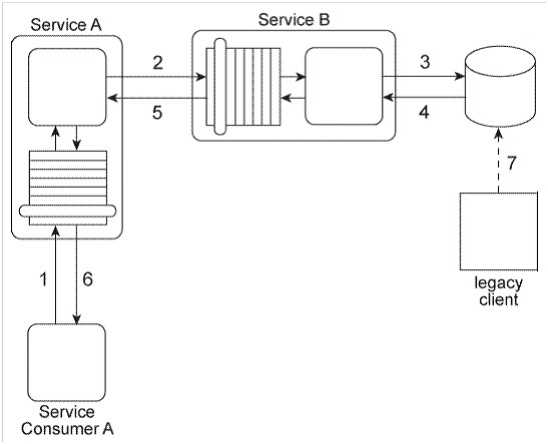 What steps can be taken to solve these problems and to prevent them from happening again in the
future?
What steps can be taken to solve these problems and to prevent them from happening again in the
future?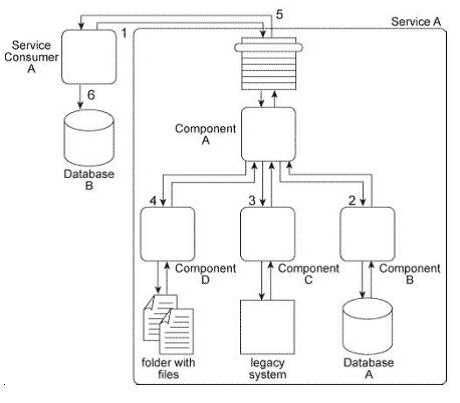 Service A is an entity service with a service architecture that has grown over the past few years. As a
result of a service inventory-wide redesign project, you are asked to revisit the Service A service
architecture in order to separate the logic provided by Components B, C, and D into three different
utility services without disrupting the behavior of Service A as it relates to Service Consumer A .
What steps can be taken to fulfill these requirements?
Service A is an entity service with a service architecture that has grown over the past few years. As a
result of a service inventory-wide redesign project, you are asked to revisit the Service A service
architecture in order to separate the logic provided by Components B, C, and D into three different
utility services without disrupting the behavior of Service A as it relates to Service Consumer A .
What steps can be taken to fulfill these requirements?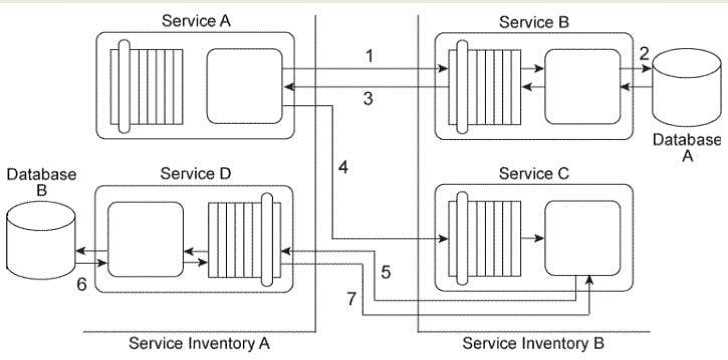 You are an architect with a project team building services for Service Inventory A . You are told that
the owners of Service Inventory A and Service Inventory B are not generally cooperative or
communicative. Cross-inventory service composition is tolerated, but not directly supported. As a
result, no SLAs for Service B and Service C are available and you have no knowledge about how
available these services are. Based on the service contracts you can determine that the services in
Service Inventory B use different data models and a different transport protocol than the services in
Service Inventory A . Furthermore, recent testing results have shown that the performance of Service
D is highly unpredictable due to the heavy amount of concurrent access it receives from service
consumers from other organizations. You are also told that there is a concern about how long Service
Consumer A will need to remain stateful while waiting for a response from Service A . What steps can
be taken to solve these problems?
You are an architect with a project team building services for Service Inventory A . You are told that
the owners of Service Inventory A and Service Inventory B are not generally cooperative or
communicative. Cross-inventory service composition is tolerated, but not directly supported. As a
result, no SLAs for Service B and Service C are available and you have no knowledge about how
available these services are. Based on the service contracts you can determine that the services in
Service Inventory B use different data models and a different transport protocol than the services in
Service Inventory A . Furthermore, recent testing results have shown that the performance of Service
D is highly unpredictable due to the heavy amount of concurrent access it receives from service
consumers from other organizations. You are also told that there is a concern about how long Service
Consumer A will need to remain stateful while waiting for a response from Service A . What steps can
be taken to solve these problems?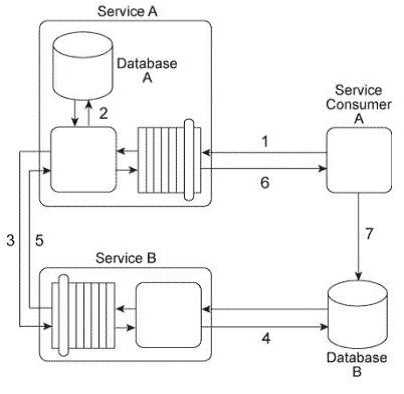 There are two problems with this service composition architecture that you are asked to address:
First, both Service Consumer A and Service B need to transform the business document data from an
XML format to a proprietary Comma Separated Value (CSV) in order to write the data to Database B .
This has led to redundant data format transformation logic that has been difficult to keep in synch
when Database B changes. Secondly, Service A is an entity service that is being reused by several
other service compositions. It has lately developed reliability problems that have caused the service
to become unavailable for extended periods. What steps can be taken to solve these problems?
There are two problems with this service composition architecture that you are asked to address:
First, both Service Consumer A and Service B need to transform the business document data from an
XML format to a proprietary Comma Separated Value (CSV) in order to write the data to Database B .
This has led to redundant data format transformation logic that has been difficult to keep in synch
when Database B changes. Secondly, Service A is an entity service that is being reused by several
other service compositions. It has lately developed reliability problems that have caused the service
to become unavailable for extended periods. What steps can be taken to solve these problems?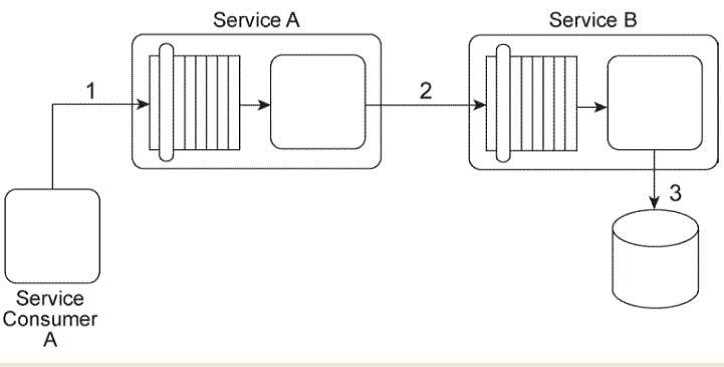 Due to the incompatibility of the XML schemas used by the services, the sending of the invoice
document from Service Consumer A through to Service B cannot be accomplished using the services
as they currently exist. Assuming that the Contract Centralization pattern is being applied and that
the Logic Centralization is not being applied, what steps can be taken to enable the sending of the
invoice document from Service Consumer A to the database without adding logic that will increase
the runtime performance requirements of the service composition?
Due to the incompatibility of the XML schemas used by the services, the sending of the invoice
document from Service Consumer A through to Service B cannot be accomplished using the services
as they currently exist. Assuming that the Contract Centralization pattern is being applied and that
the Logic Centralization is not being applied, what steps can be taken to enable the sending of the
invoice document from Service Consumer A to the database without adding logic that will increase
the runtime performance requirements of the service composition?