
Q: 7
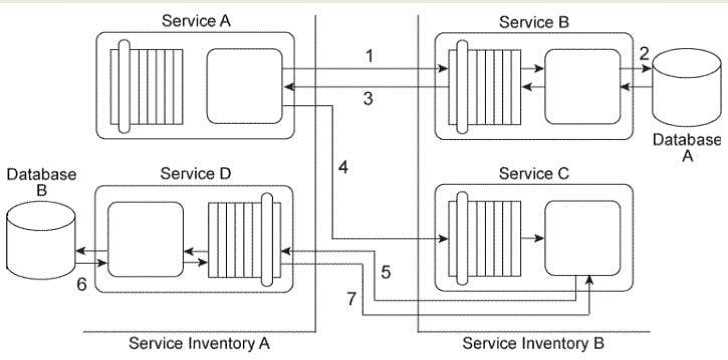
Service Consumer A invokes Service A (1). The logic within Service A is required to retrieve three
independent data values from Services B, C, and D and to then return these data values back to
Service Consumer A . To accomplish this, Service A begins by sending a request message to Service B
(2). After receiving a response message with the first data value from Service B, Service A sends a
request message to Service C (3). After it receives a response message with the second data value
from Service C, Service A then sends a request message to Service D (4). Upon receiving a response
message with the third data value from Service D . Service A finally sends its own response message
(containing all three collected data values) back to Service Consumer A . Service Consumer A and
Service A reside in Service Inventory A . Service B and Service C reside in Service Inventory B . Service
D is a public service that can be openly accessed via the World Wide Web. The service is also
available for purchase so that it can be deployed independently within IT enterprises. Due to the
rigorous application of the Service Abstraction principle within Service Inventory B, the only
information that is made available about Service B and Service C are the published service contracts.
For Service D, the service contract plus a Service Level Agreement (SLA) are made available. The SLA
indicates that Service D has a planned outage every night from 11 PM to midnight.
 You are an architect with a project team building services for Service Inventory A . You are told that
the owners of Service Inventory A and Service Inventory B are not generally cooperative or
communicative. Cross-inventory service composition is tolerated, but not directly supported. As a
result, no SLAs for Service B and Service C are available and you have no knowledge about how
available these services are. Based on the service contracts you can determine that the services in
Service Inventory B use different data models and a different transport protocol than the services in
Service Inventory A . Furthermore, recent testing results have shown that the performance of Service
D is highly unpredictable due to the heavy amount of concurrent access it receives from service
consumers from other organizations. You are also told that there is a concern about how long Service
Consumer A will need to remain stateful while waiting for a response from Service A . What steps can
be taken to solve these problems?
You are an architect with a project team building services for Service Inventory A . You are told that
the owners of Service Inventory A and Service Inventory B are not generally cooperative or
communicative. Cross-inventory service composition is tolerated, but not directly supported. As a
result, no SLAs for Service B and Service C are available and you have no knowledge about how
available these services are. Based on the service contracts you can determine that the services in
Service Inventory B use different data models and a different transport protocol than the services in
Service Inventory A . Furthermore, recent testing results have shown that the performance of Service
D is highly unpredictable due to the heavy amount of concurrent access it receives from service
consumers from other organizations. You are also told that there is a concern about how long Service
Consumer A will need to remain stateful while waiting for a response from Service A . What steps can
be taken to solve these problems?
 You are an architect with a project team building services for Service Inventory A . You are told that
the owners of Service Inventory A and Service Inventory B are not generally cooperative or
communicative. Cross-inventory service composition is tolerated, but not directly supported. As a
result, no SLAs for Service B and Service C are available and you have no knowledge about how
available these services are. Based on the service contracts you can determine that the services in
Service Inventory B use different data models and a different transport protocol than the services in
Service Inventory A . Furthermore, recent testing results have shown that the performance of Service
D is highly unpredictable due to the heavy amount of concurrent access it receives from service
consumers from other organizations. You are also told that there is a concern about how long Service
Consumer A will need to remain stateful while waiting for a response from Service A . What steps can
be taken to solve these problems?
You are an architect with a project team building services for Service Inventory A . You are told that
the owners of Service Inventory A and Service Inventory B are not generally cooperative or
communicative. Cross-inventory service composition is tolerated, but not directly supported. As a
result, no SLAs for Service B and Service C are available and you have no knowledge about how
available these services are. Based on the service contracts you can determine that the services in
Service Inventory B use different data models and a different transport protocol than the services in
Service Inventory A . Furthermore, recent testing results have shown that the performance of Service
D is highly unpredictable due to the heavy amount of concurrent access it receives from service
consumers from other organizations. You are also told that there is a concern about how long Service
Consumer A will need to remain stateful while waiting for a response from Service A . What steps can
be taken to solve these problems?Options
Discussion
No comments yet. Be the first to comment.
Be respectful. No spam.
