
Q: 4
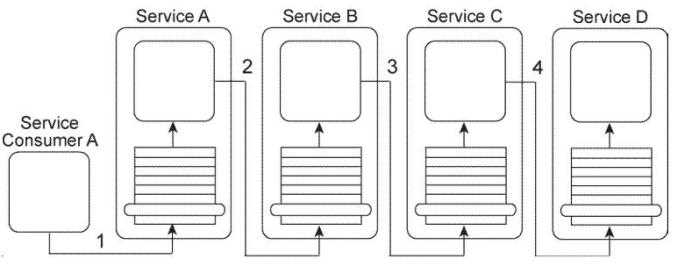
Service Consumer A sends a message to Service A (1), which then forwards the message to Service B
(2). Service B forwards the message to Service C (3), which finally forwards the message to Service D
(4). Services A, B, and C each contain logic that reads the content of the message and, based on this
content, determines which service to forward the message to. As a result, what is shown in the
Figure is one of several possible runtime scenarios.
 You are told that the current service composition architecture is having performance problems
because of two specific reasons. First, too many services need to be explicitly invoked in order for the
message to arrive at its destination. Secondly, because each of the intermediary services is required
to read the entire message contents in order to determine where to forward the message to, it is
taking too long for the overall task to complete. What steps can be taken to solve these problems
without sacrificing any of the functionality that currently exists?
You are told that the current service composition architecture is having performance problems
because of two specific reasons. First, too many services need to be explicitly invoked in order for the
message to arrive at its destination. Secondly, because each of the intermediary services is required
to read the entire message contents in order to determine where to forward the message to, it is
taking too long for the overall task to complete. What steps can be taken to solve these problems
without sacrificing any of the functionality that currently exists?
 You are told that the current service composition architecture is having performance problems
because of two specific reasons. First, too many services need to be explicitly invoked in order for the
message to arrive at its destination. Secondly, because each of the intermediary services is required
to read the entire message contents in order to determine where to forward the message to, it is
taking too long for the overall task to complete. What steps can be taken to solve these problems
without sacrificing any of the functionality that currently exists?
You are told that the current service composition architecture is having performance problems
because of two specific reasons. First, too many services need to be explicitly invoked in order for the
message to arrive at its destination. Secondly, because each of the intermediary services is required
to read the entire message contents in order to determine where to forward the message to, it is
taking too long for the overall task to complete. What steps can be taken to solve these problems
without sacrificing any of the functionality that currently exists?Options
Discussion
No comments yet. Be the first to comment.
Be respectful. No spam.
