
Q: 8
Refer to Exhibit.
 Service Consumer A sends a message to Service A (1), which then forwards the message to Service B
(2). Service B forwards the message to Service C (3), which finally forwards the message to Service D
(4). However, Services A, B and C each contain logic that reads the contents of the message to
determine what intermediate processing to perform and which service to forward the message to.
As a result, what is shown in the diagram is only one of several possible runtime scenarios.
Currently, this service composition architecture is performing adequately, despite the number of
services that can be involved in the transmission of one message. However, you are told that new
logic is being added to Service A that will require it to compose one other service to retrieve new
data at runtime that Service A will need access to in order to determine where to forward the
message to. The involvement of the additional service will make the service composition too large
and slow.
What steps can be taken to improve the service composition architecture while still accommodating
the new requirements and avoiding an increase in the amount of service composition members?
Service Consumer A sends a message to Service A (1), which then forwards the message to Service B
(2). Service B forwards the message to Service C (3), which finally forwards the message to Service D
(4). However, Services A, B and C each contain logic that reads the contents of the message to
determine what intermediate processing to perform and which service to forward the message to.
As a result, what is shown in the diagram is only one of several possible runtime scenarios.
Currently, this service composition architecture is performing adequately, despite the number of
services that can be involved in the transmission of one message. However, you are told that new
logic is being added to Service A that will require it to compose one other service to retrieve new
data at runtime that Service A will need access to in order to determine where to forward the
message to. The involvement of the additional service will make the service composition too large
and slow.
What steps can be taken to improve the service composition architecture while still accommodating
the new requirements and avoiding an increase in the amount of service composition members?
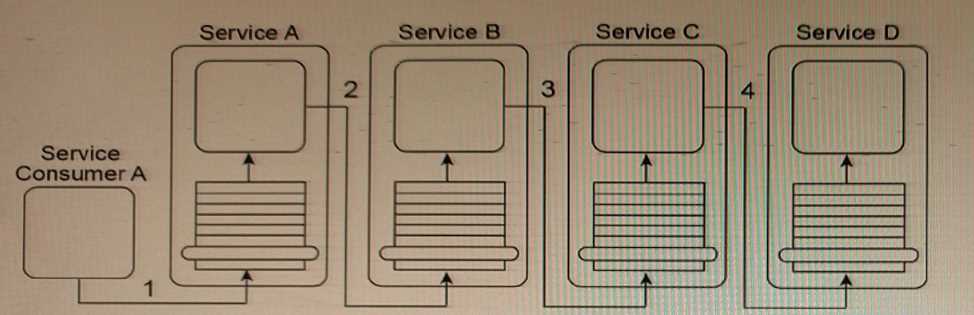 Service Consumer A sends a message to Service A (1), which then forwards the message to Service B
(2). Service B forwards the message to Service C (3), which finally forwards the message to Service D
(4). However, Services A, B and C each contain logic that reads the contents of the message to
determine what intermediate processing to perform and which service to forward the message to.
As a result, what is shown in the diagram is only one of several possible runtime scenarios.
Currently, this service composition architecture is performing adequately, despite the number of
services that can be involved in the transmission of one message. However, you are told that new
logic is being added to Service A that will require it to compose one other service to retrieve new
data at runtime that Service A will need access to in order to determine where to forward the
message to. The involvement of the additional service will make the service composition too large
and slow.
What steps can be taken to improve the service composition architecture while still accommodating
the new requirements and avoiding an increase in the amount of service composition members?
Service Consumer A sends a message to Service A (1), which then forwards the message to Service B
(2). Service B forwards the message to Service C (3), which finally forwards the message to Service D
(4). However, Services A, B and C each contain logic that reads the contents of the message to
determine what intermediate processing to perform and which service to forward the message to.
As a result, what is shown in the diagram is only one of several possible runtime scenarios.
Currently, this service composition architecture is performing adequately, despite the number of
services that can be involved in the transmission of one message. However, you are told that new
logic is being added to Service A that will require it to compose one other service to retrieve new
data at runtime that Service A will need access to in order to determine where to forward the
message to. The involvement of the additional service will make the service composition too large
and slow.
What steps can be taken to improve the service composition architecture while still accommodating
the new requirements and avoiding an increase in the amount of service composition members?Options
Discussion
No comments yet. Be the first to comment.
Be respectful. No spam.
