
Q: 5
Refer to Exhibit.
 Service A is a task service that is required to carry out a series of updates to a set of databases in
order to complete a task. To perform the database updates. Service A must interact with three other
services that each provides standardized data access capabilities.
Service A sends its first update request message to Service B (1), which then responds with a
message containing either a success or failure code (2). Service A then sends its second update
request message to Service C (3), which also responds with a message containing either a success or
failure code (4). Finally, Service A sends a request message to Service D (5), which responds with its
own message containing either a success or failure code (6).
Services B, C and D are agnostic services that are reused and shared by multiple service consumers.
This has caused unacceptable performance degradation for the service consumers of Service A as it is
taking too long to complete its overall task. You've been asked to enhance the service composition
architecture so that Service A provides consistent and predictable runtime performance. You are
furthermore notified that a new type of data will be introduced to all three databases. It is important
that this data is exchanged in a standardized manner so that the data model used for the data in
inter-service messages is the same.
What steps can be taken to fulfill these requirements?
Service A is a task service that is required to carry out a series of updates to a set of databases in
order to complete a task. To perform the database updates. Service A must interact with three other
services that each provides standardized data access capabilities.
Service A sends its first update request message to Service B (1), which then responds with a
message containing either a success or failure code (2). Service A then sends its second update
request message to Service C (3), which also responds with a message containing either a success or
failure code (4). Finally, Service A sends a request message to Service D (5), which responds with its
own message containing either a success or failure code (6).
Services B, C and D are agnostic services that are reused and shared by multiple service consumers.
This has caused unacceptable performance degradation for the service consumers of Service A as it is
taking too long to complete its overall task. You've been asked to enhance the service composition
architecture so that Service A provides consistent and predictable runtime performance. You are
furthermore notified that a new type of data will be introduced to all three databases. It is important
that this data is exchanged in a standardized manner so that the data model used for the data in
inter-service messages is the same.
What steps can be taken to fulfill these requirements?
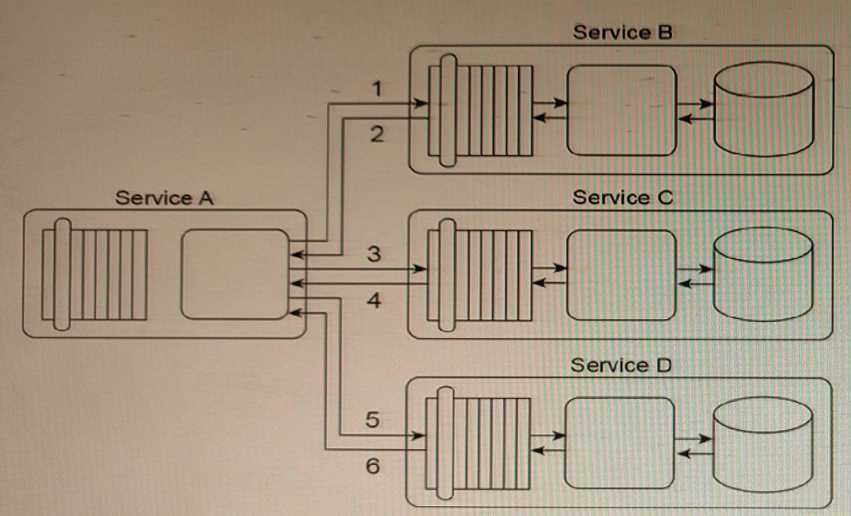 Service A is a task service that is required to carry out a series of updates to a set of databases in
order to complete a task. To perform the database updates. Service A must interact with three other
services that each provides standardized data access capabilities.
Service A sends its first update request message to Service B (1), which then responds with a
message containing either a success or failure code (2). Service A then sends its second update
request message to Service C (3), which also responds with a message containing either a success or
failure code (4). Finally, Service A sends a request message to Service D (5), which responds with its
own message containing either a success or failure code (6).
Services B, C and D are agnostic services that are reused and shared by multiple service consumers.
This has caused unacceptable performance degradation for the service consumers of Service A as it is
taking too long to complete its overall task. You've been asked to enhance the service composition
architecture so that Service A provides consistent and predictable runtime performance. You are
furthermore notified that a new type of data will be introduced to all three databases. It is important
that this data is exchanged in a standardized manner so that the data model used for the data in
inter-service messages is the same.
What steps can be taken to fulfill these requirements?
Service A is a task service that is required to carry out a series of updates to a set of databases in
order to complete a task. To perform the database updates. Service A must interact with three other
services that each provides standardized data access capabilities.
Service A sends its first update request message to Service B (1), which then responds with a
message containing either a success or failure code (2). Service A then sends its second update
request message to Service C (3), which also responds with a message containing either a success or
failure code (4). Finally, Service A sends a request message to Service D (5), which responds with its
own message containing either a success or failure code (6).
Services B, C and D are agnostic services that are reused and shared by multiple service consumers.
This has caused unacceptable performance degradation for the service consumers of Service A as it is
taking too long to complete its overall task. You've been asked to enhance the service composition
architecture so that Service A provides consistent and predictable runtime performance. You are
furthermore notified that a new type of data will be introduced to all three databases. It is important
that this data is exchanged in a standardized manner so that the data model used for the data in
inter-service messages is the same.
What steps can be taken to fulfill these requirements?Options
Discussion
No comments yet. Be the first to comment.
Be respectful. No spam.
