
Refer to Exhibit. 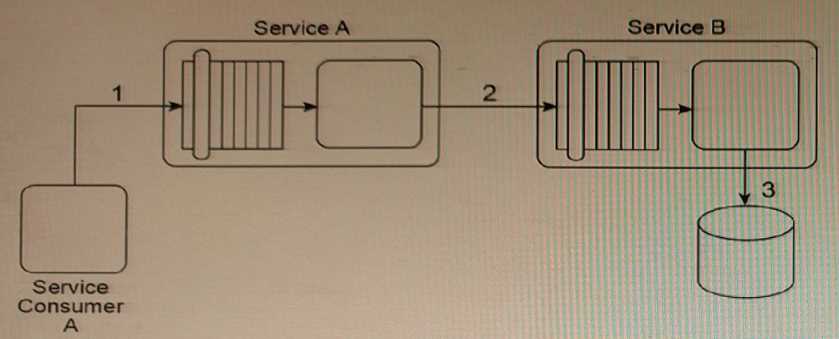 Service A is a SOAP-based Web service with a functional context dedicated to invoice-related processing. Service B is a REST-based utility service that provides generic data access to a database. In this service composition architecture, Service Consumer A sends a SOAP message containing an invoice XML document to Service A (1). Service A then sends the invoice XML document to Service B (2), which then writes the invoice document to a database (3). The data model used by Service Consumer A to represent the invoice document is based on XML Schema A. The service contract of Service A is designed to accept invoice documents based on XML Schema B. The service contract for Service B is designed to accept invoice documents based on XML Schema A. The database to which Service B needs to write the invoice record only accepts entire business documents in a proprietary Comma Separated Value (CSV) format. Due to the incompatibility of the XML schemas used by the services, the sending of the invoice document from Service Consumer A through to Service B cannot be accomplished using the services as they currently exist. Assuming that the Contract Centralization pattern is being applied and that the Logic Centralization pattern is not being applied, what steps can be taken to enable the sending of the invoice document from Service Consumer A to the database without adding logic that will increase the runtime performance requirements?
Q: 3
Options
Discussion
No comments yet. Be the first to comment.
Be respectful. No spam.
Question 3 of 10
