
Q: 10
Refer to Exhibit.
 Services A, B, and C are non-agnostic task services. Service A and Service B use the same shared state
database to defer their state data at runtime.
An assessment of the three services reveals that each contains some agnostic logic that cannot be
made available for reuse because it is bundled together with non-agnostic logic.
The assessment also determines that because Service A, Service B and the shared state database are
each located in physically separate environments, the remote communication required for Service A
and Service B to interact with the shared state database is causing an unreasonable decrease in
runtime performance.
How can the application of the Orchestration pattern improve this architecture?
Services A, B, and C are non-agnostic task services. Service A and Service B use the same shared state
database to defer their state data at runtime.
An assessment of the three services reveals that each contains some agnostic logic that cannot be
made available for reuse because it is bundled together with non-agnostic logic.
The assessment also determines that because Service A, Service B and the shared state database are
each located in physically separate environments, the remote communication required for Service A
and Service B to interact with the shared state database is causing an unreasonable decrease in
runtime performance.
How can the application of the Orchestration pattern improve this architecture?
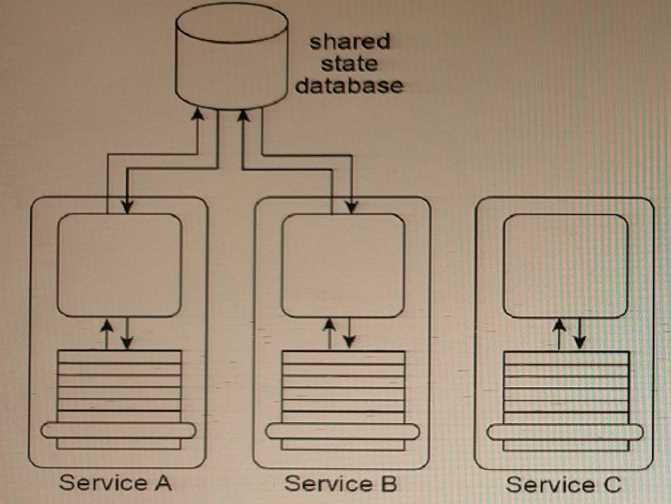 Services A, B, and C are non-agnostic task services. Service A and Service B use the same shared state
database to defer their state data at runtime.
An assessment of the three services reveals that each contains some agnostic logic that cannot be
made available for reuse because it is bundled together with non-agnostic logic.
The assessment also determines that because Service A, Service B and the shared state database are
each located in physically separate environments, the remote communication required for Service A
and Service B to interact with the shared state database is causing an unreasonable decrease in
runtime performance.
How can the application of the Orchestration pattern improve this architecture?
Services A, B, and C are non-agnostic task services. Service A and Service B use the same shared state
database to defer their state data at runtime.
An assessment of the three services reveals that each contains some agnostic logic that cannot be
made available for reuse because it is bundled together with non-agnostic logic.
The assessment also determines that because Service A, Service B and the shared state database are
each located in physically separate environments, the remote communication required for Service A
and Service B to interact with the shared state database is causing an unreasonable decrease in
runtime performance.
How can the application of the Orchestration pattern improve this architecture?Options
Discussion
No comments yet. Be the first to comment.
Be respectful. No spam.
