1. Sayles
N. B.
& Trawick
M. H. (2021). Health Information Management: Concepts
Principles
and Practice (6th ed.). AHIMA Press. In Chapter 25
"Quality and Performance Improvement
" the text describes the PDCA (Plan-Do-Check-Act) cycle
emphasizing that after implementing a change ("Do")
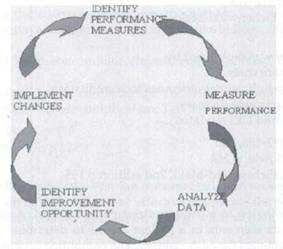
the organization must "Check" the results and "Act" on the findings. The model in the question omits these crucial "Do
" "Check
" and "Act" components
which are encompassed by the concept of ongoing monitoring and reassessment of an implemented change.
2. Agency for Healthcare Research and Quality (AHRQ). (2020
January). Plan-Do-Study-Act (PDSA) Cycle. U.S. Department of Health & Human Services. Retrieved from https://www.ahrq.gov/health-literacy/improve/precautions/tool2b.html. This official resource outlines the standard four-stage cycle for improvement. It explicitly states that the "Study" (or Check) phase involves analyzing data to determine if the change was effective
a step of reassessment missing from the question's diagram.
3. McLaughlin
C. P.
& Kaluzny
A. D. (2006). Continuous Quality Improvement in Health Care: Theory
Implementations
and Applications (3rd ed.). Jones and Bartlett Publishers. Chapter 4
"Tools and Techniques for Continuous Improvement
" details the Shewhart Cycle (PDCA)
noting that the cycle is not complete without studying the results of a test (Check/Study) and taking action based on those results (Act). This confirms the need for a reassessment phase.