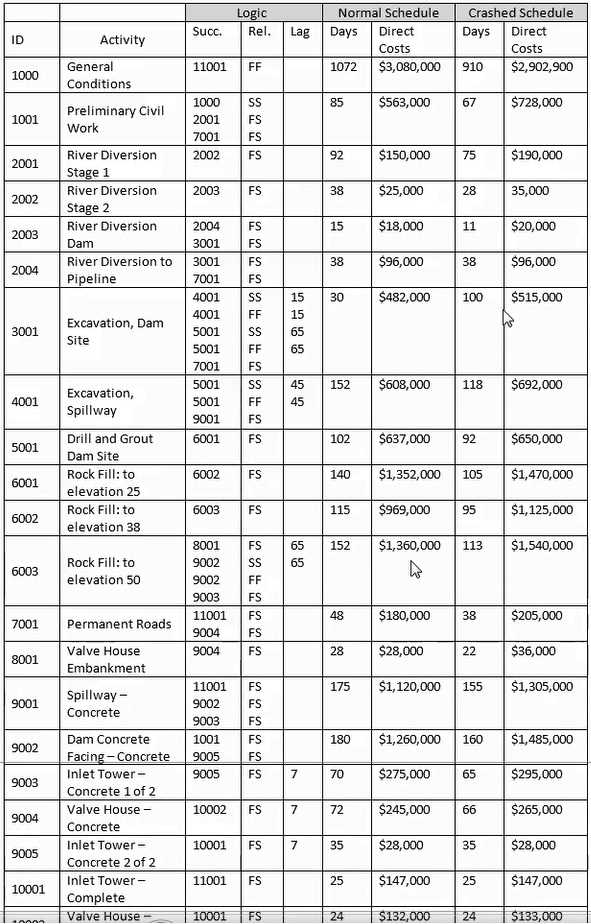
Analyze Activity 2001 in the "Normal" Schedule:
Activity 2001 ("River Diversion Stage 1") has a duration of 92 days under the "Normal" schedule.
The logic column shows it has a Successor ID of 2002, and a Finish-to-Start (FS) relationship with no
lag. This indicates that Activity 2002 will begin immediately after Activity 2001 finishes.
Identify Concurrent Activities Using the Schedule Logic:
To determine concurrency, we need to look for activities that overlap in time with Activity 2001
during its duration. Concurrent activities must either:
Start before Activity 2001 finishes, or
Finish after Activity 2001 starts.
Review Activities in the Normal Schedule:
Activity 1001 ("Preliminary Civil Work"):
Has a duration of 85 days, starts before Activity 2001, and overlaps with it.
Logic: Its successor is Activity 2001 (Start-to-Start [SS] relationship), confirming the overlap.
Activity 1000 ("General Conditions"):
Duration is 1072 days. However, this is an overarching activity, and its inclusion is not specific to
being concurrent with Activity 2001.
Activity 7001 ("Permanent Roads"):
Starts much later, after Activity 2001 ends, and thus is not concurrent.
Activity 2003 ("River Diversion Dam"):
Starts after Activity 2001 completes (FS relationship), so it is not concurrent.
Conclusion:
The only activity that overlaps and runs concurrently with Activity 2001 in the "Normal" schedule is
Activity 1001.
Reference:
PSP Study Guide (2019), Chapter on Schedule Development, Section 2.2.4 – Relationships: Discusses
how Start-to-Start (SS) and other dependencies impact concurrency.
AACE Recommended Practice 10S-90: "Cost Engineering Terminology" for definitions of concurrent
activities.