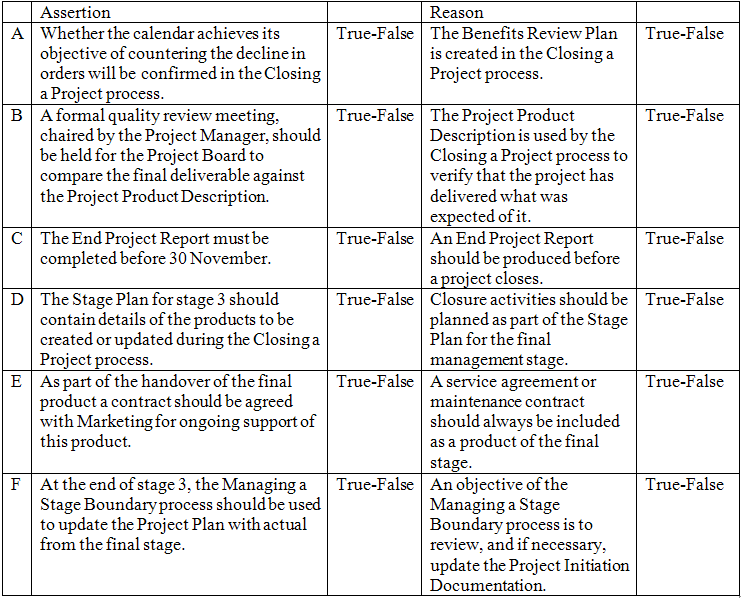
Line A: Option E (Assertion False, Reason False)
- Assertion: False. The Closing a Project process confirms acceptance of the project product (the Calendar). It does not confirm if the calendar achieves the outcome (countering the decline in orders). This benefit is realized after the project is finished and is measured during the Post-Project Benefits Review.
- Reason: False. The Benefits Management Approach (formerly Benefits Review Plan) is created during the Initiating a Project process (IP). It is only updated during the Closing a Project process to reflect post-project review dates.
Line B: Option D (Assertion False, Reason True)
- Assertion: False. The Project Board operates at the Directing level and does not participate in technical quality inspections. A quality review is a technical assessment performed by the project team or independent reviewers, not the Board.
- Reason: True. The Closing a Project process uses the original Project Product Description to verify that the final deliverable meets the criteria defined at the start of the project.
Line C: Option D (Assertion False, Reason True)
- Assertion: False. The date (30 November) refers to the delivery of the specialist product (the Calendar) for printing. The End Project Report is a management product created after the specialist products have been handed over and approved. Therefore, the report is typically completed after the product deadline as part of the final administrative closure.
- Reason: True. An End Project Report is a mandatory output of the Closing a Project process and must be produced to authorize the project's closure.
Line D: Option A (Both True, Reason Explains Assertion)
- Assertion: True. The "Closing a Project" process is not a separate stage; it is a process performed at the end of the final delivery stage (Stage 3). Therefore, the work required to close the project must be included in the Stage Plan for Stage 3.
- Reason: True. PRINCE2 principles dictate that resources and activities for closure (e.g., handover, archiving, reporting) must be planned. Since closure happens in the final stage, these activities belong in that stage's plan.
- Logic: The Reason correctly explains why the Stage Plan for Stage 3 must contain closure details.
Line E: Option E (Assertion False, Reason False)
- Assertion: False. Marketing is likely the "User" side of the project. Support for a product (maintenance) is typically agreed upon with an operational team (e.g., IT or Facilities), not the Marketing department. Additionally, internal agreements are usually Service Level Agreements (SLAs), not commercial "contracts."
- Reason: False. While operational support is often needed, it is not "always" included. Some projects (e.g., a project to dismantle a building) may not produce a product requiring maintenance. The word "always" makes this statement false in the PRINCE2 context.
Line F: Option D (Assertion False, Reason True)
- Assertion: False. The Managing a Stage Boundary process is used to plan the next stage. It is never used at the end of the final stage. The final stage transitions directly into Closing a Project.
- Reason: True. A primary objective of the Managing a Stage Boundary process is to review the performance of the current stage and update the Project Initiation Documentation (PID) if necessary for the next stage.