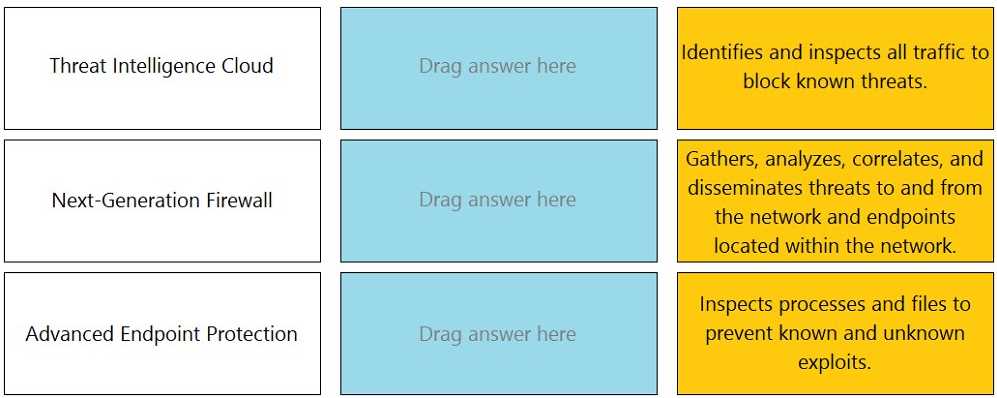
Gartner, Inc., "Next-Generation Firewalls (NGFWs) Reviews and Ratings." While a commercial source, Gartner's definition is foundational and widely cited in academic and vendor literature. It defines an NGFW as a "deep-packet inspection firewall that moves beyond port/protocol inspection and blocking to include application-level inspection, intrusion prevention, and bringing intelligence from outside the firewall." This aligns with identifying and inspecting all traffic to block known threats.
National Institute of Standards and Technology (NIST), Special Publication 800-150: Guide to Cyber Threat Information Sharing, 2016. Section 2.2 describes cyber threat intelligence as information that has been "aggregated, transformed, analyzed, interpreted, or enriched to provide the necessary context for decision-making processes." This directly corresponds to the function of a Threat Intelligence Cloud which gathers, analyzes, correlates, and disseminates threats.
Carnegie Mellon University, Software Engineering Institute (SEI), Defining Endpoint Detection and Response, 2021. This publication describes Endpoint Detection and Response (EDR), a core component of AEP, as having a primary function to "monitor endpoint events, including process creation, network connections, and modifications to the file system" to detect malicious activity. This function is essential to inspecting processes and files to prevent known and unknown exploits. (Available at: resources.sei.cmu.edu)