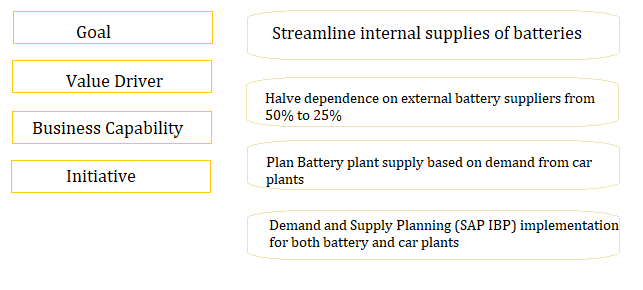
The Open Group Architecture Framework (TOGAF®) Standard, Version 10: The TOGAF framework describes the process of deriving architecture requirements from business goals. Phase A, Architecture Vision, explicitly involves identifying "business goals, strategic drivers, and objectives." Business capabilities are then identified as necessary to realize these goals. This establishes the hierarchy of Goal -> Capability.
Source: The Open Group, "TOGAF® Standard, Version 10, Phase A: Architecture Vision."
URL: https://pubs.opengroup.org/architecture/togaf-standard/adm-phase-a.html (Specifically, see Section 3.6, Approach: Business Scenarios, which links business goals to requirements).
University Courseware (MIT Sloan School of Management): Course materials on business and IT strategy frequently cover capability-based planning, where strategic goals are translated into required business capabilities, which are then enabled by specific IT initiatives.
Source: MIT OpenCourseWare, 15.561, "Information Technology as an Integrating Force in Manufacturing," Lecture Notes.
URL: https://ocw.mit.edu/courses/15-561-information-technology-as-an-integrating-force-in-manufacturing-spring-2001/pages/lecture-notes/ (Concepts in lectures on "Strategic Alignment" illustrate the flow from business strategy to IT systems/initiatives).
Peer-Reviewed Publication (IEEE): Academic literature on strategic alignment provides frameworks for linking business objectives to IT projects. These models consistently show a cascading relationship from goals to value propositions, to the capabilities needed, and finally to the enabling initiatives.
Source: Versteeg, G., & Bouwman, H. (2006). "Business architecture: A new paradigm to relate business strategy to ICT." Information Systems Frontiers, 8(2), 91-102.
URL: https://link.springer.com/article/10.1007/s10796-006-7993-y (Page 98 discusses how strategy is translated into business capabilities, which then guide the development of processes and IT systems).