
Q: 11
Which of the following describes a purpose of Architecture Principles?
Options
Discussion
B not D. Principles set direction and alignment with strategy, not contracts. Makes sense if you follow TOGAF logic. Anyone disagree?
B , that's what TOGAF guides say. Architecture principles are all about setting direction and making sure everyone's aligned with business strategy. Seen similar wording in official study guides and practice tests so pretty confident here. Disagree?
Option D here. I picked it because forming a contract sounds like it creates a formal agreement, which is sometimes talked about for architecture principles. Not totally sold on it though, since "control the business" in B also fits. Anyone else interpret it this way?
I don’t think D fits here-D is tempting but it sounds more like a governance artefact or formal agreement, not what architecture principles are. B is the better match since principles guide and align the organization’s decisions for strategic objectives. Saw a similar question in a practice bank. Open to counter points if someone disagrees.
Probably B. Architecture principles are all about setting a clear direction for business and IT alignment. Question is super clear.
Be respectful. No spam.
Q: 12
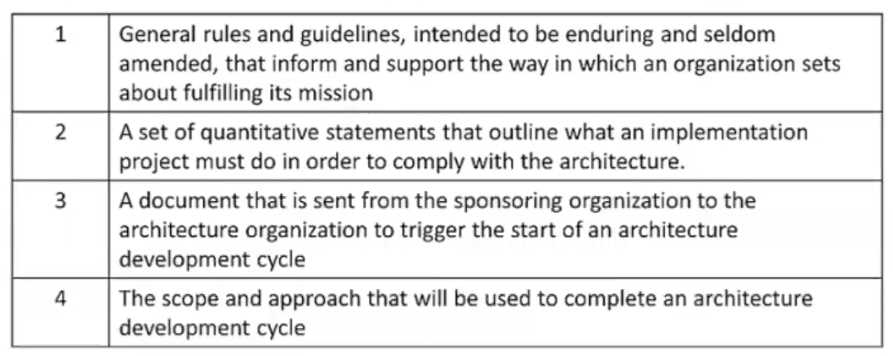
What is used to structure architectural information in an orderly way so that it can be processed to
meet stakeholder needs?
Options
Discussion
B or C? Always thought the framework (B) set up how info gets organized for stakeholders.
Option B
Its C, had a similar question come up on practice exams and this is what they wanted.
Pretty sure it's B, since architecture frameworks help organize everything. Can someone confirm?
B is wrong, C. The content metamodel directly structures all the architectural data and how pieces relate, not just the framework structure itself. Frameworks give you a method but the metamodel orders the info for processing. Pretty sure about this but open to other takes.
Gotta be B for me. The architecture framework is what sets the overall structure for organizing info, right?
C is the one here. Frameworks (B) guide method and governance but the content metamodel specifically gives structure to all architectural data itself. I get why B is tempting though, saw reports where that tripped folks up.
Why not B? Architecture frameworks define structure for organizing architecture info, feels like the sensible answer for stakeholder needs here.
Be respectful. No spam.
Q: 13
Which of the following best describes a purpose of the Gap Analysis technique?
Options
Discussion
Makes sense to me that it's D since Gap Analysis in TOGAF is about finding what functions or pieces are missing between baseline and target architectures. If the question had specifically asked about non-functional gaps, maybe A would be closer, but here it's not limited. Pretty sure D is what they're looking for, but happy to hear opposing arguments.
Maybe A. Gap Analysis can help validate if key non-functional requirements have been addressed when comparing architectures. I know D is tempting but A could fit too, since non-functional gaps are often critical in practice. Not 100% sure, open to other views.
I always thought A fit here since non-functional requirements are common gap points in architecture. Seems like Gap Analysis could help validate what's missing in those requirements too. Maybe I'm off, but A makes sense to me if you focus on non-functionals. Do you agree?
D imo. Gap Analysis is really about finding missing elements between current and future architecture, not just non-functional stuff, so A is a distractor here. Pretty sure that's what TOGAF wants. Disagree?
Spot on, it's D. Gap Analysis looks for missing functions between baseline and target architecture. Open Group/TOGAF is clear on this.
I don’t think it’s A. D is more accurate since Gap Analysis is about spotting what’s missing between current and target architectures. That usually means missing functions or processes. Pretty sure TOGAF frames it this way, but open to corrections.
Be respectful. No spam.
Q: 14
Consider the following descriptions of deliverables consumed and produced across the TOGAF ADM
cycle.
Which deliverables match these descriptions?
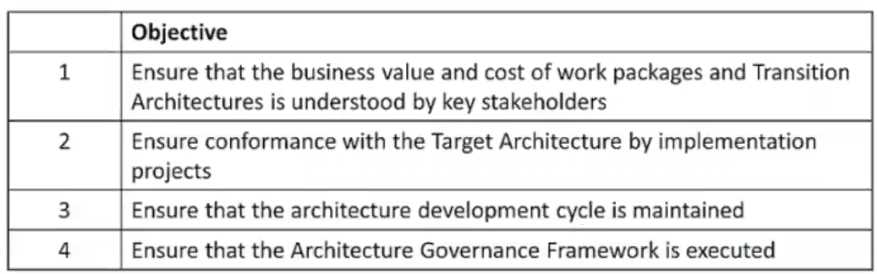
Which deliverables match these descriptions?Options
Discussion
Why do they insist on asking this ADM sequence stuff? Probably D.
C/D? If it's strictly about creation order, C could edge it, but by ADM phase flow D is the textbook match.
Yeah the ADM flow makes sense but I'm not 100% sold, maybe D is right here.
D, had something like this in a mock. Sequence matches the ADM flow.
Be respectful. No spam.
Q: 15
What is presented as ”striking a balance between positive and negative outcomes resulting from the
realization of either opportunities or threats?
Options
Discussion
C/D? Transition Management sounds tempting but positive vs negative outcomes is classic Risk Management language. Pretty sure it's D.
D , the balance of positive and negative outcomes is classic risk management speak. Saw a very similar one in a practice set, so pretty confident here.
C or D but I thought Transition Management also deals with balancing outcomes during change, especially in complex projects. It feels close, maybe I'm missing a nuance. Open to other views if someone knows for sure.
Yeah, the key is that it mentions both opportunities and threats. That terminology points right at D, Risk Management. The others don't really hit that dual aspect. Pretty sure that's what OG means here, but open if someone disagrees.
D imo. Pretty sure risk management deals with both threats and opportunities, right? Let me know if I missed something.
Be respectful. No spam.
Q: 16
What should be put in place through organization structures, roles, responsibilities, skills and
processes to carry out architectural activity effectively?
Options
Discussion
C/D? The mention of frameworks can be a trap since roles and responsibilities are sometimes documented there too.
It's A for me, since EA Capability is all about the actual org structure, defined roles, and the day-to-day execution around architecture in TOGAF. Framework (C) gives you guidance but not the operational piece, so not quite what they're asking. Pretty sure on this but let me know if I'm missing something.
Option A but if the question specifically asked for documentation instead of structure, C might fit. Strictly going by roles and processes though, that's EA Capability.
Be respectful. No spam.
Q: 17
In which part of the ADM cycle do building block gaps become associated with work packages that
will address the gaps?
Options
Discussion
This is where I'd pick D. Phase E is where you map all those building block gaps to actual work packages in TOGAF ADM. Earlier phases mostly focus on identifying the gaps, but E is about planning how to address them. Pretty sure this lines up with TOGAF guidance.
D
B , saw B come up as the trap on a mock before. Phases F deals a lot with implementation planning so it's easy to mix up.
Its B, seen something similar in official practice questions and guide. Would double-check the ADM mapping in the reference though.
Be respectful. No spam.
Q: 18
What are the four dimensions used to scope an architecture?
Options
Discussion
C vs B? I think it's probably C, that's what I've seen in TOGAF practice sets, but some folks mention B if it's not strictly TOGAF. Anyone else seen both pop up on similar questions in exam reports?
C is right, B looks tempting but those aren't the TOGAF scoping terms. If it's TOGAF, gotta be C.
B isn’t right here, C matches the official four dimensions in TOGAF. Check the framework language to be sure.
C is the TOGAF way to scope: breadth, depth, time period and architecture domains. The others mix up unrelated concepts. Pretty sure C lines right up with the official framework. Correct me if I missed anything.
Probably C, but are they asking specifically for TOGAF’s architecture scoping? If they mean something else, option B could fit.
Be respectful. No spam.
Q: 19
Which of the following are interests important to the stakeholders in a system?
Options
Discussion
C , saw a similar question in an exam report and it matched the TOGAF use of "concerns" as stakeholder interests.
Makes sense, I'd pick C. TOGAF calls stakeholder interests "concerns" so this fits the question best for me.
For these kinds of stakeholder interest questions, C lines up with the TOGAF wording. I've come across similar examples in the official study guide and TOGAF practice tests. Pretty confident it's C, but happy to hear other takes.
C not A. Requirements are the formalized needs but 'concerns' is the TOGAF term for any stakeholder-relevant interest in a system. Pretty sure that's what the question meant.
Official guide and practice tests cover this-seen "concerns" as stakeholder interests in similar practice questions before.
A tbh, because requirements capture what stakeholders actually want, so interests could line up there in some situations.
C vs A. Requirements sound tempting but TOGAF calls interests "concerns" more than anything else. I think some might mix those up.
Yeah, pretty sure it's C here since TOGAF calls out 'concerns' as the main interests from a stakeholder perspective. Requirements come after concerns get identified. Anyone else remember seeing this in the official docs?
Its C. Concerns fit the TOGAF definition for stakeholder interests.
Be respectful. No spam.
Q: 20
Consider the following ADM phases objectives.
Which phase does each objective match?
Which phase does each objective match?Options
Discussion
B tbh, Phase H is all about ongoing architecture change management and that's what objective 1 describes. Then objectives 2 and 3 fit Migration Planning (Phase F), with Phase G best matching objective 4's focus on governance. Pretty sure this lines up, but open to other views if someone thinks otherwise.
B had something like this in a mock and option B lined up with the phase objectives.
Option B If they mean the initial phase order, does that change the mapping? Official guide is helpful here.
Be respectful. No spam.
Question 11 of 20 · Page 2 / 2