In this scenario, you want the border leaf device to advertise Type 5 EVPN routes to another border
leaf in a different data center. Type 5 routes in EVPN are used to advertise IP prefixes, which means
that for proper route advertisement, you need to configure the correct settings within the evpn
hierarchy.
Step-by-Step Analysis:
Understanding EVPN Type 5 Routes:
EVPN Type 5 routes are used to advertise IP prefixes across EVPN instances, which allow different
data centers or networks to exchange routing information effectively.
VRF Target Setting:
The vrf-target configuration is crucial because it defines the export and import policies for the VRF
within the EVPN instance. For EVPN Type 5 routes to be advertised to other border leaf devices, the
vrf-target needs to be correctly configured under the evpn hierarchy, not just within the routing
instance.
Command to solve this:
move vrf-target target:65000:1 to evpn
Other Options:
Option B: Adding a VLAN configuration would not address the requirement to advertise Type 5
routes.
Option C: Adding VXLAN encapsulation may be necessary for other scenarios but does not directly
address the Type 5 route advertisement.
Option D: Changing the route-distinguisher will differentiate routes but does not impact the
advertisement of Type 5 routes to other data centers.
By moving the vrf-target to the evpn hierarchy, you enable the proper route advertisement, ensuring
that the Type 5 routes for local networks are shared with other data center border leaf devices. This
is aligned with best practices for multi-data center EVPN implementations, which emphasize the
correct placement of routing policies within the EVPN configuration.

 You want to enable the border leaf device to send Type 5 routes of local networks to the border leaf
device in another data center. What must be changed to the configuration shown in the exhibit to
satisfy this requirement?
You want to enable the border leaf device to send Type 5 routes of local networks to the border leaf
device in another data center. What must be changed to the configuration shown in the exhibit to
satisfy this requirement?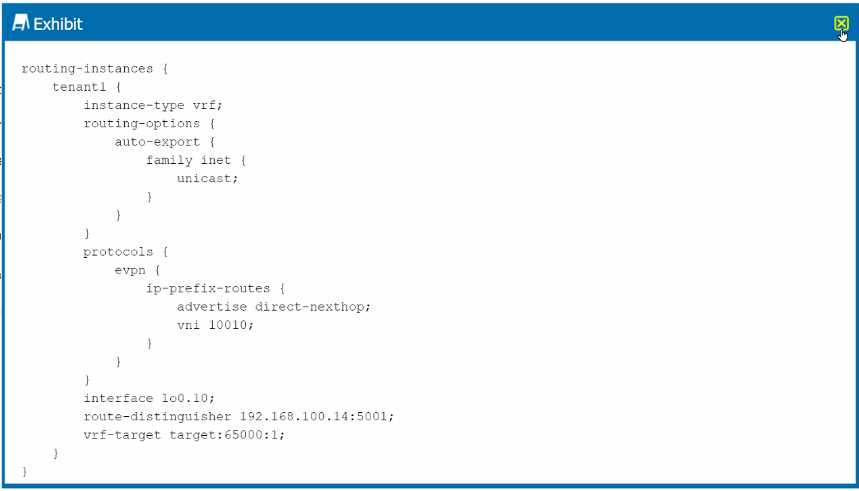 You want to enable the border leaf device to send Type 5 routes of local networks to the border leaf
device in another data center. What must be changed to the configuration shown in the exhibit to
satisfy this requirement?
You want to enable the border leaf device to send Type 5 routes of local networks to the border leaf
device in another data center. What must be changed to the configuration shown in the exhibit to
satisfy this requirement?