Option A makes sense if they're asking about link-local addresses, but does the question mention if it's for all IPv6 devices or just specific ones? If the scope is limited, that might affect which option fits best.
Q: 11
Which statement is correct about the FE80;:/10 prefix?
Options
Discussion
A . FE80::/10 is always used for link-local addressing in IPv6, not loopback or multicast. Seen this in labs before, so pretty confident unless I'm missing some weird Juniper context.
Pretty sure A, that FE80::/10 is for link-local addresses only. The question doesn’t mention anything about multicast or loopback here.
B tbh. FE80::/10 reminds me of loopback, since FE80 looks like a reserved or private range. Maybe I'm off but B seems close if not A. Anyone see similar in practice exams?
Be respectful. No spam.
Q: 12
Exhibit
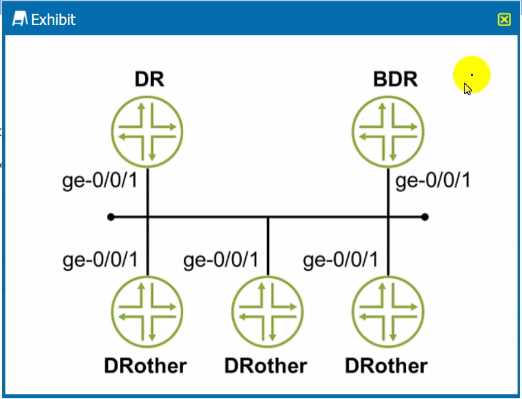
You are asked to configure the OSPF environment to prevent the DRother routers from participating
in DR/BDR election.
Referring to the exhibit, which command will accomplish this task?
You are asked to configure the OSPF environment to prevent the DRother routers from participating
in DR/BDR election.
Referring to the exhibit, which command will accomplish this task?Options
Discussion
Not D. Setting interface-type to p2p would avoid DR/BDR elections entirely, but the question asks to prevent DRother routers from participating in elections-not make the segment p2p. B (priority 0) is what Junos and most OSPF books say for this use case. Happens a lot on multi-access segments, pretty sure that's what they're testing.
I keep seeing B in both labs and the official Juniper book. Setting OSPF priority to 0 on the interface keeps that router from being in DR/BDR elections, which fits what they're asking. Pretty sure that's standard for broadcast networks, but open if anyone disagrees.
Its B, OSPF priority 0 keeps DRothers out of the election. Not 100 percent sure, open to other views.
B here, pretty sure from practice labs and Juniper docs. OSPF priority 0 means the router won't take part in DR/BDR elections at all. This comes up a lot in the official guide.
B based on similar questions in the official study guide. Setting OSPF priority to 0 stops DRother routers from joining the election.
Be respectful. No spam.
Q: 13
Which two statements are correct about the way that BGP propagates routes by default? (Choose
two.)
Options
Discussion
C or D? Check Juniper docs and try the practice labs, BGP rules can be tricky.
Probably AB, based on what I saw in the official guide and a practice test. Quick question though: is this asking about default BGP behavior or are we supposed to assume route reflection is configured? That would change which options are correct.
B tbh. A is spot on since EBGP routes are shared with IBGP peers, and B covers the split-horizon rule-IBGP-learned routes aren't passed to other IBGP by default. D trips people up if you forget that's only with route reflectors.
A and B make sense. EBGP routes get sent to IBGP by default, but IBGP-learned routes don't pass to other IBGP peers unless you're using a route reflector or confederation. Pretty sure that's what they're after.
AB
Be respectful. No spam.
Q: 14
Exhibit
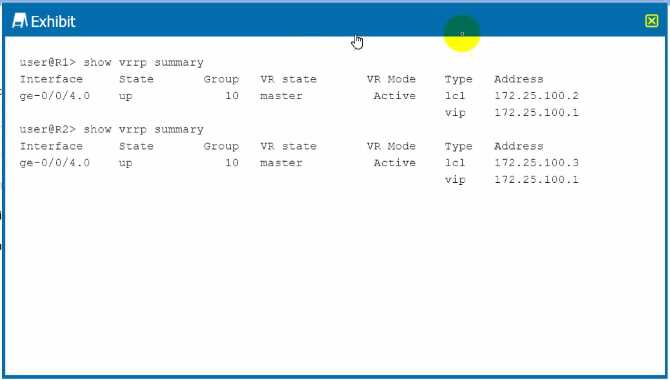
Referring to the exhibit, which statement is true about VRRP?
Referring to the exhibit, which statement is true about VRRP?Options
Discussion
C. Both routers master means VRRP is running active/active as designed. No signs of a config issue from the exhibit, so C fits here.
Option C If you enable active-active on both routers, master state for each is expected, not a config issue.
C. I've seen similar outputs in Junos practice, both routers as master usually means active/active on VRRP, not a config fault. A is tempting but that's more likely if priorities or IPs were off. Anyone disagree?
C imo. Had something like this in a mock and both routers in master means VRRP active/active, not broken.
Makes sense to pick C for this one. Both devices are in master state, which matches VRRP active/active scenarios used for load balancing. Haven't seen anything in the exhibit to suggest it's broken so C should be right.
Its C, both routers as master usually points to VRRP active/active for load sharing. A is a common distractor but that's more likely for priority or comms issues. Open to other thoughts but C matches Junos behavior.
Probably C here. In Junos, when you see both routers as master in VRRP, it's usually intentional for load balancing (active/active). I remember seeing something similar in the exam guides. The other options would suggest misconfigs or IP overlap, but nothing points to that in the exhibit. I'm about 80% sure on this, but if anyone noticed a gotcha let me know.
C VRRP active/active is normal here, both routers being master fits the exhibit details. Open to other takes but looks right.
Its C. Both routers listed as master means they're running VRRP in active/active mode for load sharing. Doesn't look like a config error from the info given. Pretty sure that's what's happening here but open to correction if I'm missing something.
Be respectful. No spam.
Q: 15
Which statement is correct about IS-IS?
Options
Discussion
I’d say C. IS-IS is actually link-state, not distance vector. B looks like a trap since path vector is usually for BGP. Correct me if I'm missing something.
C not A. IS-IS is definitely link-state, uses SPF, not distance vector like RIP or EIGRP. Pretty sure about this.
For me, A. I remember from a similar question that IS-IS acts like a distance vector protocol because it propagates routing info across routers, kind of like RIP. The trap here could be between distance vector and link-state since both share some convergence methods. Open to being corrected if I missed something technical.
Its C
Be respectful. No spam.
Question 11 of 20 · Page 2 / 2