
Q: 3
Click the Exhibit button.
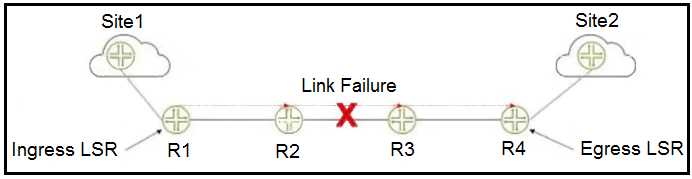
 Referring to the exhibit, you have an established RSVP LSP between R1 and R4 when you experience
a link failure between R2 and R3.
Which two statements are correct? (Choose two.)
Referring to the exhibit, you have an established RSVP LSP between R1 and R4 when you experience
a link failure between R2 and R3.
Which two statements are correct? (Choose two.)
 Referring to the exhibit, you have an established RSVP LSP between R1 and R4 when you experience
a link failure between R2 and R3.
Which two statements are correct? (Choose two.)
Referring to the exhibit, you have an established RSVP LSP between R1 and R4 when you experience
a link failure between R2 and R3.
Which two statements are correct? (Choose two.)Options
Discussion
Makes sense to me, C.
Kinda tricky one, but I'd say C. From what I remember, PathTear can go upstream from R2 to R1 when the link fails, signaling to clean up the LSP state. Not 100 percent sure, someone correct me if that's off.
Maybe C. PathTear from R2 upstream sounds like the right RSVP-TE signal after a link failure, at least that's what I've seen in some Juniper guides. Not fully sure, since the directions can be confusing here-open to being corrected.
C/D? These RSVP-TE teardown questions kill me, docs say PathTear from R2 upstream kinda fits C and D fits with ResvTear from R3 but I always mix up the flow. I think C is right too, but not 100%.
Feels like it's A and D. In RSVP-TE, R2 will send a ResvTear upstream and R3 does the ResvTear downstream. That's what you see in Juniper's docs for signaling after link failure. Open if anyone saw this behave differently.
AD imo. Standard RSVP-TE teardown on Junos sends ResvTear upstream (A) and ResvTear downstream (D) after a link failure like R2-R3. That's what I remember from the official guide. Pretty sure but open to corrections.
C , since PathTear is often sent by R2 upstream after a failure and that matches typical RSVP-TE signaling flow. I thought ResvTear comes from the downstream router, but I might be mixing up the order or direction here. Anyone else see C used in practice?
The question doesn’t ask for "first message sent after failure"-it just says which statements are correct about standard RSVP teardown. C is tempting if you think only about immediate signaling, but Juniper docs show both A and D happen as part of the normal process. Trap is picking C because of message order.
Not C, AD. That's standard RSVP-TE flow for link failures per Juniper docs.
Its A and D, matches what's covered in the Juniper official guide and the practice tests. Both routers send ResvTear messages in their respective directions after a link failure. Pretty sure that's how RSVP-TE handles this, but open to corrections if anyone's seen exceptions.
Be respectful. No spam.
