
Q: 1
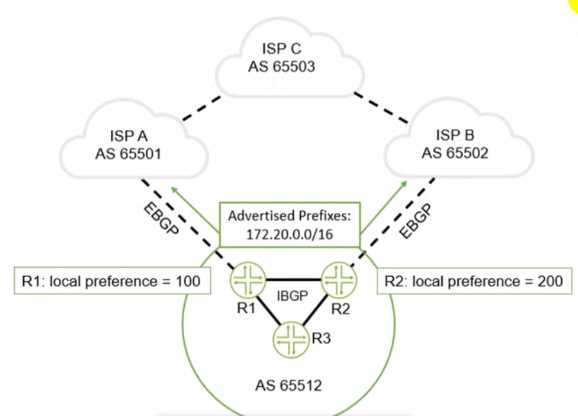
Exhibit
 You are advertising a summary route that represents your local network (172.20.0.0716) to both ISP
A and ISPB. You want to influence all traffic sent to you from ISP C to go through R2.
How would you accomplish this task?
You are advertising a summary route that represents your local network (172.20.0.0716) to both ISP
A and ISPB. You want to influence all traffic sent to you from ISP C to go through R2.
How would you accomplish this task?
 You are advertising a summary route that represents your local network (172.20.0.0716) to both ISP
A and ISPB. You want to influence all traffic sent to you from ISP C to go through R2.
How would you accomplish this task?
You are advertising a summary route that represents your local network (172.20.0.0716) to both ISP
A and ISPB. You want to influence all traffic sent to you from ISP C to go through R2.
How would you accomplish this task?Options
Discussion
Had something just like this on my exam. The trick is to use AS path prepending from R2 so ISP C sees a longer path if coming via R1, making traffic favor the R2 route. Option C lines up with that. Anyone see it differently?
A I think changing local preference on R1 (B) would push inbound traffic through that path, since higher local pref is preferred. Not totally sure if that affects ISP C though, but seems logical to me. Open to other takes.
Yeah, C makes the most sense. If you want to steer incoming routes from ISP C via R2, you need to manipulate the AS path by prepending your AS on R2's outbound route towards ISP 2. Pretty sure that's the usual BGP trick for this scenario.
C here. The distractor is A, but to influence inbound from ISP C you need to prepend on R2 when sending to ISP 2, not on R1. Seen similar logic in practice exams, pretty sure this is the right call.
These BGP questions are always tricky with the path engineering. C
Maybe C. Not totally confident here but AS path prepending on R2 looks like the best bet to affect traffic from ISP C. Anyone see a situation where A could work instead?
C
C here, not A. The trap is thinking you prepend on R1, but for inbound traffic engineering from ISP C, the AS path must be lengthened out of R2 toward ISP 2. Seen this on Juniper practice sets, pretty sure it's C unless I'm missing something.
C imo. You want ISP C to prefer the path via R2, so you prepend your AS on that route when advertising it out from R2 to influence BGP path selection using AS path length. Local preference changes (like B or D) won’t work across different ASes. Pretty sure C’s what Juniper expects here.
Be respectful. No spam.
