📖 About this Domain
This domain covers the Border Gateway Protocol (BGP), the primary exterior gateway protocol used in service provider networks. It focuses on the concepts, operation, and configuration of BGP within the Junos OS. You will learn about BGP peering, path selection, and route propagation.
🎓 What You Will Learn
- You will learn the fundamental operations of BGP, including session establishment for both IBGP and EBGP.
- You will understand the BGP path selection algorithm and the role of key attributes like LOCAL_PREF, AS_PATH, and MED.
- You will explore BGP scaling mechanisms, primarily route reflection, to manage large internal BGP topologies.
- You will learn to implement Junos routing policies to filter BGP routes and manipulate path attributes.
🛠️ Skills You Will Build
- You will build the skill to configure and verify BGP peerings under the `[edit protocols bgp]` hierarchy.
- You will be able to implement routing policies to control the flow of BGP routing information using `policy-statement`.
- You will develop troubleshooting skills using commands like `show bgp summary` and `show route receive-protocol bgp`.
- You will gain the ability to influence traffic paths by manipulating BGP attributes such as local preference and AS path prepending.
💡 Top Tips to Prepare
- Focus on hands-on lab practice for configuring BGP sessions and applying import/export policies.
- Memorize the BGP path selection algorithm and the default values for key attributes.
- Master the use of operational commands to verify BGP neighbor states and analyze advertised and received routes.
- Understand the distinct functions of a route reflector and the purpose of a cluster ID.
📖 About this Domain
This domain covers the Open Shortest Path First (OSPF) routing protocol, a link-state Interior Gateway Protocol (IGP). You will learn the concepts, operations, and configuration of both OSPFv2 and OSPFv3 within the Junos OS environment. The focus is on single-area and multi-area OSPF deployments common in enterprise networks.
🎓 What You Will Learn
- Core OSPF concepts including link-state advertisements (LSAs), designated router (DR) election, and various OSPF area types like stub and not-so-stubby areas (NSSA).
- Configuration of single-area and multi-area OSPFv2 and OSPFv3 under the [edit protocols ospf] hierarchy on Junos devices.
- The process of OSPF neighbor adjacency formation, including the different neighbor states and requirements for establishing adjacencies.
- Methods for OSPF route summarization using area-range and summary-address, and route filtering using Junos routing policies.
🛠️ Skills You Will Build
- Ability to implement OSPF routing by configuring areas, interfaces, and router parameters using the Junos CLI.
- Proficiency in verifying OSPF operations by examining neighbor adjacencies, the link-state database (LSDB), and the routing table with show commands.
- Competence in troubleshooting common OSPF issues such as adjacency failures, missing routes, and incorrect path selection.
- Skill to optimize OSPF scalability and performance through route summarization and the implementation of different stub area types.
💡 Top Tips to Prepare
- Master the different LSA types and the area types they are permitted in, as this is critical for understanding OSPF route propagation.
- Practice configuring OSPF from scratch in a lab, focusing on the [edit protocols ospf area area-id] hierarchy and interface settings.
- Memorize the OSPF neighbor states and the conditions required to form a full adjacency, such as matching MTU and area type.
- Understand the differences between stub, totally stubby, and NSSA areas, and how each type filters LSAs to reduce the LSDB size.
📖 About this Domain
This domain covers Layer 2 Ethernet switching fundamentals within the Junos OS. It details the concepts of frame forwarding, MAC address learning, and network segmentation. The focus is on configuring and monitoring switching and Virtual LANs (VLANs) on Juniper devices.
🎓 What You Will Learn
- The concepts, operation, and functionality of transparent bridging and Ethernet frame processing.
- How to describe the use case for VLANs and the process of tagging frames with 802.1Q.
- The configuration of different port modes, including access, trunk, and tagged-access.
- The basic concepts of inter-VLAN routing and its implementation using Routed VLAN Interfaces (RVIs).
🛠️ Skills You Will Build
- Configuring basic Layer 2 switching features under the `[edit ethernet-switching-options]` hierarchy.
- Implementing and verifying VLANs and assigning interfaces to them on EX Series switches.
- Monitoring the Ethernet switching table and VLAN status using operational mode commands.
- Troubleshooting common Layer 2 issues related to MAC learning and VLAN port configuration.
💡 Top Tips to Prepare
- Memorize the steps of the frame forwarding decision process: learn, flood, forward, or filter.
- Practice configuring VLANs and assigning ports using both the `set vlans` and `set interfaces` commands.
- Master the output of `show ethernet-switching table` and `show vlans` for verification and troubleshooting.
- Understand the distinction between the default VLAN and a native VLAN on a trunk port in Junos.
📖 About this Domain
This domain covers the Intermediate System-to-Intermediate System (IS-IS) routing protocol. You will learn its function as a link-state Interior Gateway Protocol (IGP) within Junos OS. The focus is on IS-IS configuration, operation, and monitoring in service provider and enterprise networks.
🎓 What You Will Learn
- You will learn the fundamentals of IS-IS, including levels, areas, and Network Entity Title (NET) addressing.
- You will understand the process of IS-IS adjacency formation and the role of the Designated Intermediate System (DIS).
- You will learn how Link-State PDUs (LSPs) are used to build and maintain the link-state database (LSDB).
- You will identify the Junos configuration statements and operational commands for implementing and verifying IS-IS.
🛠️ Skills You Will Build
- You will build the skill to configure a multi-level IS-IS routing design on Junos devices.
- You will develop the ability to troubleshoot IS-IS adjacency states using commands like `show isis adjacency`.
- You will gain proficiency in analyzing the IS-IS LSDB to verify network topology and routing information.
- You will be able to implement routing policies to control the advertisement and reception of IS-IS routes.
💡 Top Tips to Prepare
- Master the structure and components of the NET address, including the area ID and system ID.
- Practice configuring and verifying the DIS election process on broadcast multi-access network segments.
- Utilize `traceoptions` flag `all` under the IS-IS protocol hierarchy to debug adjacency and LSP exchange issues.
- Clearly differentiate the roles of Level 1 (intra-area) and Level 2 (inter-area) routing and their interaction.
📖 About this Domain
This domain covers logical tunnel interfaces for connecting non-contiguous networks across an IP-based infrastructure. It focuses on the configuration and verification of Generic Routing Encapsulation (GRE) and IP-in-IP (IP-IP) tunnels. You will learn how Junos OS uses these encapsulation methods to transport various traffic types.
🎓 What You Will Learn
- You will learn to configure GRE tunnels using the gr- interface for encapsulating multiprotocol traffic.
- You will learn to implement IP-IP tunnels using the ip- interface for simple IP packet encapsulation.
- You will learn the role of tunnel source and destination addresses in establishing the tunnel endpoints.
- You will learn to verify tunnel status and connectivity using Junos operational mode commands.
🛠️ Skills You Will Build
- You will build the skill to deploy GRE tunnels to connect remote networks over a public or private IP backbone.
- You will gain proficiency in establishing IP-IP tunnels for basic IP-only site-to-site connectivity.
- You will develop the ability to configure static routes to direct traffic through a configured tunnel interface.
- You will learn to troubleshoot tunnel encapsulation and routing issues using commands like `show interfaces terse` and `ping`.
💡 Top Tips to Prepare
- Practice the configuration of both gr- and ip- interfaces within the `[edit interfaces]` hierarchy in a lab.
- Understand the key difference that GRE can carry non-IP and multicast traffic, while IP-IP is limited to unicast IP.
- Master the `show interfaces` and `show route` commands to verify tunnel state and routing table entries.
- Ensure you configure routes, either static or dynamic, to forward traffic into the tunnel interface for it to be encapsulated.
📖 About this Domain
This domain focuses on Junos OS features that provide network resiliency and minimize service disruption. It covers technologies designed to prevent single points of failure at both the link and device level. Key concepts include link aggregation, control plane redundancy, and multi-chassis platforms.
🎓 What You Will Learn
- You will learn to configure and monitor Link Aggregation Groups (LAG) and the Link Aggregation Control Protocol (LACP) for interface redundancy.
- You will learn the concepts and operation of Graceful Restart (GR), Graceful Routing Engine Switchover (GRES), and Nonstop Active Routing (NSR) for control plane resiliency.
- You will learn the architecture and configuration of Virtual Chassis (VC) technology to manage multiple interconnected switches as a single logical device.
- You will learn the purpose of Unified In-Service Software Upgrades (ISSU) to perform software upgrades without disrupting traffic forwarding.
🛠️ Skills You Will Build
- You will build the skill to implement and verify LAGs to increase bandwidth and provide link-level failover.
- You will gain the ability to configure and differentiate between GR, GRES, and NSR to ensure continuous packet forwarding during a Routing Engine switchover.
- You will develop the skill to deploy a basic Virtual Chassis, including primary-role election and member configuration.
- You will build troubleshooting skills for HA features using Junos operational commands like `show chassis routing-engine` and `show virtual-chassis status`.
💡 Top Tips to Prepare
- Focus on the configuration hierarchy for LAGs under `set interfaces aeX aggregated-ether-options lacp`.
- Clearly distinguish the roles of Graceful Restart, GRES, and NSR, and know which protocols support them.
- Practice Virtual Chassis setup, including preprovisioned configuration and understanding the VCP and VCEP roles.
- Memorize the key `show` commands to verify the operational state of all high availability features covered in this domain.
📖 About this Domain
This domain covers routing concepts not tied to a specific dynamic routing protocol. It focuses on how Junos OS makes forwarding decisions using static, aggregate, and generated routes. You will learn about the routing information base (RIB), forwarding information base (FIB), and route preference.
🎓 What You Will Learn
- Learn the configuration and verification of static, aggregate, and generated routes within the Junos OS.
- Understand martian addresses and how Junos OS handles these unroutable IP addresses.
- Explore different routing-instance types, such as virtual-router, for network segmentation and VRF functionality.
- Grasp the concepts and configuration of per-packet and per-flow load balancing across equal-cost multipath (ECMP) links.
🛠️ Skills You Will Build
- Ability to manipulate the routing table by configuring static, aggregate, and generated routes to control traffic flow.
- Skill to implement forwarding policies using the forwarding-table export command to influence packet forwarding decisions.
- Competency in creating and managing separate routing tables using routing instances for traffic isolation.
- Proficiency in configuring and verifying load-balancing policies to distribute traffic across multiple paths.
💡 Top Tips to Prepare
- Master the distinction between the routing table (inet.0) and the forwarding table, including the route selection process.
- Practice CLI configuration of static routes with qualified-next-hop and aggregate routes with policy.
- Memorize the default route preference values as this is critical for predicting active path selection.
- Focus on the specific policy configuration required to enable per-flow load balancing using forwarding-table export.
📖 About this Domain
This domain covers Junos OS features for securing the Layer 2 environment. It focuses on mitigating common switching-based threats. You will learn to protect the network infrastructure at the access layer using EX Series switches.
🎓 What You Will Learn
- You will learn port security features including MAC limiting, persistent MAC learning, and IP source guard.
- You will learn to implement DHCP snooping to build a binding database and filter untrusted DHCP messages.
- You will learn how dynamic ARP inspection (DAI) prevents ARP spoofing by validating ARP packets.
- You will learn to configure storm control to suppress excessive broadcast, unknown unicast, and multicast traffic.
🛠️ Skills You Will Build
- You will build the skill to configure secure-access-port parameters on EX Series switch interfaces.
- You will be able to implement and verify DHCP snooping and DAI configurations in a switched environment.
- You will gain the ability to apply storm control profiles to mitigate denial-of-service attacks.
- You will develop troubleshooting skills for Layer 2 security features using Junos OS operational commands.
💡 Top Tips to Prepare
- Focus on the `ethernet-switching-options` configuration hierarchy for port security and storm control.
- Practice configuring DHCP snooping and DAI in a lab, paying close attention to trusted versus untrusted ports.
- Memorize key verification commands like `show ethernet-switching port-error` and `show dhcp-snooping binding`.
- Understand the relationship between the DHCP snooping database and how DAI uses it for validation.
📖 About this Domain
This domain covers Layer 2 loop prevention using Spanning Tree Protocol (STP) on Junos devices. It details the concepts, operations, and various versions of STP, including RSTP and MSTP. The focus is on protocol mechanics, convergence, and configuration to build a loop-free topology.
🎓 What You Will Learn
- Identify the concepts, operation, and functionality of legacy STP, RSTP, and MSTP.
- Understand the function of Bridge Protocol Data Units (BPDUs) and the root bridge election process.
- Differentiate between STP port roles like root port, designated port, and alternate port.
- Recognize the various port states in STP and RSTP, such as blocking, listening, learning, and forwarding.
🛠️ Skills You Will Build
- Configure and monitor RSTP and MSTP on Juniper EX Series switches.
- Implement STP protection features including BPDU protection, root protection, and loop protection.
- Troubleshoot common STP issues like convergence failures and unexpected topology changes.
- Analyze STP output from operational mode commands to verify topology and port status.
💡 Top Tips to Prepare
- Master the root bridge election process and path cost calculation for all STP variants.
- Practice configuring MSTP instances and correctly mapping VLANs to an MSTI.
- Memorize the differences in port states and convergence times between legacy STP and RSTP.
- Utilize `show spanning-tree bridge` and `show spanning-tree interface` commands to validate configurations in a lab.

 Referring to the exhibit, which statement about the IS-IS interface is true?
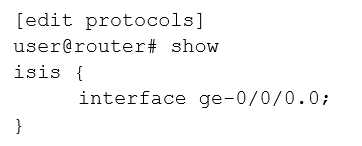 Referring to the exhibit, which statement about the IS-IS interface is true?