OSPF DR/BDR election is a process that occurs on multi-access data links. It is intended to select two
OSPF nodes: one to be acting as the Designated Router (DR), and another to be acting as the Backup
Designated Router (BDR). The DR and BDR are responsible for generating network LSAs for the multi-
access network and synchronizing the LSDB with other routers on the same network1.
The DR/BDR election is based on two criteria: the OSPF priority and the router ID. The OSPF priority
is a value between 0 and 255 that can be configured on each interface participating in OSPF. The
default priority is 1. A priority of 0 means that the router will not participate in the election and will
never become a DR or BDR. The router with the highest priority will become the DR, and the router
with the second highest priority will become the BDR. If there is a tie in priority, then the router ID is
used as a tie-breaker. The router ID is a 32-bit number that uniquely identifies each router in an OSPF
domain. It can be manually configured or automatically derived from the highest IP address on a
loopback interface or any active interface2.
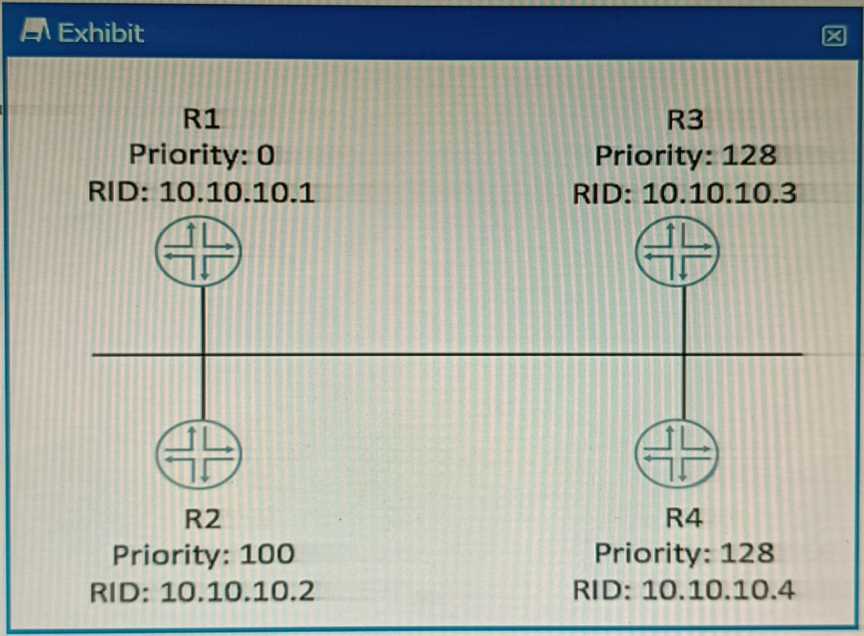
In this scenario, all routers have the same priority of 1, so the router ID will determine the outcome
of the election. The router IDs are shown in the exhibit as RID values. The highest RID belongs to R4
(10.10.10.4), so R4 will become the DR. The second highest RID belongs to R3 (10.10.10.3), so R3 will
become the BDR.
Reference:
1: OSPF DR/BDR Election: Process, Configuration, and Tuning 2: OSPF Designated Router (DR) and
Backup Designated Router (BDR)

 Which router will become the OSPF BDR if all routers are powered on at the same time?
 Which router will become the OSPF BDR if all routers are powered on at the same time?