View Mode
Q: 1
Refer to Scenario An IT services company has been providing hosted and managed IT services to a number of major customers for over 20 years. It has invested heavily in ITIL-based service management processes over the last five years, which has resulted in an increase in the quality of the IT services and an increase in customer satisfaction with the services. This activity has led to a significant growth in the number of customers that the company serves. The company has implemented all of the service design, service transition and service operation processes to some extent, and is now developing other processes based on ITIL service strategy. As a result of this latest activity they have recognized that their existing service management tool is limited in its ability to support several existing processes, and all of the planned new ones. The supplier of the existing tool is reducing its investment in future development of the tool and is, therefore, unwilling to commit to any additional new facilities or functionality. This has now become an issue for the company and, as a result, they are looking to replace the existing tool with a more comprehensive alternative. The company plans to develop a requirements specification for the replacement tool and is redwing the areas that need to be considered, including its deployment throughout the organization. The budget for the new tool is limited, therefore it is essential that the new tool can be implemented and used as quickly as possible in order to obtain maximum return on investment (ROI). Which one of the following options provides the BEST description of the areas that should be addressed by the requirements specification for the new tool?
Options
Q: 2
Scenario A retail company has enjoyed significant growth in profit over the past year due to negotiating lower buying costs from its suppliers. The organization wishes to reinvest some of this profit to fund a program of change to optimize the use of IT services. They hope this will support revenue growth in the next financial year whilst maintaining profitability. The program consists of two main initiatives: • An expansion of the on-line retailing services to offer more functionality • Enhancement of the marketing service to allow greater targeting of promotional offers. There are various options for providing these services that involve use of the current infrastructure or the new virtualization technology, which is slowly being deployed across the organization. The board of directors wishes to conduct a financial review over the next 3 months to compare the cost of providing each service. Projected business revenues will allow the return on investment (ROI) of each option to be calculated. This review will provide an input to the IT organization’s service portfolio management process, allowing the various investment options to be considered and an informed decision to be made. The organization has a good appreciation of its IT costs along with a mature service catalogue and configuration management system (CMS). Refer to the Scenario. Which one of the following options would be the BEST approach to providing the information for the financial review of the service options?
Options
Q: 3
Scenario A travel company specializes in providing complete holiday packages to meet customer requirements. There have been instances over the past year where the business has been unable to process holiday bookings due to failure of the IT services. Sales have been lost and the failure has been raised at board level. The IT director has assured the board that the situation will be rectified. Most holiday bookings are made either by telephone via the company's call centre or through a dedicated website. Both interface with the same back-end booking-processing service. Apart from the call centre and website, the main business services map onto organizational departments and cover: marketing, finance, business operations and central administration. After some initial investigation within the IT organization, it is clear that the intermittent failures, which were related to a lack of capacity, have occurred during exceptional peak holiday booking periods. The IT organization is not certain when or if these are going to occur in the future. Some booking periods are predictable, such as those associated with promotional offers. Other patterns are totally unpredictable as they often coincide with bad weather being experienced where customers live. You have been asked how the activities of demand management, based on ITIL practices, can be used to address this issue. Refer to Scenario Which one of the following options is the BEST set of actions required to resolve the issue?
Options
Q: 4
Scenario A clothing manufacturer has made a decision to supplement factory-based retail outlets by opening a series of stores at out-of-town shopping malls. The internal IT organization provides support to many mission-critical business systems for both the manufacturing and retail operations. It must increase its portfolio of services and service options to meet the planned new expansion. Typically, the business is subject to seasonal patterns of demand, which recently have begun to exceed the capability of some of the IT services. This has led to periods of poor performance of some of the critical systems and therefore to degraded service quality. In periods of minimal demand, there is a surplus of capacity and performance is optimal. There is concern that the additional business demand from the new stores will exacerbate these service performance issues. The board of directors, made up of representatives from each business unit, has asked for a review of the business supply and demand issues currently being faced by the IT organization. Many service management processes have been implemented including service portfolio management and capacity management. However, IT does not have a demand management process. Additionally, performance levels on many of the supporting services have remained unchanged for the past 3 years, even though some may now be less relevant to the overall performance of the critical services. Refer to the Scenario. The review of the supply and demand issues concluded that the implementation of a demand management process could help the IT organization address the issues. Which one of the following options provides the BEST solution to both the problems currently being faced and those related to the proposed expansion?
Options
Q: 5
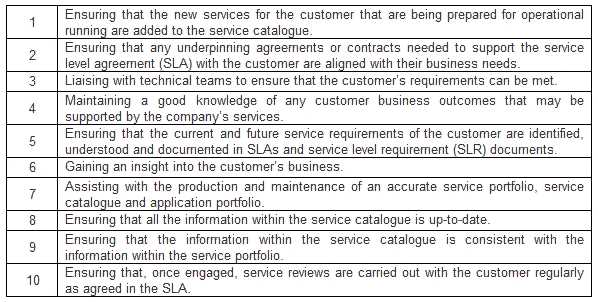
Scenario An IT services company provides IT services to many customers. The company has grown rapidly over the last three years and has recognized the need to implement service management processes to ensure that they continue to provide services that meet their customer's needs. A service management implementation project was set up a year ago and most processes are now in place including service level management and service catalogue management. In addition a business relationship manager has been allocated. An opportunity has arisen to engage a new customer, which could lead to a very large contract. Contact has been made with the potential customer and a meeting arranged. This will be the first time that these processes have been used to engage a new customer and the IT service manager wishes to make sure that all concerned are clear of their roles. Refer to Scenario Which one of the following options CORRECTLY assigns the responsibilities to the service level manager, service catalogue manager and the business relationship manager? Responsibilities: PeopleCert ITIL SOA question
Options
Q: 6
Scenario A company provides an internet-based gift delivery service which is highly dependent upon IT services provided by the internal IT organization. A year ago the customer payments service that supports the gift ordering website regularly experienced poor availability. The organization hired a service management consultant to assess why the IT services were performing poorly and to rectify the situation. As part of the solution, the consultant implemented service level management and adopted the role of interim service level manager. Service level agreements were negotiated with the business and agreed. The necessary underpinning agreements were negotiated and put in place. Regular monitoring and reporting was implemented. Monthly service review meetings with the business unit managers were established to discuss IT service performance and any issues and improvements. Within a year of the start of the initiative the gift ordering website IT service was performing at 98.7% availability, a significant improvement. This month's service review meeting was attended by the chief executive officer (CEO) after concerns were expressed about the most recent availability figure for the customer payments service, which was 94%. This covered the period which included one of the traditionally most popular gift ordering times. The consultant stated that the poor availability was almost entirely due to an incident that occurred during one of the busiest periods and. as a result, the overall monthly availability percentage was low. Initial investigation has shown that the service desk used the SLA to designate the incident as a 'Priority 2'. This was however lower than the 'Priority 1" the business believed the incident should have been. The subsequent delay in restoration of the service meant some customer orders were lost. The CEO reminded the consultant that a repeat of such an incident would not only have a major effect on monthly revenues but also seriously affect the company's reputation. The consultant agreed that this was unacceptable and committed to review this issue and report back to the CEO. Refer to Scenario
Options
Q: 7
Scenario A financial services organization has undergone a period of rapid expansion. From its operating base it has expanded to serve customers in over 25 countries spread around the globe. There are plans to enter more markets in the next 12 months. The key stakeholders involved in the global expansion project have briefed the chief information officer (CIO) on the plans. They have identified IT service performance as one of the major threats to the plan. The CIO has been under pressure from the board due to poor IT service performance in the previous six months. The chief concern has been significant performance variations in network connectivity and communications. The organization currently has three contracts with different local external suppliers in operating markets supporting three IT network hubs. Whilst the suppliers are all happy to follow local internal IT processes, getting the three to work together on incidents or changes has proved increasingly difficult. A number of outages have resulted in a blame culture where even the local internal IT departments have been sympathetic to their service providers, resulting in strained relationships between these internal departments at an operational level. Other issues encountered at one or more locations have included: • Long-term service improvements have been sacrificed in favour of short-term fixes that avoid the payment of contract penalties by the suppliers • Changes in ownership of the customer relationship by the suppliers The CIO believes that a lack of communication between suppliers has been the key cause of failures. All three supplier contracts are due for renewal in the next 12 months. After consultation, a decision to re-tender for network services has been taken by IT, and approved by the CIO and the board of directors. Refer to the Scenario. When considering suppliers, which one of the following options would BEST ensure that network issues are addressed in order to meet the needs of the financial services organization?
Options
Q: 8
Scenario A commercial IT services company has been successful for many years. Its key strategic differentiator has been the provision of new services to meet customers’ needs in very short lead times. Recently profits have dipped, forcing senior management to take a look at the lifecycle costs of providing the IT services to their external customers. The organization has had a service catalogue containing customer and supporting views for some time. It is an essential source of information about the IT services and is used by both the business relationship managers and the IT services teams. Services are designed internally but often transitioned and operated in partnership with other suppliers. For each service, the service catalogue currently contains: • A description of the service • Summary of the service level targets • The level of support and support details • Details of the supporting services and components • Details of services obtained from suppliers When sales leads are obtained from potential new customers, the requirements are compared with services in the service catalogue and, if no matching service can be found, a project is set up to quickly develop a new service. In the past this has been justified as meeting the needs of the customers, and full business cases were not developed. A senior service manager has suggested introducing a service portfolio management process and needs to get the support of the IT management team. The management team wishes to know what extra information would be included in a service portfolio over and above what is already in the service catalogue and what value it would be to them. The company is looking to restrict investment in new resources. Therefore, only a few projects can be authorized in the next budget cycle. Refer to the Scenario. Which one of the following sets of statements BEST describes the elements that a service portfolio contains in addition to the elements in a service catalogue, and describes the additional value service portfolio management would bring to the IT services company in resolving their current issues?
Options
Q: 9
A major international company owns shopping malls in many countries. They are responsible for the security, safety and comfort of shoppers visiting the stores in the mall and the facilities management of the locations. The company relies on IT services provided by its IT division. The IT division consists of a corporate IT department at the company's headquarters and a local IT team at each mall. The IT division obtains IT services and products from over 100 different suppliers globally. The management of suppliers within the IT division is currently performed by the local IT teams in each country, often by the most appropriate technical manager. This has resulted in inconsistent processes and levels of service across the countries. The management team realizes that this is an ineffective use of IT resources and will have an impact on the future growth of the company. They are currently reviewing the situation and wish to develop supplier management processes that are more closely aligned to ITIL practices. The management team recently conducted a survey of all of the local IT teams within the different countries to collect details about the number and type of contracts and suppliers. The IT division has developed and implemented many other ITIL processes over the last two years, which has led to significant improvements. The management team would like to build on this success and develop and implement a supplier management process. You have recently joined the corporate IT department and have been given the results of the survey carried out by the management team. Refer to Scenario Which one of the following options is the BEST sequence of activities to adopt in order to implement a supplier management process and to bring the current situation under control?
Options
Q: 10
Scenario An IT security company provides secure data services to many large financial organizations in several countries. The company has an administrative headquarters in its home country and a data centre in each country of operation. Each data centre obtains support for services from third-party contracts provided by a number of suppliers. All supporting services are scoped and documented, and are aligned to the corporate strategy and the regulations in force in each country. The security services company maintains and regularly reviews a preferred supplier list from which suppliers are selected as required. A service desk function is provided by one of the suppliers. Over the last 10 years, a strong relationship has been built up with the supplier based on the high-quality, consistent service they have provided. The nature of the financial business requires the service desk contract to contain severe penalty clauses that can be enforced if the agreed service levels are not maintained, although these have never been required. A number of complaints have been received from a new banking customer highlighting that, over the previous three months, the level of service provided by the service desk in the management and handling of incidents has been inconsistent, and many incidents have not been resolved in line with agreed targets. The IT security company has a service level manager who has performed the role for many years. Recently, a new supplier management process was implemented and a supplier manager appointed. Some confusion has arisen over how, and by whom, the recent complaints should be dealt with. Refer to the Scenario. You have been asked to resolve the confusion over the service level manager and supplier manager roles. Which one of the following options BEST represents the correct division of responsibilities and will also address the current complaints regarding the service desk supplier?
Options
Question 1 of 20 · Page 1 / 2

Premium Access Includes

  • Quiz Simulator
  • Exam Mode
  • Progress Tracking
  • Question Saving
  • Flash Cards
  • Drag & Drops
  • 3 Months Access
  • PDF Downloads
Get Premium Access
Scroll to Top

FLASH OFFER

Days
Hours
Minutes
Seconds

avail 10% DISCOUNT on YOUR PURCHASE