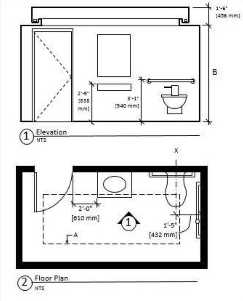
1. Ching
F. D. K. (2015). Architectural Graphics (6th ed.). John Wiley & Sons. In Chapter 3
"Orthographic Drawing
" the section on Plan Drawings illustrates that dashed lines (hidden lines) are used to "indicate the presence of significant objects above or below the cutting plane" (p. 84
Figure 3.51 "Plan Line Types").
2. United States National CAD Standard® (NCS) V6. (2014). Uniform Drawing System (UDS) Module 02: Sheet Organization. National Institute of Building Sciences. Section 2.3.2
"Line Types
" defines the "HIDDEN" linetype as dashed lines used to represent "edges of an object that are behind or under another object." This principle extends to objects above the cut plane in a plan view.
3. MIT OpenCourseWare. (2004). 4.111 Introduction to Architecture & Environmental Design
Spring 2004. Lecture 10: Drawing and Representation. Massachusetts Institute of Technology. The lecture notes on orthographic projection explain that hidden lines are used to represent edges that are not visible from the current viewpoint
which in a floor plan includes elements above the cut plane.