1. Official Vendor Documentation: ArubaOS-CX 10.11 Security Guide
Chapter "Simple Network Management Protocol (SNMP)"
Section "SNMPv3 security levels". The guide details the authPriv security level
which "provides authentication and encryption
" contrasting it with the less secure SNMPv1 and SNMPv2c versions.
2. Peer-reviewed Academic Publications (Standards Body): IETF RFC 3414
"User-based Security Model (USM) for version 3 of the Simple Network Management Protocol (SNMPv3)"
Section 1.2
"Security Services". This document specifies that the USM provides "Data privacy
" defined as "the encryption of data to prevent its disclosure to unauthorized parties."
3. University Courseware: Kurose
J. F.
& Ross
K. W. (2017). Computer Networking: A Top-Down Approach (7th ed.). Pearson. In Chapter 9
"Network Management
" the text explicitly states
"SNMPv3 provides for encryption of transmitted data
" highlighting this as a key security feature absent in earlier versions like SNMPv2c.

 B)
B)
 C)
C)
 D)
D)
 E)
E)
 B)
B)
 C)
C)
 D)
D)
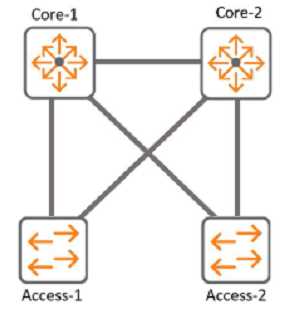 With Access-1, What needs to be identically configured With MSTP to load-balance VLANS?