
Q: 3
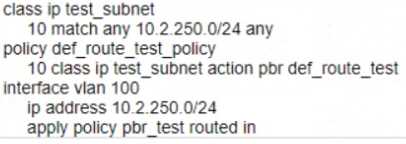
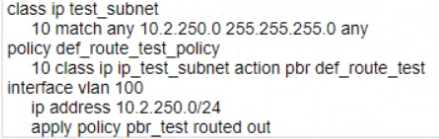
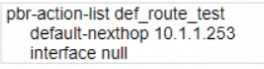
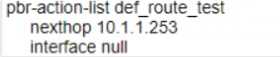
You are configuring Policy Based Routing (PBR) for a subnet that will be used to test a new default
route for your network Traffic originating from 10.2.250.0/24 should use a new default route to
10.1.1.253. Other non-default routes for this subnet should not be affected by this change.
What are two parts of the solution for these requirements? (Select two.)
A)
 B)
C)
D)
E)
B)
C)
D)
E)
 B)
B)
 C)
C)
 D)
D)
 E)
E)
Options
Discussion
C/E tbh, since C matches the source subnet and could catch outbound flows, and E might be the policy applying that class. If we're testing a new default for all traffic from 10.2.250.0/24, wouldn't that fit? Could be missing something subtle though.
Had something like this in a mock. Pretty sure it's B and D, since B is the ACL/class matching both the source subnet and default route, and D applies the policy to set the next-hop. C would match too much traffic. Agree?
B/D tbh, saw a similar question in an exam report and it's always about picking the class matching both source subnet plus default route and the policy that sets next-hop.
B . C looks close but it'll match more than just default-route, which isn't what we want here.
A is wrong, B and D make more sense since only B matches source subnet plus default route and D sets the next-hop. C and E would catch all traffic or miss the real target I think. Let me know if you see it different.
C/E doesn't seem right to me. B and D match the requirement for default-route traffic from 10.2.250.0/24, I think.
B/D. Only those target default-route traffic from 10.2.250.0/24 like the question says.
PBR config always trips me up a bit. I picked C and E since I thought E looked like the policy and C seemed to match traffic from 10.2.250.0/24, but now I'm wondering if option B is actually the correct ACL for matching default-route traffic from that subnet. Not fully sure, but that's my reasoning here. Agree?
Be respectful. No spam.
